
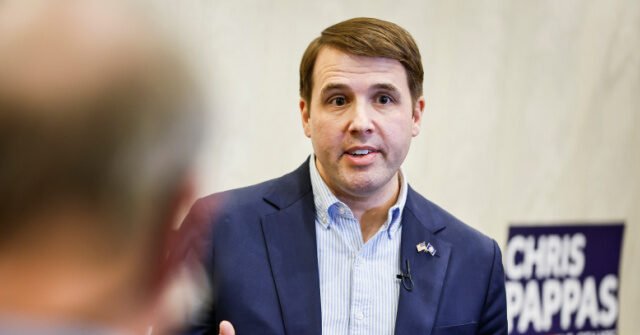
Rep. Chris Pappas’s campaign for New Hampshire’s open U.S. Senate seat is reshuffling its television advertising for late September, pulling roughly $24,825 out of the Portland, Maine, broadcast market, according to tracking data reported this week by the New Hampshire Journal.
The report, citing the ad-monitoring firm AdImpact, describes the move as a revision to the Democrat’s broadcast flight for the Sept. 22–28 window. An AdImpact “Spend Alert” flagged the Portland reduction, noting that one of eight previously active markets had been reported at the time of the disclosure.
AdImpact’s market-by-market breakdown listed the Portland buy at $24,889 with 92 percent of stations reporting. The same data showed the campaign’s heaviest investment by far in the Boston market, at $516,340 with 98 percent of stations reporting, alongside a $27,000 buy in Burlington, Vermont.
Portland’s television market reaches into New Hampshire’s eastern counties, including the Seacoast region, which makes even a modest withdrawal notable in a race where both parties are watching every broadcast dollar.
A one-point poll — inside the margin
The reported ad shift lands as Republicans press the case that the contest is considerably closer than Democrats have let on. A poll conducted for the National Republican Senatorial Committee by the GOP firm Fabrizio, Lee & Associates put former Sen. John E. Sununu at 37 percent and Pappas at 36 percent — a single point, well inside the survey’s four-point margin of error.
“While the race is statistically tied and well within the survey’s margin of error, these results clearly challenge the prevailing media narrative that Democrats have a lock on New Hampshire,” the NRSC pollsters’ memo stated, according to reporting on the survey. The memo also claimed voters are taking “a fresh look” at Sununu.
That is a partisan poll commissioned by the committee backing Sununu, and its findings should be read with that in mind. But the narrow gap it describes is consistent with the broader argument Republicans have been making since the Sept. 8 primary — that Sununu’s statewide profile and near-universal name recognition neutralize what Democrats had hoped would be a comfortable hold.
Sununu won the Republican primary with 69.6 percent against former Massachusetts Sen. Scott Brown, and he did so with President Donald Trump’s endorsement. Pappas, meanwhile, defeated democratic socialist Karishma Manzur to claim the Democratic nomination.
Nonpartisan forecasters, however, still rate the general election as leaning Democratic, and the seat has not gone to a Republican since 2010. Sen. Jeanne Shaheen, the retiring Democrat whose departure opened the race, has held it since 2009.
Outside money floods in
The Pappas campaign has also drawn substantial outside support. The Senate Majority PAC, aligned with Senate Democrats, reserved $10.2 million in New Hampshire television advertising backing Pappas earlier this year — the smallest reservation among the group’s eight target states, and one the PAC characterized only as an “initial” buy.
On the other side, the conservative group One Nation launched a $6 million buy targeting Pappas over his past ties to an Amazon lobbyist, an attack line that signals where Republicans believe the Democrat is most vulnerable.
Taken together, the ad picture in New Hampshire is a study in competing signals. Pappas retains an enormous spending advantage in the pricey Boston media market, which serves the bulk of the state’s population, and the Senate Majority PAC’s nine-figure-scale involvement nationally suggests Democrats are not abandoning the seat. Yet the Portland pullback and the razor-thin NRSC poll give Republicans fresh material for their argument that the race is live.</n
Neither the Pappas campaign nor AdImpact responded publicly to the New Hampshire Journal’s reporting on the ad revision as of publication. Campaigns routinely adjust broadcast buys as they test message and reallocate resources, and a single-week reduction in one market does not by itself indicate a broader retreat.
What it does do is add a data point to a race that Republicans are determined to frame as tightening. With the general election set for Nov. 3, both parties now have roughly six weeks to convert their advertising and their polling into turnout.
Source: www.breitbart.com — https://www.breitbart.com/politics/2026/09/17/report-pappas-pulls-tv-ad-money-from-nh-senate-market-amid-tight-race/