
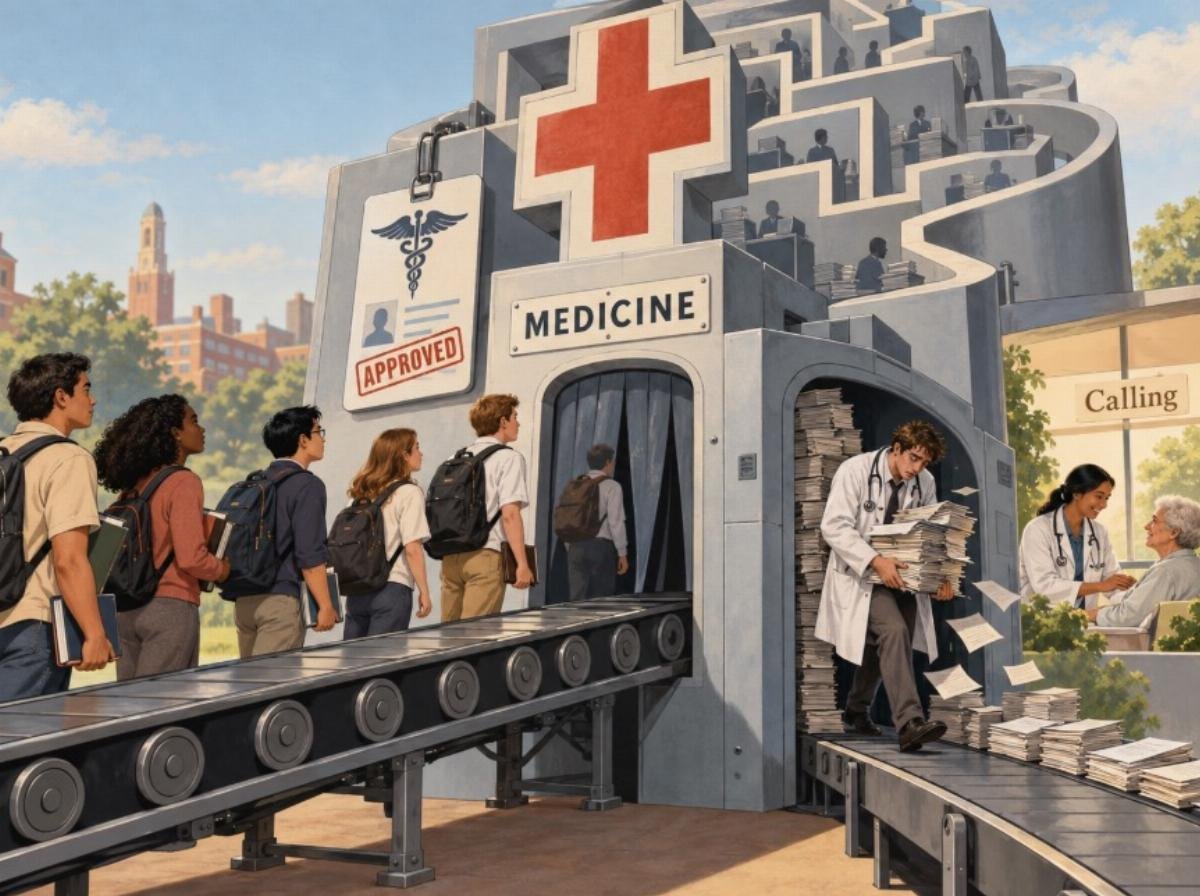
For years, David DeMay stood in front of lecture halls full of premed students. The question he heard most often, he writes in a new essay for American Thinker, was almost never about the science. It was about the logistics.
Students wanted to know where they would fit in — how the institutional gears turned, where the slots were, what they needed to do to line up for the badge. Not what they were willing to take responsibility for shaping, but which door to stand in front of.
That question, in DeMay’s telling, is not a small thing. It is a diagnosis.
The conveyor belt problem
DeMay, writing in the September 20 piece “The credentialed maze: why medicine must stop being the default,” describes what he calls a crisis of agency. Young people, he argues, are selecting their life’s work backward — asking what the credential can do for them before asking what reality they want to take responsibility for. The pattern he watched in his own classrooms has, he says, since spread: credentialism has decoupled from the actual craft, turning complex disciplines into bureaucratic and entrepreneurial funnels.
His complaint is not that medicine is hard, or that the training is long. It is that the credential has stopped signaling mastery over a high-stakes, life-and-death reality. What it signals now, in his account, is mastery over compliance, risk management, and administrative extraction — the skills of navigating a system rather than practicing a trade within it.
Once a field like medicine becomes, in his words, an entrepreneurial paradise and a paper-shuffling clearinghouse, the moral center of gravity collapses. The people inside it are optimized for the wrong thing.
The exit ramp
The visible consequence, DeMay writes, is the modern exodus. Talented people spend a decade grinding through medical training, then leave clinical practice at the first opportunity. Some move into politics, others into medical administration. His read on the motivation is blunt: not to heal, but to chase power or escape a machinery they can no longer stomach.
He frames that as a staggering misallocation of human capital — government money and human genius poured into an apparatus that, in his phrasing, consumes production rather than generating it. The people best equipped to practice medicine are being absorbed by the structures built around it.
Start with the person, not the credential
The fix DeMay proposes is not a policy reform. It is a reordering of the question.
Before a student opens a biology textbook, before organic chemistry, before the admissions committee enters the picture, he argues the foundational inquiry has to be personal and unyielding: What do you actually want to do with your life?
If the honest answer is status, security, or a guaranteed seat in the administrative-medical complex, DeMay warns that the system will happily consume you. It will teach you to check the boxes, bill the codes, and protect the institution. None of that is the same as healing.
True agency, and true healing in his account, requires a different anchor entirely — a calling rooted in reality, immune to what he calls credentialist theater, and willing to bear the actual weight of the work.
An argument about costs, not just culture
DeMay’s essay is framed as a cultural critique, but it ends with a claim about consequences. Until young people are taught to start with agency instead of credentials, he writes, the country will keep producing operators for a system designed to spin itself into oblivion — and the costs will keep outweighing the benefits.
It is a familiar genre of argument on the right: that professional credentialing has become a self-perpetuating bureaucracy disconnected from the work it supposedly certifies. What gives DeMay’s version its particular edge is that it comes from inside the classroom, from someone who spent years watching the first question his students asked — and concluding that the question itself was the problem.
The essay, published in American Thinker’s opinion section, is less a set of proposals than a challenge to how the next generation is told to think about a career in medicine. DeMay’s answer to the students who once asked him where they would fit in is implicit throughout: that was never the right thing to be looking for.
Source: www.americanthinker.com — https://www.americanthinker.com/blog/2026/09/the-credentialed-maze-why-medicine-must-stop-being-the-default/