
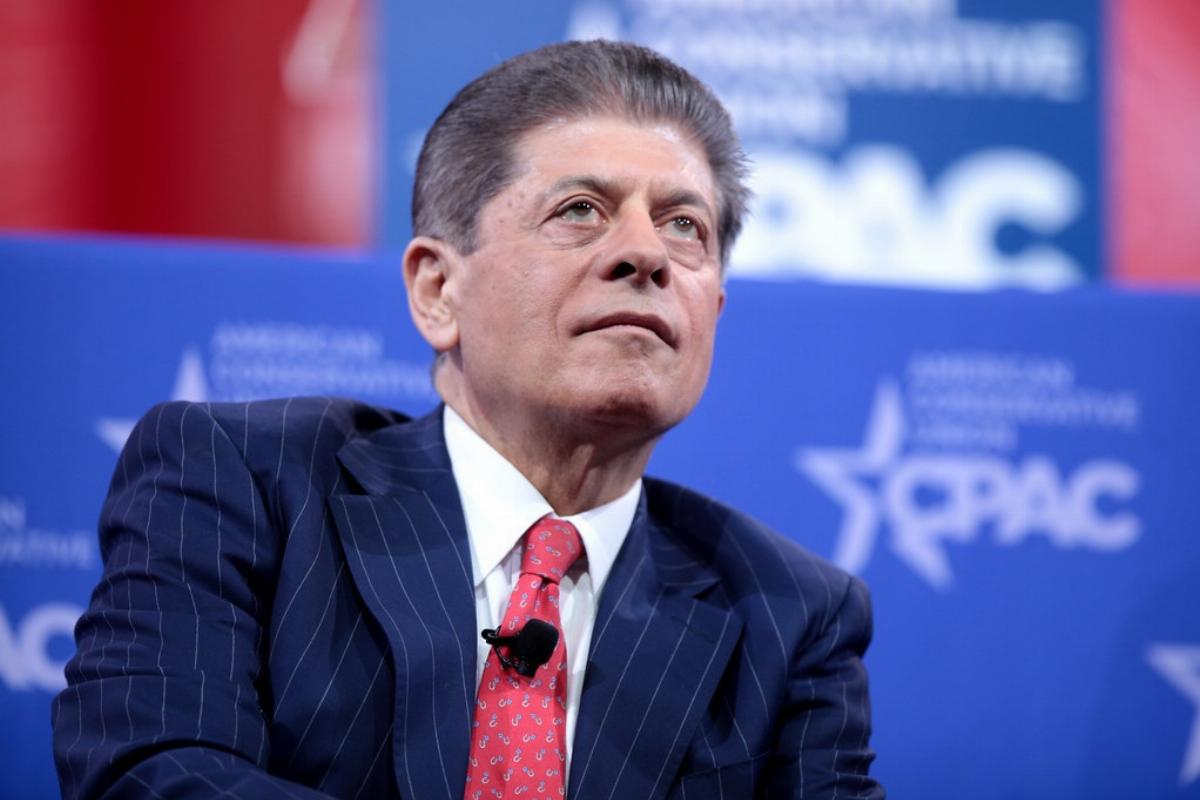
Judge Andrew Napolitano has spent years questioning the premises of American foreign policy, and on his program “Judging Freedom” he has repeatedly turned that skepticism on Washington’s role in the Russia-Ukraine conflict. A new column in American Thinker by Mario Alexis Portella takes that record seriously — not to demand its suppression, but to ask what happens when a set of arguments, repeated often enough, begins to mirror the narrative coming out of Moscow.
The piece, published September 18, 2026, is careful not to reduce the former judge’s commentary to propaganda. Portella writes that Napolitano’s guests and recurring themes deserve examination on their own terms: Scott Ritter, Col. Douglas Macgregor, former CIA analyst Larry C. Johnson, Professor Jeffrey Sachs, and Professor John Mearsheimer all appear in the show’s orbit, and their arguments about NATO expansion, Western interventionism, and Russian security concerns track with a broader anti-interventionist tradition in American debate.
Some of those arguments, Portella notes, echo the Kremlin’s own framing of the February 2022 invasion — the claim that Russia’s military intervention was a response to Western expansionism rather than an unprovoked offensive. The distinction matters, he argues, because the war in Ukraine cannot be understood merely as a geopolitical rivalry between Washington and Moscow. It is, in his description, a military offensive launched by Russia against an independent nation, and it has been accompanied by serious allegations of war crimes, including attacks on civilians and the unlawful transfer of protected persons.
Legitimate questions, uneven scrutiny
To be clear, Portella does not argue that the subjects Napolitano raises are off-limits. NATO enlargement, American military interventions in the Middle East, and Washington’s record of backing authoritarian allies are all fair game, he concedes, and he acknowledges that the U.S. government has often acted in ways that contradict its own professed principles of liberal democracy. Commentators should be free to point that out.
The question, as Portella frames it, is whether the same analytical rigor is applied across the board. He points to an August 18, 2026 discussion between Napolitano and Mearsheimer, in which the host asked whether Putin’s strategic patience was paying off. The conversation moved through Russian strategic objectives, territorial gains, and NATO enlargement as an alleged existential threat to Russia. Those are standard topics for geopolitical analysis, Portella writes — but he contends that the emphasis lands repeatedly on Western responsibility while Ukraine’s sovereignty and Russia’s role in starting the hostilities receive comparatively little weight.
He describes Putin’s claim that Ukraine belongs to Russia’s historical sphere of influence as an interpretive lens rather than a straightforward policy goal. Whether or not Moscow intends to reconstitute the Soviet Union or the Russian Empire, Portella argues, the underlying idea treats the sovereignty of neighboring states as something measured by how much they contribute to Russia’s historical continuity and strategic security. That framing, he suggests, does real work in the debate — and it tends to do it in one direction.
Reluctant actor or responsible party
Portella is explicit that commentary on “Judging Freedom” should not be read as a personal endorsement of the Russian government. His concern is more subtle: that the cumulative effect of the show’s framing can cast Moscow as a reluctant actor in a conflict engineered in Washington, an interpretive apparatus that softens or obscures Russian culpability. He cites the International Criminal Court’s allegations and the abductions of Ukrainian children as matters that deserve direct attention, and he insists that whatever miscalculations the West may have made, Putin made a deliberate choice to launch the invasion. Responsibility for that choice, he writes, rests in Moscow, not Washington.
The column also takes on Napolitano’s consistent noninterventionism. Portella draws a line between opposing direct American military involvement — a defensible position — and suggesting that Ukraine should surrender its sovereignty because Russia objects to its alliances. He notes that Napolitano often speaks emotionally about Ukrainian men being pulled off the streets and forced to fight, and asks whether “Judging Freedom” ever applies the same scrutiny to Putin’s own forced mobilization. The omission, in his view, is telling.
A serious legal accounting of the war, Portella argues, has to ask not only whether the United States made mistakes but whether Russia’s conduct violated international law. It has, he writes, and that conclusion cannot be reached by examining American foreign policy alone. The legal responsibility for launching an invasion belongs to the state that chose to launch it.
Where the line sits
None of this means, Portella cautions, that every criticism of Ukraine or the United States amounts to Russian propaganda. His argument is narrower: a repetitive narrative risks reading as an implicit endorsement of Putin, particularly when it reaches audiences already inclined to distrust American institutions — the target often called the “Deep State.” Skepticism toward Washington’s hypocrisy, he writes, should not slide into automatic sympathy for Moscow, especially given the Russian government’s extensive restrictions on civic organizations and political dissent.
Portella also addresses the weight that Napolitano’s legal background carries in these conversations. His experience shapes how he thinks about presidential authority, military operations, and constitutional limits, but the commentary on “Judging Freedom” is analysis and interpretation, not a binding judicial ruling. It should be evaluated, Portella argues, on the quality of its reasoning and evidence rather than on the credentials or prominence of the person delivering it.
The stakes, as the column presents them, are about method rather than allegiance. The value of “Judging Freedom” to public debate depends on whether it can critique U.S. foreign policy while consistently examining Russia’s responsibility for starting the war — separating what happened before the invasion from the question of who chose to invade. That, Portella concludes, is how American policy can be evaluated without accepting the Kremlin’s justification as a given.
Source: www.americanthinker.com — https://www.americanthinker.com/articles/2026/09/when-antiwar-commentary-reflects-the-kremlin-s-narrative/
Source: www.americanthinker.com
Related coverage
- Maryland Orthodox Jews sue county over synagogue gun ban ahead of Rosh Hashana
- What Would America Look Like If Kamala Harris Had Won? One Author’s Counterfactual
- BBC Criticized for Framing ‘Bare Nails’ Trend as a Race and Class Issue
- Russia’s Century-Old Playbook: How Soviet Propaganda Keeps America Stuck in a Racial Time Loop