
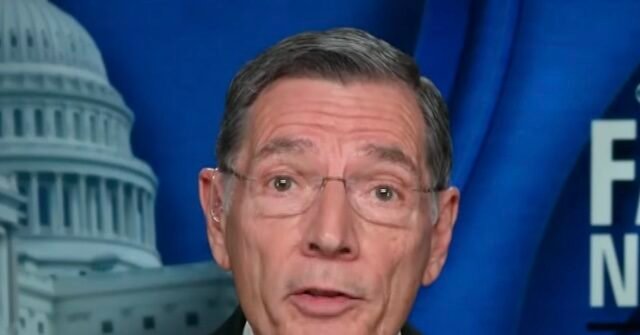
Sen. John Barrasso (R-WY) said Sunday that President Donald Trump’s decision to bar CNN, MS NOW and Politico from the White House does not violate the Constitution, defending the move during an appearance on NBC’s “Meet the Press.”
Host Kristen Welker pressed Barrasso directly on whether he supported the ban, asking, “Do you agree with the president’s ban?”
Barrasso responded by framing the dispute around press conduct rather than constitutional limits. “We all respect and value the freedom of the press. It’s in the Constitution,” he said, before drawing a comparison to Trump’s own experience with tech platforms. “The president remember, in his first term, he was banned from Twitter, he was banned from Facebook and I didn’t see people come to his defense. So it goes both ways.”
The Wyoming senator added that the press has an obligation to report fairly and that Trump does not believe that standard is being met. “Every politician wants fair treatment from the press, as do I, as does the president,” Barrasso said.
Welker cites court rulings as she presses for an answer
Welker pushed back, noting that every president has complained about press coverage but that the First Amendment protects freedom of the press. She told Barrasso that courts have blocked the White House from restricting access to reporters over their coverage, then asked him plainly: “Do you believe he is violating the Constitution with this ban?”
“No,” Barrasso replied. “I believe the press has an obligation to report fairly.”
He then pointed to the 2020 controversy over the Hunter Biden laptop as an example of what he described as media failures. According to Barrasso, the press “ignored the reality for a long period of time, said it was a Russian hoax.”
A long-running fight over White House access
The exchange reflects a recurring tension over which outlets get access to the White House press facilities and how a president can regulate that access. Welker’s reference to court rulings barring the White House from punishing outlets over their coverage pointed to the legal backdrop against which such decisions are typically judged.
Barrasso’s argument rested less on the legality of the ban than on a reciprocal standard: if Trump could be removed from social media platforms without an outcry from the press, he suggested, the press should not expect special protection when a president restricts its access.
The remarks also illustrated the broader debate over how much latitude a president has to shape his own press pool. While the First Amendment broadly protects press freedom, the practical question of who receives White House credentials — and why — has been contested across administrations. Barrasso’s answer aligned him with the administration’s position that the decision is a matter of discretion rather than a constitutional violation.
Trump’s move to exclude the three outlets from the White House drew immediate scrutiny, and Barrasso’s comments are among the more prominent Republican defenses of it so far. The senator did not elaborate on what specific coverage he believed justified the exclusion, beyond his reference to the laptop story.
Barrasso, a member of Senate Republican leadership, has generally aligned with Trump on major issues, making his willingness to defend the ban on national television notable. His framing — that the press has obligations as well as rights — is likely to be echoed by other Republicans asked about the decision in the coming days.
Welker’s questioning, meanwhile, highlighted the difficulty of pinning down a yes-or-no constitutional answer from a lawmaker who prefers to talk about press behavior. Barrasso never conceded that the ban created a legal problem, and he returned repeatedly to the fairness argument rather than engaging with the court rulings Welker cited.
For media organizations, the practical stakes are significant: losing White House access complicates coverage of the president and the day-to-day operations of the executive branch. For the White House, the decision signals a harder line toward outlets it considers hostile.
The back-and-forth also captured a familiar dynamic in the Trump era, in which disputes over press access are litigated as much in television interviews and public statements as in courtrooms. Barrasso’s appearance placed him squarely in that debate, offering a defense of the president’s action while acknowledging the constitutional value of a free press.
Whether the ban ultimately faces a legal challenge remains to be seen. But Barrasso’s position is clear: in his view, banning CNN, MS NOW and Politico from the White House is not a constitutional violation, and the press would do well to look at its own conduct before objecting.
Source: www.breitbart.com — https://www.breitbart.com/clips/2026/09/20/sen-barrasso-trump-banning-media-outlets-doesnt-violate-constitution/