
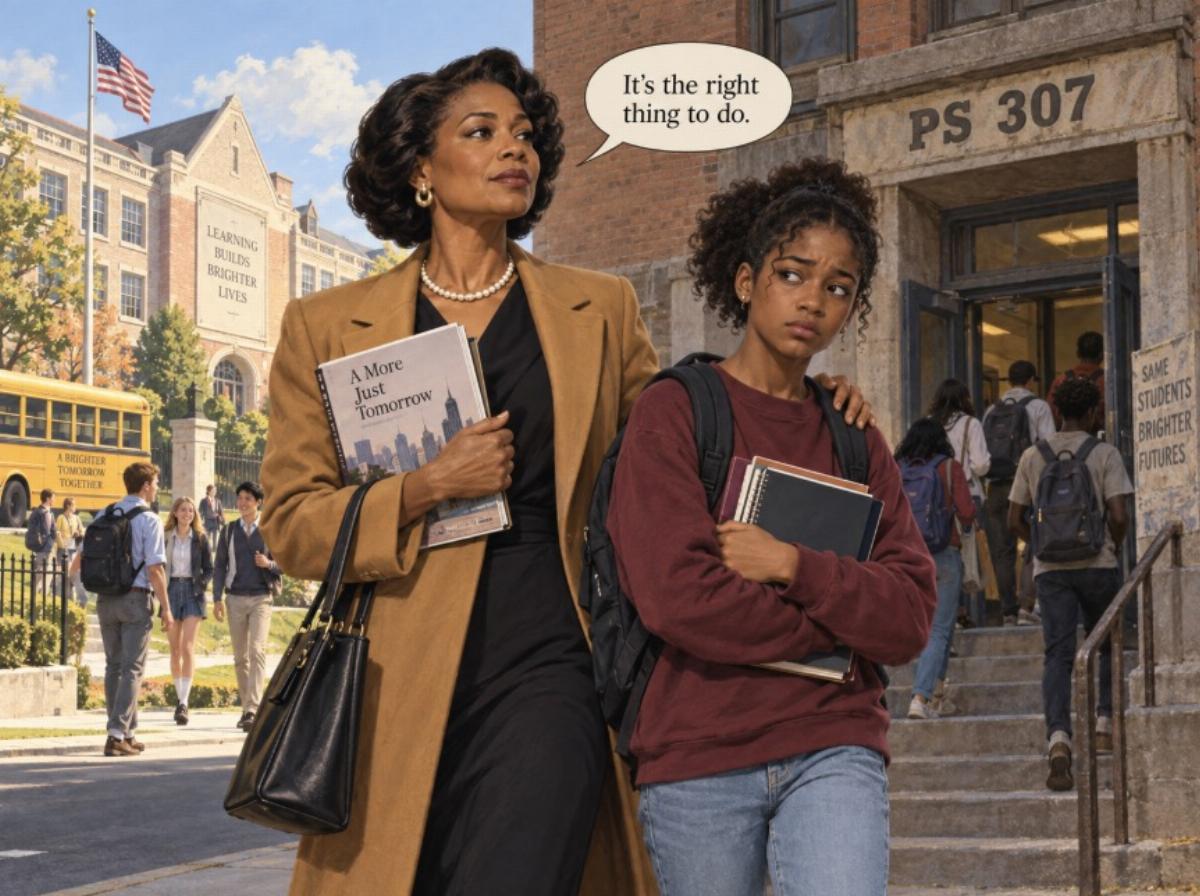
Nikole Hannah-Jones, the journalist behind the 1619 Project, has written publicly about a decision she says was rooted in her reporting on school segregation: enrolling her own daughter in a predominantly Black, high-poverty public school in Brooklyn. This week, American Thinker published a sharply critical column by Andrea Widburg arguing that this was less a parenting choice than an act of ideological sacrifice — one that used a child to prove a point about systemic racism.
Widburg’s piece, published September 20, seizes on an essay Hannah-Jones wrote for The New York Times Magazine in which the journalist explains that she and her husband deliberately chose Public School 307 — described in the column as “a segregated, high-poverty school across from the Farragut housing projects in Brooklyn” — for their daughter Najya, now 16. Hannah-Jones wrote that the decision was “informed by values shaped by my years of reporting on the enduring and too often seemingly hopeless battle for school integration.”
Widburg frames that as a confession. If poor Black children weren’t going to a good school, the reasoning goes, neither would Hannah-Jones’s daughter — a principle the columnist compares to generations of ideologues who put their beliefs ahead of their children’s needs.
A familiar pattern, according to the column
Widburg reaches back through history for examples. Jean-Jacques Rousseau, celebrated for his theories on raising children, consigned all five of his own to a foundling hospital. Mahatma Gandhi declined to give his son Harilal the English legal education he himself had received and recommended other young men for a scholarship that could have helped his son. Doris Lessing abandoned two children in southern Rhodesia to align herself with a communist who rejected the family entirely. Bronson Alcott kept his family in poverty to live out his ideals — though Widburg concedes Louisa May Alcott might never have written her beloved girls’ books without that financial pressure. Leo Tolstoy, the columnist notes, ultimately transferred his remaining property to his wife and children.
The point, in Widburg’s telling, is that Hannah-Jones belongs on that list because she was affluent, well-educated, and could have chosen differently.
The systemic-versus-cultural dispute at the heart of it
Much of the column’s energy goes toward rebutting Hannah-Jones’s explanation of why Black students fare worse than white ones. She points to underqualified teachers, less rigorous curriculum, outdated technology, and underfunded facilities — and cites a 2019 EdBuild analysis finding that schools in predominantly nonwhite districts receive $23 billion less in annual funding than their heavily white counterparts. She also attributes the problem in New York to a combination of housing segregation and what she calls “academic” sorting, or school choice, that begins as early as pre-K and pushes most Black students, even middle-class ones, into racially segregated schools with high poverty rates.
Widburg doesn’t dispute the funding figure so much as reject the framework. She argues culture, not cash, is what matters — and offers her own upbringing in San Francisco as evidence. The public schools she attended, she writes, were flooded with Asian students whose families had fled Mao’s China, Cambodia’s killing fields, and Vietnam’s wars. They lived in deep poverty near Chinatown, few had English-speaking parents, and they had no money for tutors or extracurriculars. Most still thrived academically, she says, and so many gained admission to the academic high school Lowell that leftists on the school board imposed a quota on them. When the quota was struck down in court, Widburg adds, the board destroyed Lowell’s academic standing.
Widburg extends the argument to other groups — turn-of-the-last-century Jews and modern Indian immigrants — who she says figured out that education is the path to wealth in America. She contrasts that with what John McWhorter described in Losing the Race: Self-Sabotage in Black America: that since the 1960s, doing well in school has been treated in some Black communities as “a white thing,” a betrayal of racial heritage. She also invokes the court-ordered desegregation experiment in Kansas City, where federal district judge Russell Clark directed roughly $2 billion into a predominantly Black school district without the hoped-for academic gains — evidence, in her view, that money alone can’t fix a culture that devalues schooling.
The essay’s ending, and how each side reads it
What seems to bother Widburg most is how Hannah-Jones concludes her essay. In a passage Widburg quotes, Hannah-Jones writes that despite all the justifications, “an undeniable verity remains”: as long as we rescue our own children from failing schools while allowing other people’s children to languish because they were born Black and poor in a nation of racism and riches, “there is no absolution here. Not for me. Not for you. Not for any of us.”
Widburg reads that as: I feel bad about what I did to my daughter, but it was still the right thing to do. Her verdict is that this amounts to “a politically correct form of child sacrifice.” The column also asserts that Hannah-Jones’s daughter was “plunged into a chaotic, unpleasant environment where she was learning nothing,” though it doesn’t detail what specifically happened at the school beyond the essay’s description of it as segregated and high-poverty.
Hannah-Jones’s own essay runs long, and Widburg acknowledges she can’t summarize it adequately in her column. The argument here is less a piece of reporting than an interpretive clash — two writers reading the same parental decision through entirely different lenses, one seeing accountability to a community, the other seeing a child used as an instrument. For critics of the 1619 Project, the essay supplies a confession. For Hannah-Jones’s defenders, it likely reads as a rare admission of the trade-offs that come with taking your own principles seriously.
Source: www.americanthinker.com — https://www.americanthinker.com/blog/2026/09/nikole-hannah-jones-sacrificed-her-child-to-her-activism/
Source: www.americanthinker.com
Related coverage
- Book Review: ‘The Two Swords of Christ’ Casts the Crusades as a Defense of the Faith
- California’s Landfill Lawsuit Sparks Backlash as Critics Question State’s Environmental Priorities
- Texas Democrat James Talarico Has Vanished for 12 Days — and Even His Own Party Won’t Talk About It
- Lars Møller Maps the Counter-Revolution from the Vendée to Trump’s MAGA Movement