
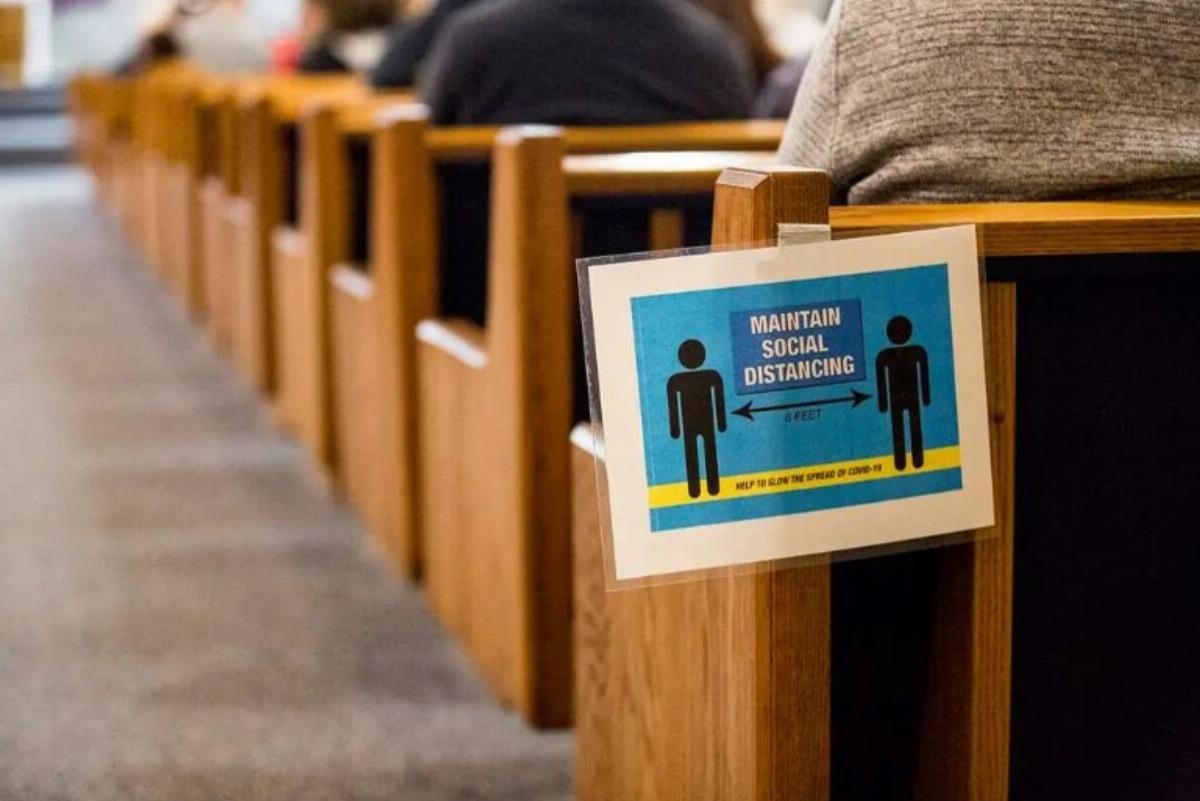
Most voters who say COVID changed their politics talk about the economy or the schools. Luis Gonzalez, writing in American Thinker, starts somewhere more personal: the word “temporary.”
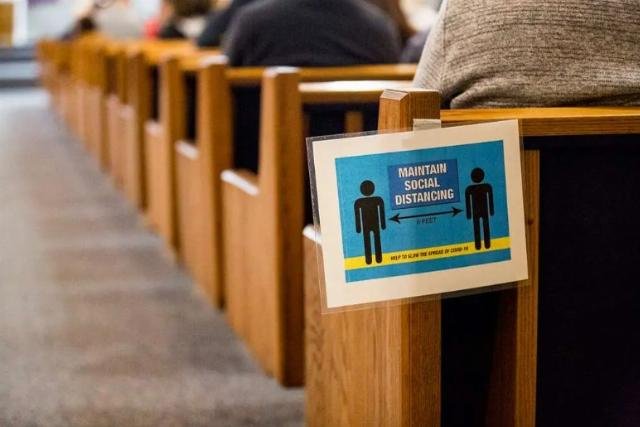
Before 2020, he writes, temporary meant temporary. Something happened, you handled it, and life eventually returned to normal. Then came the empty streets, the closed businesses, the masks, the six-foot circles on the floor — and, in his telling, a government that suddenly had an extraordinary amount to say about what ordinary Americans could and could not do.
He is explicit that his purpose is not to relitigate every lockdown decision or grade individual governors. The question he wants to sit with is narrower and, in some ways, harder: what did the whole episode teach Americans about government power?
His answer comes in two parts. First, that “temporary” turned out to be a remarkably elastic word. Second, that people will surrender ordinary freedoms surprisingly quickly when the circumstances are frightening enough.
A Turning Point, Not a Talking Point
Gonzalez does not present himself as someone who resisted from the start. He says he understood the fear — he had elderly people in his family and wanted to protect them — and that is why he eventually got the COVID shot. His objection is not to caution. It is to the moment he says government shifted from telling people to be careful to telling them what they could do.
The clearest example he cites is the OSHA vaccine-or-test requirement aimed at businesses with 100 or more employees, which would have covered roughly 84 million workers before the Supreme Court stopped it. For Gonzalez, that was the point at which the stakes changed. It was no longer simply a matter of where he could go. Government was reaching into the relationship between an employee and an employer, and once you have seen that kind of power exercised, he writes, you do not forget it.
He is equally direct about the costs that didn’t show up in a press conference. Children lost months of schooling. Businesses built over years disappeared. Families missed funerals and time with dying relatives. Some losses, he argues, simply have no statistic attached to them — there is no metric for a grandmother who couldn’t hug her grandchild.
Where he does reach for numbers, he cites NWEA’s 2023-24 analysis, which found students still needed the equivalent of 4.8 additional months of schooling in reading and 4.3 months in math to reach pre-pandemic achievement levels.
Voting Republican Without Illusions
The political conclusion Gonzalez draws is carefully bounded, and the boundaries are the interesting part. He is not voting Republican, he writes, because Republicans are perfect — they aren’t. He is not doing it because he believes Donald Trump will fix Washington in two years. He won’t, Gonzalez says; the city didn’t become what it is overnight, and no one is going to straighten it out with a magic wand.
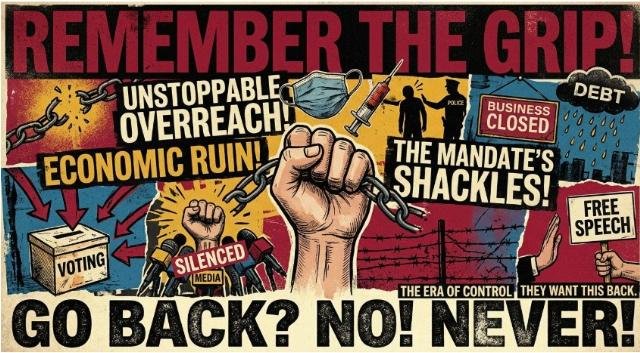
His stated reason is memory. He votes the way he does because he remembers what happened when government was granted extraordinary authority over ordinary American life. He adds that he doesn’t need to pretend every Republican is a saint or every Democrat is a socialist, and he doesn’t need to believe any single figure can solve everything. That distinction carries more weight for him than it seems to for people who, in his view, have already forgotten what happened or filed it away as ancient history.
He also expects a sequel. The next emergency, he writes, is always waiting around the corner — another pandemic, a war, terrorism, an economic crisis, or something nobody has thought of yet. Someone will stand at a microphone and say this time is different, the threat is unprecedented, and the measures are temporary. That prospect, rather than any particular policy wish list, is what drives his interest in the direction of government.
What he says he wants is modest and, he acknowledges, not the same as perfection. He wants restraint. He wants a government that remembers Americans are citizens rather than subjects, and that extraordinary powers should make people nervous precisely because they are extraordinary.
‘Surviving Something Isn’t the Same as Learning From It’
Gonzalez concedes that the system eventually pushed back. The Supreme Court checked some of the excesses, citizens pushed back too, and the country survived. But survival, in his framing, is not the same as a lesson learned. Freedom is easy to appreciate once you have it back; the harder task is remembering how quickly it can become conditional.
The essay closes on a personal note that explains the intensity of the argument. Gonzalez writes that he was a child in Cuba when he first learned what it meant to bend the knee — the government made that choice for him. During COVID, he says, he bent it again, taking the shot to protect elderly relatives. He frames the ballot as the place where he draws the line this time.
“I’m not going to bend my knee again,” he writes, adding that the next time he does, he doesn’t think he’ll be allowed to stand without a fight.
Read as a piece of political argument, the essay is less a case for any candidate than a case for a disposition — suspicion of emergency powers, held consistently rather than selectively. Its author concedes that the machinery of Washington is unlikely to be reformed on any near timeline, and he doesn’t ask readers to believe otherwise. He asks them to remember. Whether that memory is a durable voting bloc or a fading grievance is the question the next emergency will answer.
Source: www.americanthinker.com — https://www.americanthinker.com/articles/2026/09/covid-response-do-we-really-want-to-go-back-to-that/