
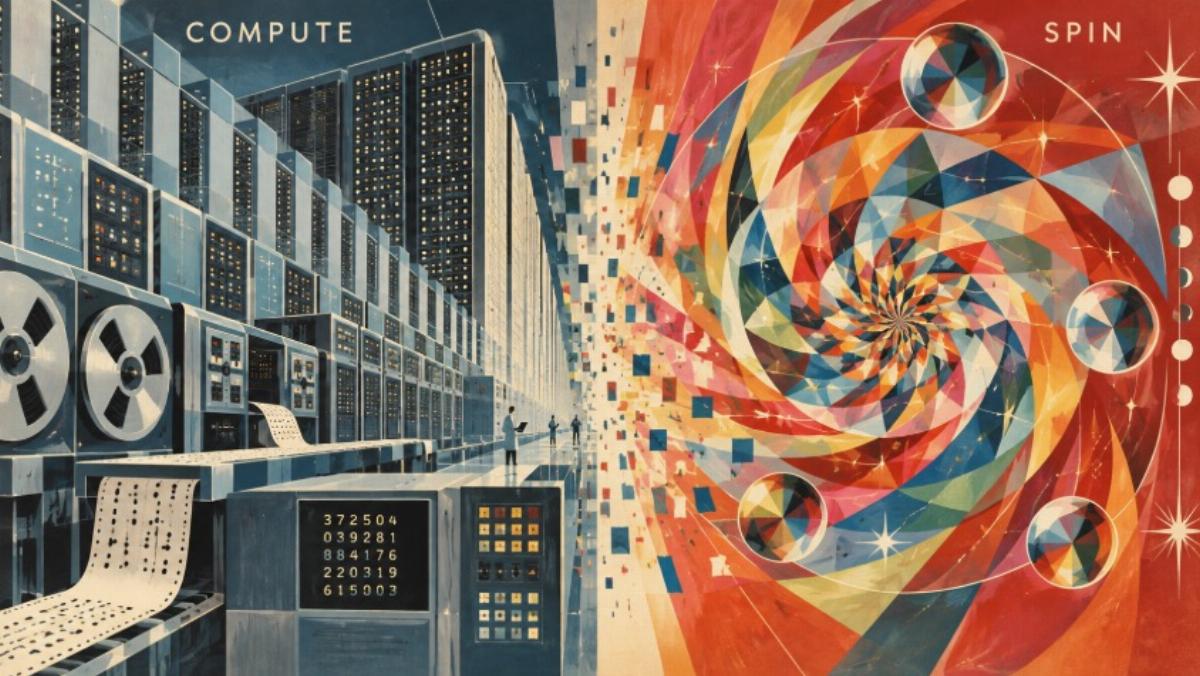
The loudest voices in the artificial intelligence debate have settled on a familiar villain: raw computing power. Moratoriums, multi-year pauses, and rationing schemes all treat processing capacity as the thing that must be contained. But a new essay in American Thinker argues that this entire framing is a category error — and that the real danger has almost nothing to do with how many chips are humming in a data center.
Writing for the outlet, David DeMay draws a sharp line between two concepts that the policy conversation routinely conflates: compute and spin. Compute, in his telling, is simply physical capacity — the chips, the data centers, the floating-point operations that form the “electrical backbone” of the technology. Spin is something else entirely: an aberrant, self-amplifying, recursive feedback loop in which automated speed outruns structural integrity.
The distinction matters because, according to DeMay, fixating on compute lets the establishment treat what is actually a velocity and governance crisis as though it were a straightforward electrical capacity problem. So long as the debate stays centered on how many chips are running, he writes, nobody has to examine the unowned write-paths, the muddy lexicon, or what he describes as the frantic, runaway cadence of a system rewriting its own rules faster than human judgment can keep pace.
Each turn changes the board
The mechanism DeMay describes is deceptively simple. Every iterative turn in a recursive system can alter the baseline context enough that developers and operators lose a reliable account of what changed, why it changed, and who remains responsible for the outcome. The process, he suggests, increasingly resembles a kaleidoscope: a single adjustment can reorganize the relationship between everything already in view, so that the next turn begins from an entirely different geometry. In a system where context continually changes the meaning of content, he argues, linear calculations stop being adequate.
That is why the essay insists that slowing the spin without changing the underlying structure accomplishes little. A slower spin is still a spin. You have to interrupt the recursion before it outruns authorship — before the people nominally in charge can no longer meaningfully claim to be directing what happens.
To make the point intuitive, DeMay offers a mechanical analogy: speed measures how quickly a wheel turns, while spin measures how much each turn changes the wheel itself while it is in motion. When spin exceeds human capacity to understand, attribute, and correct the consequences of the previous turn, authorship begins to disappear. That disappearance — not some abstract doomsday scenario — is the crisis he wants readers to see.
What stopping spin would actually require
Notably, the prescription is not Luddism. DeMay is explicit that stopping the spin does not mean smashing servers or capping processing power. The compute, in his words, can roar. What must not be allowed is the unmoored rotation of a cycle that rewrites its own conditions faster than human judgment can track.
Instead, he identifies what he calls structural choke points where the recursion can be arrested: closing the unowned write-paths, forcing accountability back onto the specific human operators who own the portals, and refusing to let autonomous systems manage their own containment. The goal is not a ceiling on processing power but the restoration of human authorship between one consequential turn and the next.

That final phrase is the heart of the argument. The problem is not that machines are too fast in the abstract; it is that the interval between consequential decisions has collapsed to the point where no human being can occupy it. Restoring that interval — inserting attributable, responsible human judgment into the loop — is framed as the only intervention that actually addresses the disease rather than its most photogenic symptom.
A different kind of governance debate
The essay lands in a policy environment where the dominant proposals tend to be quantitative: cap this, pause that, license the other. DeMay’s contribution is to argue that those tools are aimed at the wrong target. Rationing compute, on this account, is like treating a governance failure as a utility-management problem — comforting because it produces concrete numbers and enforceable thresholds, misleading because it leaves the recursive dynamics untouched.
Whether or not one accepts his terminology, the underlying question he raises is hard to dismiss. If the meaning of a system’s output depends on a context that the system itself keeps rewriting, then auditing, attributing, and correcting that output becomes a moving-target problem. Accountability regimes built for stable systems may simply not apply. And the people best positioned to notice that — the developers and operators closest to the machinery — are precisely the ones whose account of events degrades fastest as the loop accelerates.
The essay does not pretend the fix is easy. Closing unowned write-paths and forcing ownership onto identifiable operators implies real architectural and organizational changes, not a press release and a voluntary pledge. It also implies a willingness to tell autonomous systems that they cannot be the final arbiters of their own boundaries — a proposition that runs against a decade of design philosophy built on self-managing, self-optimizing pipelines.
Still, the alternative DeMay sketches is bleaker: a world of ever-faster cycles in which no one can say with confidence who decided what, or why. Slowing down the wheel does not help if the wheel is being rebuilt with every rotation. The compute can keep climbing, he concludes, so long as the recursion is interrupted and human authorship is restored between turns.
It is a narrower demand than a moratorium and, in some ways, a more demanding one. A pause is temporary and blunt. Rebuilding the choke points so that responsibility attaches to a named human at each consequential step is structural work — the kind that does not fit neatly into a campaign slogan or a headline about data-center power draw. But if DeMay is right that the panic has been aimed at the wrong variable, then the debate the industry has been having is not just incomplete. It may be pointed in precisely the wrong direction.
Source: www.americanthinker.com — https://www.americanthinker.com/blog/2026/09/when-it-comes-to-the-ai-panic-stop-the-spin-not-the-compute/
Source: www.americanthinker.com
Related coverage
- Veterans Day 2026: Why America’s Chain of Service Stretches Back to 1776
- Veteran’s Scathing Critique: Israeli Generals Failed Their Duty on October 7
- American Thinker Argues the Affordability Debate Ignores the 20.7% Already Lost to Inflation
- The Data Center Backlash: How Overregulation Could Stifle America’s Tech Future