
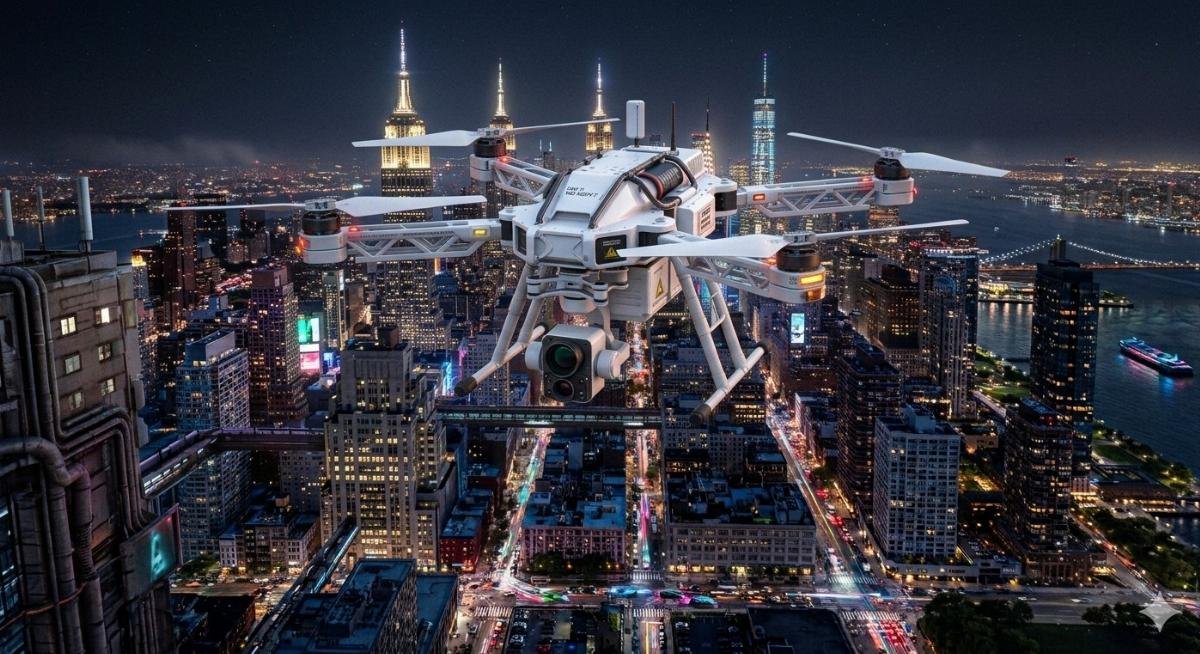
Fighting a war by drone, Matthew G. Andersson writes, is a lot like arguing on social media: it’s too easy, and nobody really wins. The analogy is glib, but the argument behind it isn’t. In a piece published this week by American Thinker, the former CEO and aerospace advisor contends that unmanned systems have quietly rewritten the rules of combat, removing the human cost that has historically forced wars toward some kind of conclusion.
An Easy Weapon to Reach For
Andersson, who describes himself as a Jet Command Pilot and a graduate of Embry-Riddle Aeronautical University, traces the modern drone back to Linden Blue’s early work at General Atomics on a Predator prototype. From there, the machines advanced fast into mainstream instruments of war. The attraction is obvious, he acknowledges: drones put a human being out of immediate harm’s way, cost a fraction of a manned fighter, and can swarm in ways a crewed aircraft cannot.
Training is a different proposition, too. Drone operators, in his telling, don’t need the airmanship skills of traditional pilots — or even basic physical fitness. They work from enclosed, sometimes mobile shelters where a computer screen serves as the cockpit. The aircraft themselves can fly on autopilot, be directed by other drones, or be guided from satellites. They are simple enough to be built or assembled in large numbers.
That ease, Andersson argues, is precisely the danger. When launching an attack carries almost no personal cost, the normal tradeoffs that govern a decision to kill get muted. Killing becomes abstract. There is no thrust and counterthrust between two people, no drone ace or war hero, no soldier class in the older sense. The drone, he writes, is about as anti-Roman as modern military culture gets.
What follows, in his account, is weaker command discipline and weaker command responsibility. There’s no real strategy to weigh beyond a single launch, and no meaningful price paid if the machine is shot down or disabled. The same tool that delivers limited explosive ordnance also works perfectly well as a terror instrument — a kamikaze device whose added dimension is fear.
Limited Damage, Broad Fear
Andersson is careful not to overstate the drone’s battlefield power. Its capacity to inflict real damage on industrial sites is limited, he writes. What it does well is terrorize civilians and intimidate opponents — sometimes. Other times it merely angers and annoys them. It is not a substitute for face-to-face fighting, for artillery, for diplomacy, or for negotiation.
He also flags the drone’s growing role in policing and surveillance, including the delivery of chemical agents to subdue a suspect and the dispersal of chemical or biological weapons with pinpoint accuracy.
All of this, he suggests, raises unsettled legal questions. A drone can function as judge and jury without due process or Miranda rights, and it cannot be hauled before a court to face war crimes charges. Establishing who actually gave the order can be difficult, since instructions can be coded, ghosted, or deleted, leaving traditional evidence hard or impossible to obtain. Intelligence agencies, he notes, have embraced the technology precisely because it suits irregular warfare and carries covert behavior built in.
To illustrate where abstraction leads, Andersson reaches for a Star Trek episode, “A Taste of Armageddon,” in which two societies fight via anonymous computers. Only when they confront real, direct war do they find their way to a settlement, jolted by the sudden recognition of what actual war costs.
The AI Multiplier
The problem compounds, in his view, as artificial intelligence is folded into the drone as a total system. Drones are already enabled by software logic; soon they will be enabled by what he calls agentic logic — self-acting AI agents, nanobots among them — producing a kind of drone-within-a-drone in the software itself. He points readers toward David Heinemeier Hansson’s discussion of agent logic on the Fridman podcast.
His worry: AI logic is unregulated and autonomous. There may be no chain of command or discipline at all, which lowers or eliminates human accountability. Law, he writes, gets detached from the doctrine of harm and liability. AI drones can’t commit torts or crimes, and if they do, the agents operate under a peculiar sort of liability waiver.
Andersson doesn’t treat automation as uniformly sinister. Satellite weapons are effective drones, he notes, and automated flight has real value in space operations and in the deployment of robots for future lunar commercialization.
A ‘Depopulation Dividend’?
Where his argument turns sharpest is on the human question. The logic of drones, robots, and intelligent systems, he writes, implies a large human “depopulation dividend.” He contends that for the progressive left — whose ideological center of gravity he frames as climate and carbon removal — the acceleration of human self-obsolescence and an ideology of drone warfare reinforce each other as tools of biological suppression.
Combine that, he argues, with a medical model of euthanasia and planned lifespans, and what he calls a drone “value triad” emerges: war machine, human replacement, and carbon neutrality. He points to the UN’s GEO-7 report and its argument for radical depopulation as evidence of credible intentions, though he adds his own caveat that he doesn’t take the UN seriously — its sponsors, he says, do.
Then there’s the commercial angle. Andersson predicts that future airline flights will be piloted by drones, cutting crew costs to nearly nothing. Drone pilots can work around the clock: no rest, no bathroom breaks, no cockpit small talk about diversity and hiring, no seniority system, no labor union. He lets the absurdity sit there for a moment — a synthetic robotic drone flying a kerosene-burning machine packed with human flesh in cramped seats, eating peanuts, drinking beer, using restrooms — before landing on his point: at some stage, that automation logic intersects what he calls the ultimate logic of progressive ideology, selecting humans for obsolescence. Their dystopian world, he writes, has no planes, no passengers, and nowhere to fly.
The drone is seductive here, he says, because it looks green next to human-centered machines: humans stay on the ground, move less, use less carbon. He cites Anthony Fauci’s NIH white paper as envisioning limits on human movement and on “human behaviors that perturb the environment” — a line he previously examined in a June American Thinker piece. The drone, in this framing, offers clean warfare — a man can kill without spilling his own blood, only someone else’s, and do it without a carbon footprint.
When Drones Kill Drones
Andersson ends with a question that has no tidy answer: what happens when there are no humans left to kill? The agentic logic he describes points toward drones killing drones. And that scenario, he argues, poses a strange challenge to the long human history of war. Human killing usually ends when the reason for it ends; since killing generally has no logical reason of its own, it stops when resources to sustain it run out. An AI agent never runs out of resources and has no reasons — so perpetual war becomes its logical code.
He returns once more to Star Trek, this time to the Nomad probe in “The Changeling,” which applies an extermination logic against “inferior” biological forms and self-terminates upon learning a human created it.
That, for Andersson, is the crux: drones and AI solve certain human limitations only insofar as they operate within them. It has been said, he writes, that civilization has always been at war and that peace is only a temporary pause caused by human exhaustion. Drones and larger automated warfare make that natural pause unnecessary — so war can become conveniently permanent.
He concedes his own bias plainly. He prefers the Roman warrior with sword and shield, Thor’s hammer, hand-to-hand combat — contests that get at war’s cause and its end, human passion and its satisfaction. The drone, he writes, knows neither.
Source: www.americanthinker.com — https://www.americanthinker.com/blog/2026/09/the-problem-with-drones/