
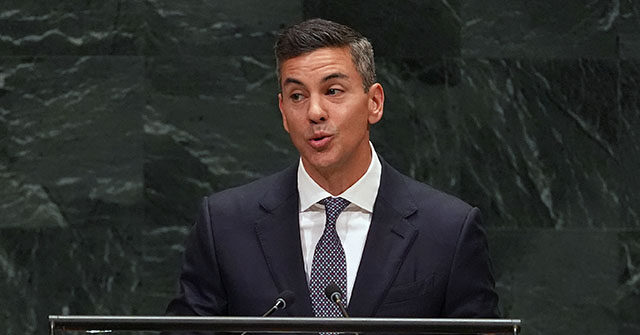
Paraguayan President Santiago Peña took the podium at the United Nations General Assembly on Wednesday with a blunt message for his regional counterparts: Latin America cannot keep outsourcing its hardest problems to Washington.
“We cannot expect the United States or any other northern power to solve our problems, we have to do it ourselves,” Peña said, according to Breitbart News’ account of the speech.
That line served as the spine of an address that ranged from democratic transitions in Venezuela and Cuba to the defense of human life, the family, and Taiwan’s place in the international system. Peña, a conservative, framed the whole thing around action over rhetoric — a pointed move given that this year’s U.N. debates are themed “Restoring trust, managing transformation.”
“Good slogan, and I wholeheartedly endorse it,” Peña said of the theme, before turning on it. “But let’s be honest, my friends, people no longer want slogans — people want solutions to their problems.”
Venezuela: A Second Step
The centerpiece of Peña’s address was Venezuela, where he said he had traveled before coming to New York — a trip he acknowledged “surprised” many observers and drew fierce criticism from others, given that Paraguay had severed ties with Caracas under socialist dictator Nicolás Maduro.
“I did not go to Venezuela to endorse a regime; I did not go to endorse anything at all,” Peña said. “No, gentlemen, quite the opposite. Paraguay loves democracy, and believes that the people of Venezuela also deserve democracy.”
Peña described the visit as a “second step” toward a democratic transition, following what he called the “much-difficult” first step: the arrest of Maduro this year. He compared the moment to Paraguay’s own experience in 1989, when the country emerged from 35 years of dictatorship into what he called a real democratic transition.
His criticism landed as much on South American leaders as on Venezuela’s government. Peña said the region had spent a quarter-century “exchanging beautiful lyrical words, thunderous declarations, mottos, and slogans about Venezuela, none of which yielded any results for the country.”
“For 25 years, we watched, waited, and condemned from a comfortable distance, but did nothing for the Venezuelan people,” he said. “We watched. We talked. But we didn’t act. We did nothing. And meanwhile, our Venezuelan brothers and sisters were suffering.”
The Paraguayan leader said his country has opened a channel of dialogue with Venezuelan authorities and is “already taking concrete steps toward a Venezuela where power rests with its sole sovereign: the people.” He was careful to distinguish engagement from capitulation.
“Dialogue does not mean renouncing our principles or forgetting the past,” Peña said. “It means having the courage to look ahead and take action.”
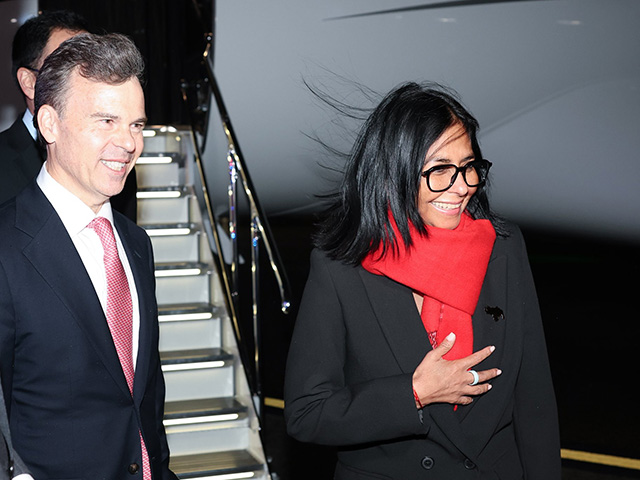
He also made clear what he is not after. “I don’t want a photo, I don’t want a statement, I want — we want — a transition,” he said.
Calls to Extend the Same Push to Cuba, Nicaragua, Haiti
Peña asked fellow Latin American governments and U.N. members to help Venezuela “reinsert itself in the world” and secure a democratic government. He then extended the appeal to other countries in the region where democratic governance is under strain.
According to the Breitbart account, he made similar calls — “perhaps with greater strength” — for free elections in Cuba, Nicaragua, and Haiti.
“Let’s bring light to these brother peoples,” Peña said. “Because where there’s free elections, there’s hope.”
Taiwan, Life, and Family Central to Paraguay’s Identity
Peña used the international stage to reaffirm Paraguay’s diplomatic recognition of Taiwan, an unusual position among Latin American states, most of which recognize Beijing. He said Paraguay’s support is rooted in shared commitments to democracy, the rule of law, human rights, and peace, and pointed to 70 years of friendly ties between the two countries.
Paraguay is not “neutral” on the question of Taiwan, he said, urging the island’s full inclusion in the United Nations and other international organizations. The backing, he stressed, is not out of convenience.
The Paraguayan president also restated domestic commitments that align with his conservative politics, affirming that his country upholds “the sanctity of human life from the moment of conception” and recognizes the family as the fundamental unit of society.
A Call for Results, Not Statements
The broader argument running through Peña’s remarks was that trust, the stated goal of this year’s U.N. gathering, cannot be rebuilt with rhetoric. It has to come, he said, from “facing problems without fear and proposing solutions, offering results.”
That framing positions Paraguay, a relatively small landlocked country, as an advocate for a regional posture less reliant on larger powers — and as a government willing to engage directly with adversaries while insisting that engagement serve a democratic endgame.
The speech comes amid wider hemispheric jockeying over Venezuela’s political future, with the United States among the actors shaping the pressure campaign and negotiating channels around Caracas. Peña’s message was that Latin America should not treat that involvement as a substitute for its own.
“I want — we want — a transition,” he said.
Source: www.breitbart.com — https://www.breitbart.com/latin-america/2026/09/23/paraguays-president-santiago-pena-at-u-n-we-cant-expect-u-s-to-solve-our-problems/
Source: www.breitbart.com
Related coverage
- Joe Kent Calls Midterm Results a ‘Referendum on the Iran War’ as Dems Take Congress
- Philly Police Hunt Suspect Who Sucker-Punched Stranger in Broad Daylight, Then Laughed
- Polls: Voters Prioritize Economy, Iran Over Trump Probes as Dems Push Investigations
- Danbury, CT Council Votes to Let Non-Citizens Serve as Police in Blow to ICE Raids