
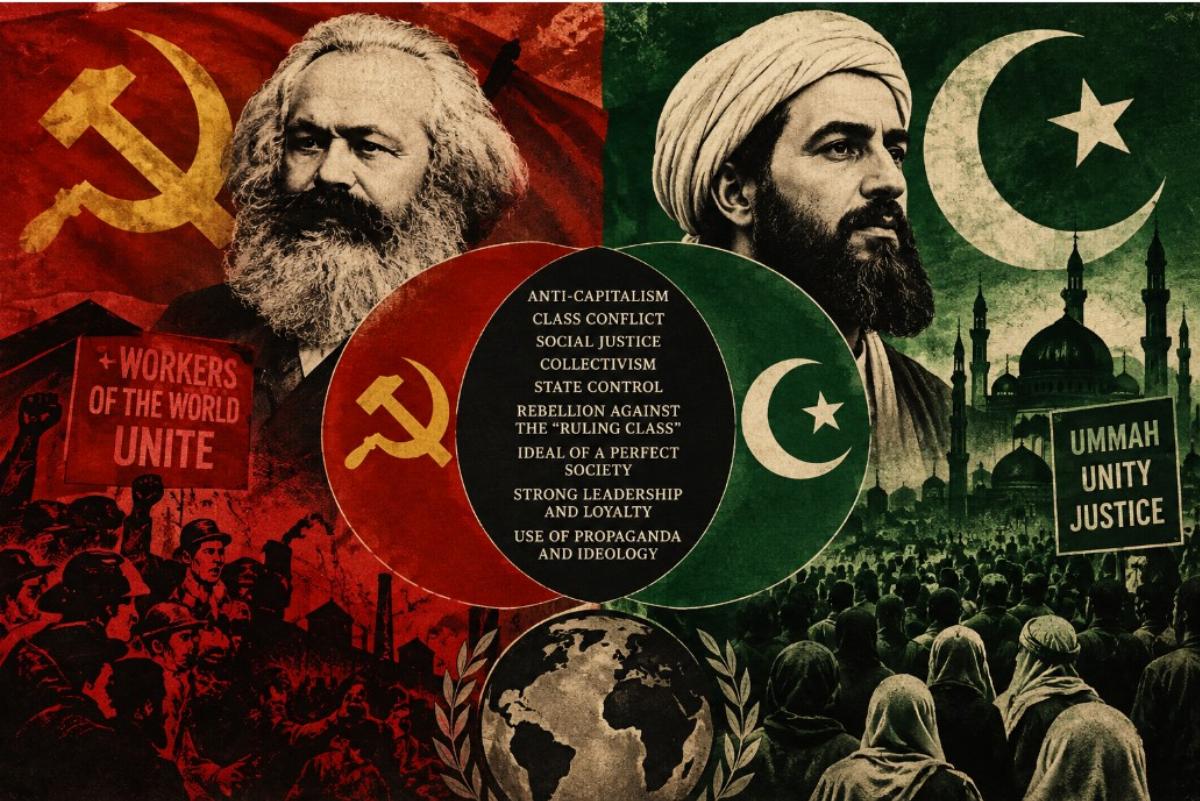
In a provocative new column for American Thinker, writer Eric Utter contends that Islamists and Marxists — two groups ordinarily understood as occupying very different corners of the ideological map — have far more in common than most observers acknowledge. The piece, published September 23, 2026, under the headline “Islamists and Marxists, united in hate,” argues that both movements treat outsiders as “infidels,” that both harbor an urge to convert, enslave, or kill non-believers, and that both are ultimately committed to dismantling Western nations, their markets, and the rights of their citizens.
Utter’s central claim is not merely that the two ideologies occasionally find themselves on the same side of a protest or a policy fight, but that they share a fundamental disposition: an intolerance of any agenda but their own, and a refusal to fully assimilate into a culture they do not dominate. “Both Islamists and Marxists will have no truck with any agenda but their own,” he writes, framing this as a defining feature rather than an incidental overlap.
A shared ‘infidel’ framework
The column opens by asserting that both groups view anyone outside their “outsized cults” as an infidel — a term Utter borrows from religious vocabulary but applies to both movements. From that shared premise, he argues, follows a shared impulse: the desire to convert, enslave, or kill those who do not belong.
Utter does not spend much time distinguishing between the theological and the secular versions of this impulse. Instead, he treats them as functionally equivalent, suggesting that the specific doctrines matter less than the structural hostility both groups display toward outsiders and dissenters. The column’s throughline is that neither movement can tolerate disagreement, and that this intolerance is not a bug but a feature.
The Marxist case, as Utter frames it
Utter devotes particular attention to the Marxist side of his comparison, arguing that leftists enslave people through “endless taxation” and the confiscation of property and the fruits of their labor. He also claims that leftists tell those in the underclass that success is impossible, encouraging them to rely on government assistance instead — a dynamic he says ensures they keep voting for the left.
On the question of Marxist willingness to kill, Utter points to a list of names and events — Steve Scalise, Charlie Kirk, Donald Trump, and “a host of others” — as evidence. He does not elaborate on each case in the column, treating the references as familiar to his audience. The rhetorical function of the list is to establish that Marxist violence is not hypothetical but a matter of public record, at least as the author reads it.
This is a contested framing. Political violence in the United States has been attributed to a range of ideological motivations across the spectrum, and the column does not attempt to litigate individual cases or their precise ideological drivers. Instead, Utter presents the list as illustrative, part of a broader argument about what he sees as a Marxist readiness to use force against opponents.
Abortion, nightclubs, and the ‘appetite for destruction’
One of the column’s more striking passages extends the metaphor of killing well beyond literal political violence. Utter writes that when Islamists or Marxists are inconvenienced, they “simply seek abortions, whether it be a baby, an adult, or anyone in between. Or even an entire night club, society or nation.”
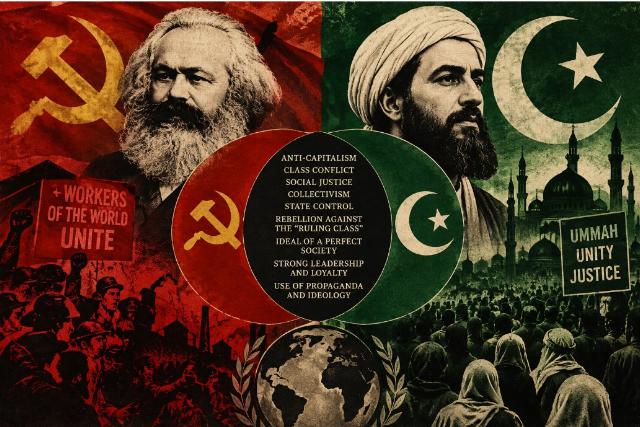
The line is deliberately provocative, linking abortion, mass shootings, and the collapse of whole societies into a single category of destruction. It is not a careful analytical claim so much as a rhetorical escalation — one that signals the column’s broader thesis that both ideologies are driven by an enormous appetite for destruction rather than by any constructive vision.
That thesis is reinforced by Utter’s observation that “nary a Islamist or Marxist nation has been both successful and free.” Rather than treating this as a problem for his argument, he treats it as confirmation: the lack of successful, free examples is, in his telling, precisely the point. The two ideologies, he suggests, are not failed experiments in governance but movements whose true aim is demolition.
The West’s ‘bizarre’ complicity
Utter’s most pointed criticism is not aimed at Islamists or Marxists at all, but at the West itself. He argues that Western nations appear “utterly — if bizarrely — committed” to satisfying the destructive appetites of both movements, a claim that implies a kind of civilizational self-sabotage.
The column warns that absent a “rapid, thorough, and fundamental recovery of Western values, culture, sanity, and confidence,” Islamists and Marxists will one day have a reckoning as they carve up what remains of the West. The language of a coming reckoning is apocalyptic, but it is also conditional: Utter holds out the possibility of recovery, provided the West recommits to the values he believes it has abandoned.
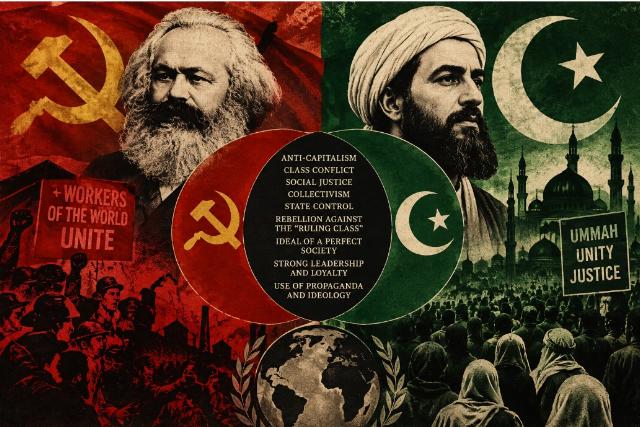
What those values are is left somewhat implicit, though the column’s references to relatively free markets, remaining rights and freedoms, and confidence suggest a broadly classical-liberal or conservative conception of the West. The emphasis is less on a specific policy program than on a posture — a willingness to defend one’s own culture rather than cede it.
An opinion piece in a familiar register
The column is consistent with American Thinker’s editorial voice, which frequently frames contemporary political conflicts as existential struggles between Western civilization and its internal and external adversaries. The publication appends a fundraising appeal to the piece, noting that “the ability to speak our minds is crucial to the republic we cherish” and asking readers to support its work.
Readers approaching the column as political analysis will find it long on assertion and short on empirical detail. Utter does not cite polling, demographic data, or scholarly research on either Islamism or Marxism. His method is rhetorical and comparative: identify a set of traits, attribute them to both movements, and argue that the overlap reveals a deeper kinship.
That method has obvious limitations. Islamism is a religious-political tradition with diverse strands, and Marxism encompasses a wide range of schools, from democratic socialists to authoritarian state communists. Collapsing each into a single “cult” risks obscuring more than it reveals. Utter anticipates this objection only implicitly, by treating internal diversity as irrelevant to what he sees as the movements’ shared outward behavior.
Still, the column is useful as a window into a strand of contemporary conservative argument that treats Islamism and Marxism not as separate threats but as a single, coordinated assault on the West. Whether or not one accepts that framing, it is a framing that has gained currency in certain corners of the right, and Utter’s column offers a compact statement of it.
His closing note — that speaking one’s mind is crucial to the republic — functions as both a conclusion and a pitch. It suggests that the column itself is an exercise in the very freedom Utter believes is under attack, and that the stakes of the argument are not merely intellectual but civic.
Source: www.americanthinker.com — https://www.americanthinker.com/blog/2026/09/islamists-and-marxists-united-in-hate/
Source: www.americanthinker.com
Related coverage
- Venezuelans Erupt After New Nobel Peace Laureate Navi Pillay Jabs Maria Corina Machado Over Trump Prize Offer
- Dolly Parton as a capitalist parable: What her rags-to-riches story really teaches
- A 20-Year-Old Photo of Mom and Me Became a Lesson in Grief, Humor, and Letting Go
- GOP faces a Nazi-style test: Will it excommunicate Dan Bilzerian before Florida’s primary?