
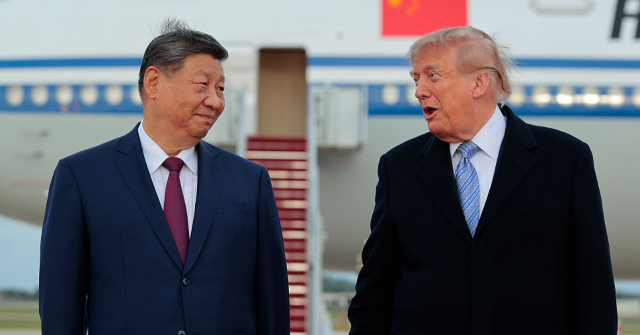
Americans tend to assume China’s President Xi Jinping governs from a position of unshakable strength, but Peter Schweizer says that image masks a far messier reality — one in which Xi has spent the past two years systematically removing the people around him from power.
On a recent episode of Breitbart’s podcast “The Drill Down,” Schweizer, the author of three bestselling books on China, told co-host Eric Eggers of the Government Accountability Institute that Xi has purged six of the eight members of the Central Military Commission, the body Schweizer describes as the most important political institution in the country.
“They were arrested, imprisoned, and charged with capital crimes,” Schweizer said. The only two survivors, he added, are Xi himself and the official tasked with investigating everyone else.
Schweizer pointed to the timing of the most recent removals: as Xi boarded a plane bound for the United States, he said, two top generals were ousted for “political unreliability.” Both had sat on the Central Military Commission.
A pattern of disappearances
The scale of the upheaval extends beyond that single body, according to Schweizer. Over the past two years, he said, more than forty-five Chinese generals or admirals have “gone missing,” with their families left without any word of their whereabouts.
“This is not the sign of a guy who is stable and loved and in a strong position,” Schweizer said.
Eggers framed the purges as evidence of two things at once — deep instability inside China and Xi’s willingness to snuff out dissent in a way unavailable to leaders of democracies.
“This guy is a hard-nosed S.O.B.,” Schweizer said, contrasting Xi’s treatment of political opponents with the criticism Trump draws at home for his rhetoric. “Xi is enormously nasty when it comes to political opponents.”
The podcast drew historical parallels to Josef Stalin’s repeated purges, exiles and executions of so-called counterrevolutionaries in the Soviet Union. The question, the hosts argued, is whether the current wave of removals reflects genuine and growing internal resistance to Xi or a fresh outbreak of Stalin-style paranoia.
An economy behind the curtain
Answering that question, they argued, requires looking past Beijing’s consistently upbeat growth figures and into how the Chinese economy is actually performing — something the hosts said is increasingly difficult to do.
“The reality is largely hidden,” Eggers said.
China is headed toward its slowest growth since 1991, according to Schweizer, and the government has stopped publishing large amounts of economic data — including indicators like business confidence and real estate transactions — because the numbers are so poor.
Eggers offered one comparison where data does exist: total U.S. debt stands at roughly 125 percent of annual GDP, while China’s debt ratio is about 300 percent of its total output.
Schweizer said those underlying dynamics matter as Trump and Xi meet in Washington this week and commentators attempt to assess the relative strength of each leader heading into the talks.
“The underlying dynamics and power positions of these two leaders is frankly the opposite of what a lot of the domestic media is telling you,” he said, attributing the gap either to animus toward Trump or to ignorance about conditions inside China.
Media incentives and the summit agenda
Both hosts predicted that legacy media coverage will not shift. Schweizer pointed to Disney’s ownership of ABC and the company’s extensive commercial interests in China, arguing that outlets with business ties there face pressure not to antagonize Xi.
“You do something to tick off Xi, and he’s going to kick them out of the country,” Schweizer said.
As for the summit itself, the hosts expect Iran and artificial intelligence to dominate the agenda. Schweizer was blunt about the prospects of China honoring any AI agreement meant to slow the technology’s development, putting the odds at “zero percent.”
He recalled that during the COVID pandemic, China signed a grant agreement with the National Institutes of Health to hand over research records — and then violated it, along with several other related commitments.
“The bottom line is they are not going to abide by any AI agreement,” Schweizer said. “It’s designed to constrain us, not them.”
On Iran, the hosts noted that China imports 90 percent of its oil, and that Trump’s moves in Venezuela and with Iran have hobbled Beijing’s ability to bring in crude. The country is drawing down its own stockpiles, they said, and will soon be forced to buy at elevated prices — adding yet more strain to an economy already under pressure.
Source: www.breitbart.com — https://www.breitbart.com/podcast/2026/09/24/peter-schweizer-xi-jinping-is-not-winning-within-china-or-abroad/