
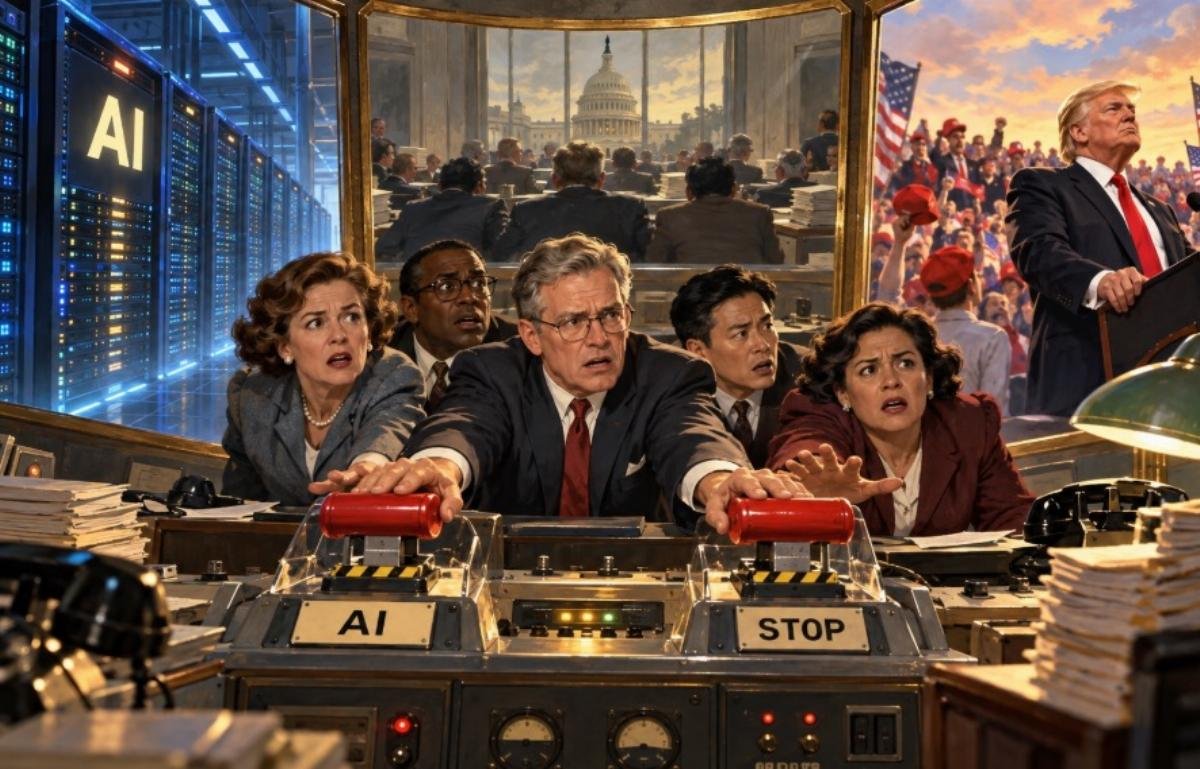
In a new essay for American Thinker, writer David DeMay offers a provocative framing of two phenomena that dominate headlines and boardrooms alike: artificial intelligence and Donald Trump. His argument, published September 26, 2026, is that the establishment’s visceral reaction to both reveals less about the threats themselves and more about the institutions trying to contain them.
DeMay’s central claim is that AI and the political movement surrounding Trump are not alien invaders but structural mirrors. They are, in his telling, high-velocity amplifiers that beam the underlying decay and unaccountable rules of modern governance back at the establishment at hyper-speed. The panic they provoke, he writes, is not a response to the chips or the candidate—it is a response to the feedback loop.
Two Panics, One Reflex
The essay opens by drawing a parallel between two very different sets of elites: those staring down a server farm humming with millions of unallocated floating-point operations, and those watching a political movement shatter decades of managed consensus. Both, DeMay argues, reach for what he calls “drywall-punching panic.”
In the case of AI, he points to policymakers drafting moratoriums to cap electricity and restrict data centers. In the political realm, he cites procedural barricades, lawfare, and institutional friction deployed against Trump. The common thread, per DeMay, is a knee-jerk demand to freeze the frame—ration the watts, outlaw the momentum, declare an emergency long enough for the committees to feel useful again.
He is careful to frame this as a category error born of self-preservation rather than strategy. The establishment, in his view, treats both AI and Trump as exogenous shocks—glitches in the matrix that must be quarantined, throttled, or legislated out of existence. But neither compute nor a political movement is an independent deity or an alien monster, he insists. They are the inevitable result of an unmoored system spinning so fast that its own caretakers no longer recognize their reflection.
The Authorship Crisis
The essay’s most interesting move is its diagnosis of what DeMay calls the “authorship crisis.” For decades, he writes, the administrative state and the technocratic elite operated behind a veil of managed decline—slow, bureaucratic, unowned write-paths where responsibility was diffused across committees so that no one was ever truly accountable. Into that vacuum stepped two distinct escalations: raw, unyielding technological scaling and a populist political force that refuses to play by polite, managed rules.
DeMay’s language here is deliberately technical, borrowing from computing. He talks about “write-paths” and “unowned systems,” suggesting that the real problem is not the wattage consumed by data centers or the disruption caused by a single political figure. The problem is that no one has signed their name to the changes. The keyboard is silent, he writes, and agency is lost.
This is a familiar conservative critique of the administrative state, but DeMay extends it in an unusual direction. He does not simply blame bureaucrats for overreach. He argues that the bureaucrats themselves are terrified of an automated, unblinking mirror of their own institutional failure. That is why, in his account, the panic is so hysterical. They do not fear the chips, and they do not simply fear a candidate. They fear a dynamic that forces them to look at what they have wrought.
Neither Strategy nor Solution
DeMay is blunt about the limits of the establishment’s response. The freeze, he writes, is not a plan for the future. It is a way to avoid looking at the record of how the present was written. It is institutional self-therapy, a refuge in process rather than a reckoning with outcomes.
He acknowledges that both AI and Trump act as amplifiers, but he does not treat that as a reason to pull the plug. Instead, he calls for a different kind of discipline—one that applies equally to a data center and to a campaign. Name the operator, introduce friction on purpose, put a signature on the change, and refuse the solemnity that turns a feedback loop into a deity.

That prescription is notable for what it does not include. There is no call for a moratorium on compute, no demand for lawfare against political opponents. DeMay’s solution is procedural and cultural: own the problem, assign responsibility, and stop treating either technology or politics as an uncontrollable force of nature.
Whether one finds this persuasive depends in part on how one views the establishment’s motivations. DeMay’s essay is not a neutral analysis. It is an argument that the ruling class has met its match in two forces it cannot manage, and that its response—panic, procedural obstruction, emergency declarations—is evidence of its own bankruptcy rather than a defense of the public good.
A Mirror, Not a Monster
The essay’s title asks what AI and Donald Trump have in common. DeMay’s answer is that both disrupt established—and broken—systems, causing intense panic in those invested in those systems. That is a thesis that will resonate with readers who already believe the administrative state is unaccountable and that technological change is inevitable. It will likely strike others as a clever reframing that lets both AI and Trump off the hook for their specific harms.
But the essay’s deeper point may be less about either subject and more about the nature of institutional failure. DeMay is arguing that the system is breaking not because of external shocks but because the keyboard is silent—because no one has been willing to claim authorship of the rules that govern us. AI and Trump, in this telling, are not causes but symptoms. They are what an unauthored system looks like when it finally moves faster than its caretakers.
That is a provocative claim, and it cuts against the grain of much contemporary commentary, which tends to treat AI and populism as separate crises with separate solutions. DeMay’s contribution is to insist they are the same crisis wearing different masks—and that the only way out is to stop reaching for the panic button and start signing our names to the future.
The essay ends with a call to action that is both broad and specific: claiming the future requires all hands on deck. It is a line that could apply to a data center, a campaign, or a country. Whether it is enough to move readers beyond panic remains to be seen.
Source: www.americanthinker.com — https://www.americanthinker.com/blog/2026/09/what-do-ai-and-donald-trump-have-in-common/