
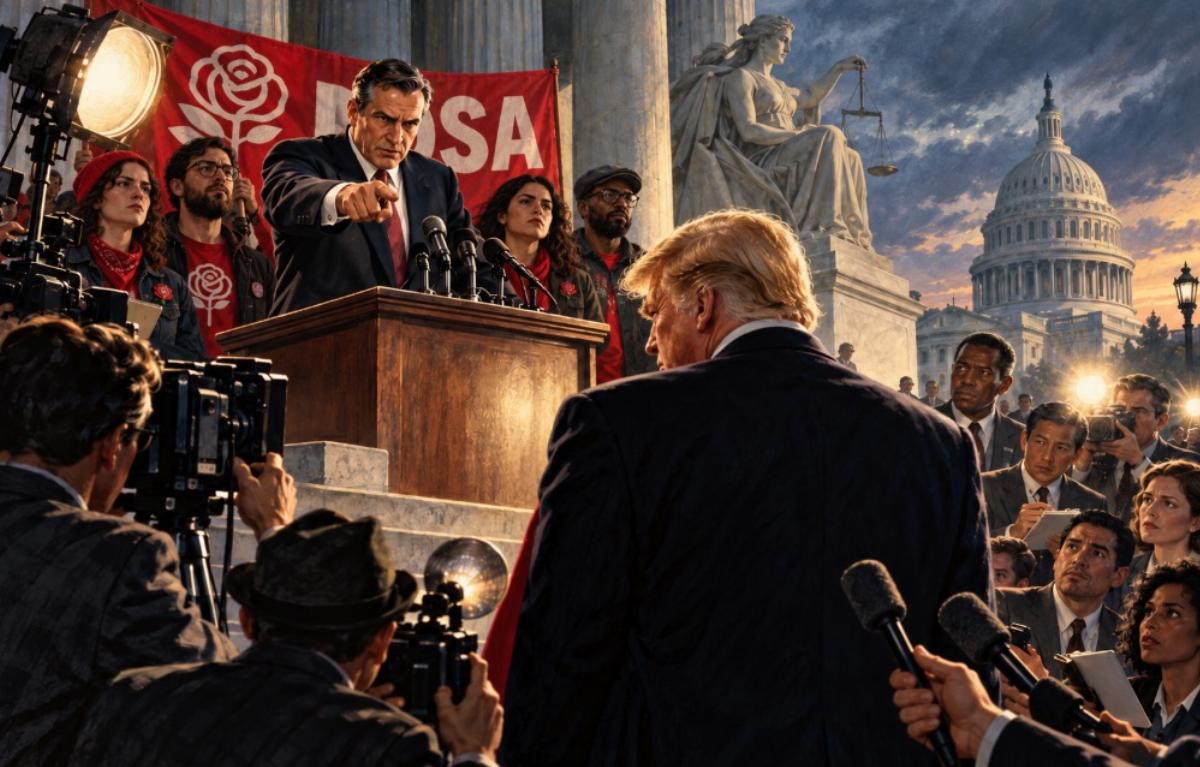
In a commentary published by American Thinker, writer Arnold Cusmariu argues that the rise of the Democratic Socialists of America as a force inside the Democratic Party represents something more ominous than a typical ideological shift. His piece, titled “Ready for an American Vyshinsky?” and dated September 27, 2026, contends that if Democrats retake Congress this fall, the DSA will claim credit and demand influence — and that the result would be a form of politics that does not negotiate and does not compromise.
Cusmariu’s central historical reference is Andrey Yanuaryevich Vyshinsky, the Soviet Procurator General who managed the Moscow show trials of the 1930s. He describes Vyshinsky, who lived from 1883 to 1954, as “a rat in human form” and “the ultimate apparatchik” — a man who later helped impose Soviet control in Romania after World War II. It was there, Cusmariu writes, that the Communist regime subjected Iuliu Maniu, a Romanian political figure he compares in significance to America’s Founders, to a Soviet-style political trial. Maniu died in prison in 1953.
From Moscow to Manhattan
What makes the comparison worth engaging, even for readers who find it overheated, is the narrower question Cusmariu raises: once legal proceedings become instruments of political combat, where does the line between prosecution and political theater sit? He does not claim the two are identical. Instead, he points to New York Attorney General Letitia James as what he calls a “useful warning” of what politically driven law enforcement can look like — noting that she campaigned on aggressively pursuing Trump and later brought the civil fraud case against him. Cusmariu concedes directly that this is “obviously not the same thing as Stalin’s Moscow trials,” but argues the underlying temptation is worth remembering.
That concession matters because it is the hinge of the piece. The argument is not that America is the Soviet Union. It is that the institutional habits that made Soviet show trials possible — prosecutors who see their job as defeating a political enemy rather than testing evidence, and a press corps willing to vouch for the legitimacy of the proceedings — can take root in a free country long before anyone notices.
Cusmariu extends the analogy to the media. He invokes Walter Duranty, the New York Times correspondent in Moscow whose coverage of Stalin’s show trials and the broader Soviet project was famously approving, and suggests that “his journalistic descendants would know what to do.” In Cusmariu’s telling, a future prosecution of a political figure would be met with round-the-clock cable coverage and a parade of Democratic legal experts assuring the public that everything was perfectly constitutional. Whether one accepts that prediction or not, the underlying point — that elite media validation is a load-bearing part of any politically motivated prosecution — is a claim that cuts across ideological lines and is worth taking seriously on its own terms.
The DSA as a rising force
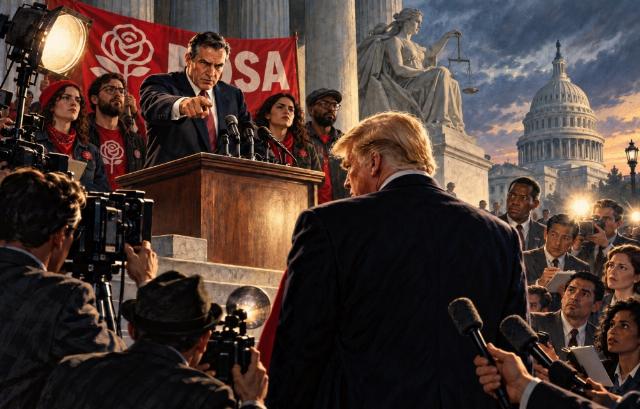
The piece begins from a premise common in conservative commentary: that if Democrats win full control of Congress this fall, they will spend the remainder of President Trump’s term working to undo his progress and block him wherever possible, with an eye toward a 2028 White House takeover. Cusmariu frames the DSA’s emergence as a driving force within the Democratic Party as the genuinely new element in that landscape. His characterization is blunt: “These folks take no prisoners. They are not interested in negotiating. It’s their way, or the highway.” He predicts that Hakeem Jeffries and Chuck Schumer will increasingly find themselves dealing with DSA leaders he describes as “Stalin, Mao, Castro types in spirit, if not yet in power.”
That is a rhetorical escalation, and readers should weigh it as such. There is a difference between a socialist caucus gaining influence inside a major party — a development with plenty of historical precedent in democracies — and the installation of a totalitarian apparatus. Cusmariu’s essay does not systematically bridge that gap; it asserts the continuity and lets the Vyshinsky frame do the work. The stronger part of his argument is the institutional one: that norms around prosecutorial independence and press neutrality are more fragile than Americans assume, and that the people who break them rarely announce themselves as Vyshinskys.
The piece closes on a note that is less apocalyptic than its title might suggest. “Now more than ever,” Cusmariu writes, “the ability to speak our minds is crucial to the republic we cherish.” The accompanying publisher’s note asks readers who find American Thinker’s work resonant to consider donating to support its staff and keep its ideas heard.
What the argument leaves open
Two things are worth separating here. The first is the historical claim, which is largely accurate in its broad strokes: Vyshinsky did manage the Moscow trials, he was later posted to Romania, and Maniu was tried and died in prison. The second is the predictive claim — that an American equivalent is plausible if the DSA’s influence grows and Democrats return to power. That claim rests on an analogy rather than evidence, and Cusmariu himself stops short of saying the cases are the same.
What remains is a warning about incentives. Prosecutors who campaign on targeting a specific person, media outlets that treat one side’s legal theories as settled, and a legislature that responds to overreach with strongly worded letters rather than structural checks — none of these require a Stalin to do damage. Cusmariu notes with evident frustration that if the GOP objects beyond such letters and a complaint that reaches the Supreme Court, he expects Chief Justice Roberts to make sure it goes nowhere. That line, more than the Vyshinsky comparison, captures the essay’s real anxiety: not that America will become the Soviet Union, but that its guardrails are thinner than advertised, and that the people most confident they would hold are the ones least likely to test them.
Whether readers share Cusmariu’s diagnosis or reject it outright, the questions he raises about the politicization of law enforcement and the media’s role in legitimizing it are not going away after November. They are the kind of questions that tend to be answered by events rather than arguments — which is precisely why the argument is being made now.
Source: www.americanthinker.com — https://www.americanthinker.com/blog/2026/09/ready-for-an-american-vyshinsky/
Source: www.americanthinker.com
Related coverage
- Texas Governor’s Shocking 2026 Loss Sparks Election Doubts — Even From a Skeptic
- Greta Thunberg Backs French Student Protests as Budget Cuts Spark Violent Clashes
- A 15-Year Study of 60,000 9/11 Responders Found No Excess Mortality — So Why Does the ‘Toxic Dust’ Story Persist?
- Anti-Aircraft Missiles Deployed Around Mar-a-Lago Amid ‘Heightened Threat Environment’