
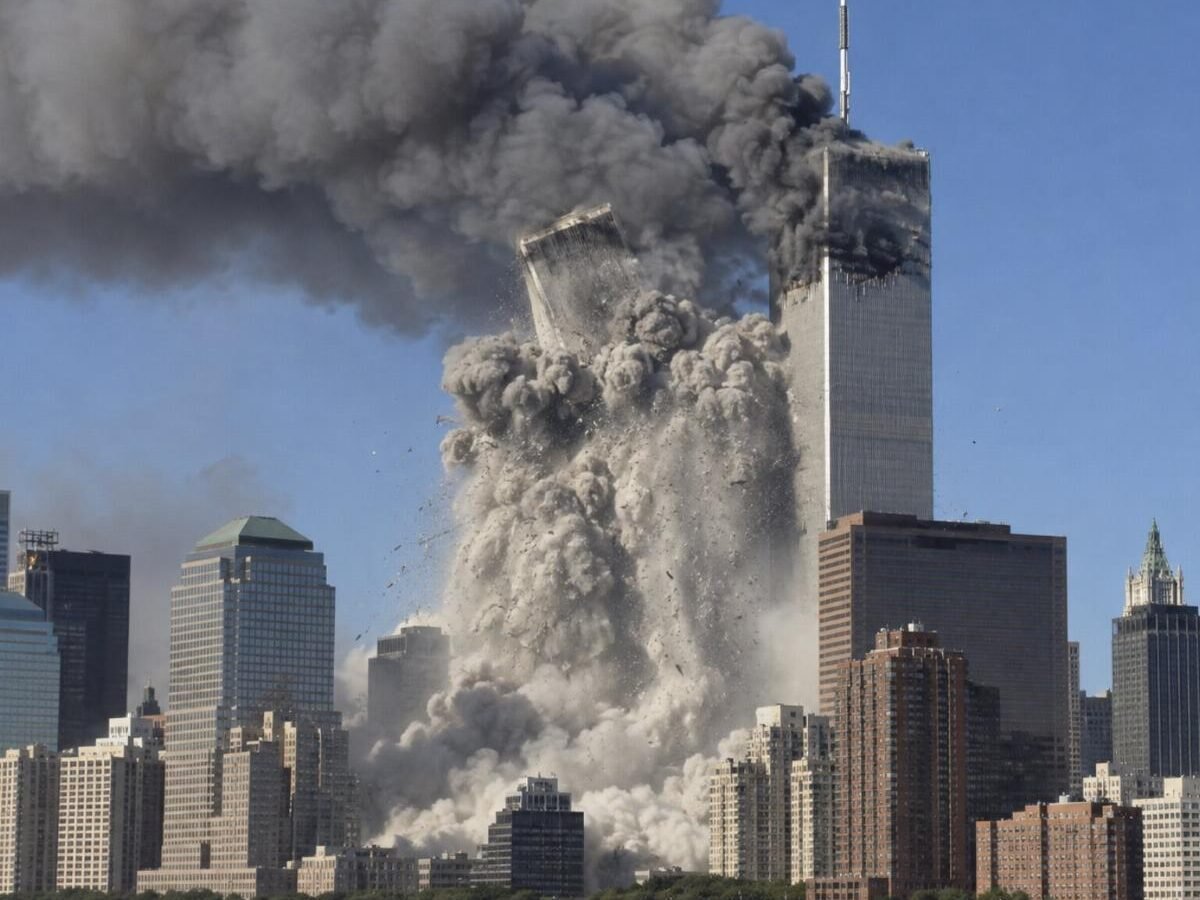
Twenty-five years after the towers fell, the most durable public image of 9/11 may not be the planes or the smoke plumes but the cloud — that billowing gray wall of pulverized concrete and ash that chased New Yorkers through Lower Manhattan. In the popular imagination, that cloud carried something worse than dust: a hidden payload of carcinogens destined to shorten the lives of everyone who breathed it in.
Writing in American Thinker on the anniversary, Bill Ponton argues that this conviction says more about American psychology than about American epidemiology. The 9/11 attacks, he writes, tapped two distinct fears — the entirely rational fear of Islamic terrorism and what he calls the “largely imaginary fear of environmental poisoning.” The second, in his telling, is a cultural habit stretching back to Rachel Carson’s Silent Spring in 1962, a fear that periodically attaches itself to a new villain: DDT, then dioxins, then lead, then asbestos, and now the dust of the World Trade Center.
The mystery-novel problem
Ponton frames the issue with a literary analogy. Pick up a whodunit, he suggests, and imagine it ending with a coroner ruling that the victim died of natural causes. It would be a terrible story — which is essentially the problem facing researchers who have spent years studying mortality among people exposed to hazardous materials during and after the collapse. The evidence, he writes, keeps refusing to deliver the ending the public expects.
His central claim is that the strongest mortality studies do not show that the 9/11-exposed population died at higher rates than comparable New York or U.S. populations. In several of the cohorts examined, observed mortality actually came in below what population averages would predict — a pattern most pronounced among responders.
The explanation researchers favor, according to Ponton, is a “healthy-worker effect.” Firefighters, police officers, construction workers and other responders were, on average, in better physical condition than the general public well before September 11, 2001. A workforce selected for physical fitness will tend to outlive a random sample of the population, which complicates any effort to isolate the health consequences of the dust itself.
The piece points to one study in particular as the strongest evidence: a 15-year analysis pooling roughly 60,000 rescue and recovery workers, which concluded there was no excess overall mortality and no excess mortality from the major causes of death when those workers were compared with New York State populations.
A fashionable bogeyman
Ponton is careful to place this in a broader intellectual tradition rather than treating it as a one-off finding. Environmental poisoning, he writes, has been “a fashionable bogeyman” for more than six decades. The specific pollutant changes with the news cycle, but the underlying anxiety stays constant: the suspicion that the modern, man-made environment is quietly killing us. The dust cloud fit that template perfectly — a visible, terrifying, man-made phenomenon that seemed to demand a body count.
What the cloud was actually made of, he notes, was largely pulverized concrete. That is a less cinematic substance than the word “toxin” implies, and it is central to his argument that the intuitive story and the empirical story have diverged.
It is worth being precise about what this argument does and does not establish. Ponton’s claim is about mortality — deaths, measured across large populations over long periods. It is not a claim that no one who worked at Ground Zero got sick. The scientific literature on 9/11 exposure includes well-documented associations with respiratory conditions, gastroesophageal reflux, and certain cancers among specific groups, and the federal World Trade Center Health Program exists precisely because those associations were taken seriously. The debate Ponton is engaging is narrower and harder: whether the exposed population, taken as a whole, has died at elevated rates compared with people who were never there. On that question, he argues, the answer from the best-designed studies has been no — and the healthy-worker effect explains why some cohorts look better off than the general public.
Why the story resists the evidence
The more interesting part of Ponton’s essay is not the epidemiology but the implicit question underneath it: why does a narrative survive when the data it rests on keeps failing to materialize?
Part of the answer is that environmental fears are not irrational in origin. They were earned. Communities have been poisoned — by leaded paint and gasoline, by industrial solvents, by contaminated water — and the lesson many people drew is that official reassurance arrives too late and too confidently. A quarter-century of WTC health research funding, litigation, and advocacy has built institutional stakes around the exposure narrative as well. And there is a genuine moral asymmetry at work: if the dust turns out to have been less lethal than feared, the cost is a correction to the record; if it turns out to have been more lethal and we dismissed it, the cost is measured in lives.
Ponton’s answer is simpler. He suggests Americans have an appetite for environmental catastrophe as narrative, and that the collapse of the World Trade Center supplied an almost perfect setting for it. The mystery novel, in his framing, is still waiting for the murder — and the coroner keeps ruling natural causes.
Whether or not one accepts that framing, the piece lands on a question that outlasts the anniversary: how do we decide, as a society, when a fear has been tested enough to be set aside? The 60,000-worker study is one answer. For many people who lived through that September and the months of acrid air that followed, it has not yet proved persuasive.
Source: www.americanthinker.com — https://www.americanthinker.com/blog/2026/09/9-11-and-our-fear-of-environmental-poisoning/