
In a sprawling essay for American Thinker titled Against Ideological Absurdity and Tyranny, writer Lars Møller makes a case that the word “counter-revolution” has been unfairly stained—and that understanding its real history is essential to grasping what is happening in American politics today. Published on September 29, 2026, the piece travels from the Federalist revolts of 1793 to the rural insurgency of the Vendée to the MAGA movement, using Victor Davis Hanson’s writing as a bridge between eras.
Møller’s central claim is that counter-revolution is not nostalgia. It is not a yearning to return to some imagined golden age. Instead, he defines it as organized resistance that arises once a utopian political experiment becomes abstract enough to “devour the concrete order of ordinary life.” In his telling, the moment an ideology passes a certain threshold of purity, it ceases to be a project of liberation and becomes an engine of tyranny—and invites its own negation.
The French 1790s as the Paradigmatic Case
Møller divides French resistance to Jacobin radicalism into two distinct traditions, both of which were crushed. The first was republican, decentralizing, and urban. The Federalist revolts of 1793 began after the Parisian coup of May 31–June 2, when Girondin deputies were expelled from the National Convention. Cities including Lyon, Marseille, Bordeaux, Caen, and Toulon rose in protest—not, Møller stresses, to restore the Bourbon monarchy, but to preserve the First French Republic against what they saw as the illegitimate domination of the capital over the departments.
These rebels were branded “fédérés,” a term of abuse meant to imply secessionist ambitions. Møller insists the label was a smear: these were republicans who wanted the national assembly’s democratic integrity respected and administration decentralized, not a breakaway movement. They were poorly coordinated, lacked professional armies, and could not build mass support beyond urban notables. By autumn 1793, republican forces had put them down.
That military victory did not calm the Revolution. It radicalized it. According to Møller, defeating the anti-Jacobin fédérés removed one of the last institutional checks on the Terror and strengthened the most extreme elements in Paris. The pattern he draws out is blunt: moderate resistance to ideological excess is first treated as treason, then crushed, and then cited as justification for even greater excess.
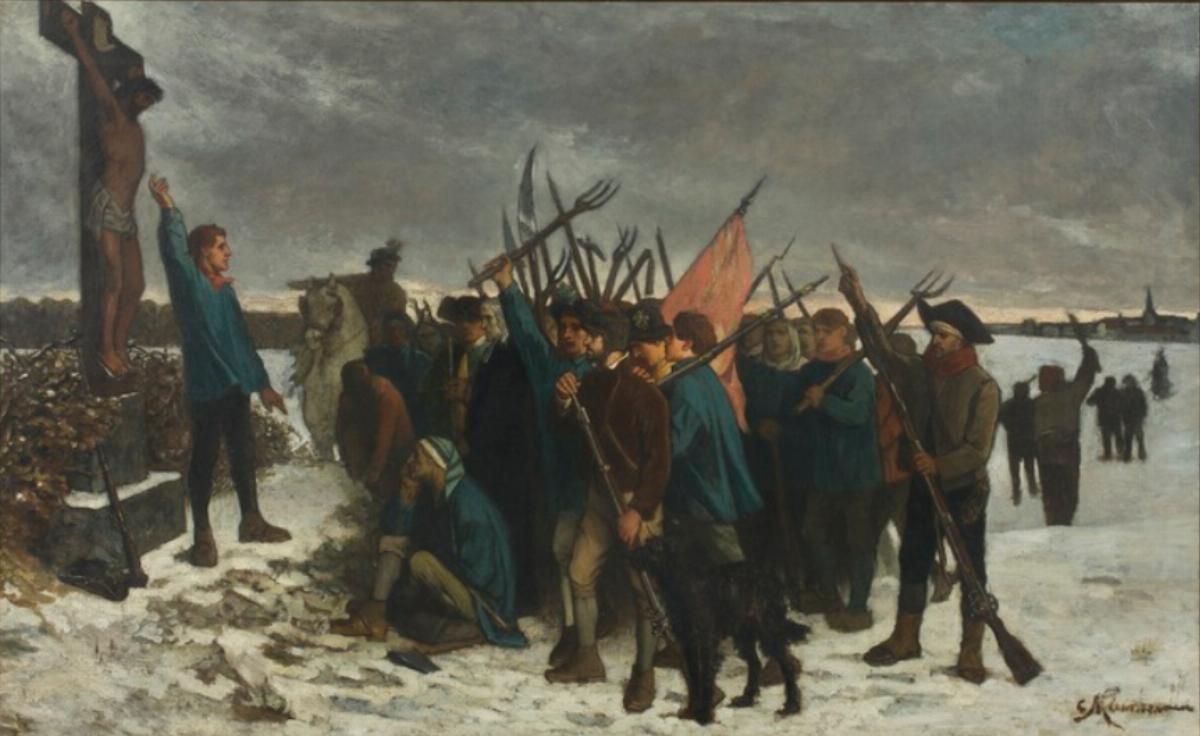
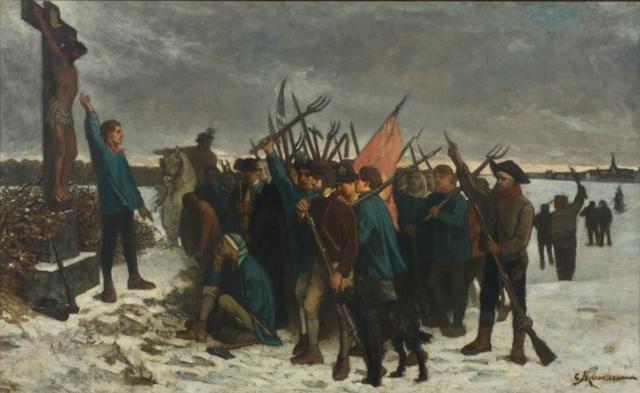
The second tradition—the War in the Vendée—was different in kind. It was the largest and longest internal military challenge to the revolutionary republic, rooted in the rural west of France. Møller points to the Civil Constitution of the Clergy of 1790, which had already alienated many priests and peasants by requiring an oath subordinating the Church to the state. The spark came in February 1793 with a mass conscription decree. Peasants with little attachment to abstract rights refused to send their sons to fight wars they did not understand for a regime that had shuttered churches, sold ecclesiastical lands, and treated their faith as superstition.
Local nobles who had not emigrated joined them, and the Royal and Catholic Army fought under the banner of the Sacred Heart. Møller describes the conflict as simultaneously religious, social, and political: a defense of local custom and transcendent authority against the homogenizing claims of the revolutionary state. The Republican response, he writes, was scorched-earth—General Louis Marie Turreau’s “infernal columns” and the mass drownings at Nantes under Jean-Baptiste Carrier. Tens of thousands of civilians and combatants died, in events Møller says foreshadow the worst excesses of the October Revolution.
His conclusion about the Vendée is that it was not merely defeated but punished as an example. The repression intensified the Terror and cemented the Jacobin conviction that any lingering attachment to tradition was a mortal threat to the Republic. In Møller’s framing, the Vendée was the “purest” counter-revolution of the 1790s because it rejected the premises of the new order rather than just its excesses. Its failure showed how thoroughly a revolutionary regime can mobilize violence once opposition has been redefined as existential heresy.
Hanson’s American Application
From there, Møller turns to the present, drawing on Victor Davis Hanson’s application of the same vocabulary to Donald Trump’s political movement. Hanson, a classicist and military historian, has presented Trump as a contemporary counter-revolution against a progressive administrative and cultural regime that has grown indifferent to large parts of the American public.
Hanson’s precedents are several. The most immediate is Grover Cleveland, the only other American president to serve non-consecutive terms. Møller relays Hanson’s argument that Trump’s return after the 2021–2025 interregnum mirrors Cleveland’s recovery after 1889—and that his years in the political and legal wilderness clarified his sense of the institutional forces arrayed against him, sharpening a second-term program aimed at dismantling them.
More structurally, Hanson compares the scale of Trump’s agenda—trade realignment, energy independence, regulatory rollback, and the explicit repudiation of diversity, equity, and inclusion mandates—to the transformative resets of Franklin D. Roosevelt’s New Deal and Ronald Reagan’s revolution. The ideological content is inverted, Møller notes, yet the ambition to reorient the relationship between state, economy, and culture is comparable in breadth.
The essay’s most distinctive framing is classical. Hanson casts Trump as a tragic hero in the mold of Sophocles’ Ajax or the protagonist of John Ford’s 1956 film The Searchers: a figure whose personal flaws are glaring and whose manners offend the refined, but whose particular talents prove necessary against threats polite society prefers to ignore. Once the crisis is managed, such a hero is often discarded by the very civilization he preserved. Møller finds the cycle of election, defeat, legal persecution, and restoration fits this pattern with “uncomfortable precision.” Hanson also situates the movement in a longer history of populist revolt against metropolitan elites, invoking the late Roman Republic, in which the peripheral and working classes—the people Hillary Clinton famously called a “basket of deplorables”—pushed back against a self-regarding administrative and cultural center.
Møller is careful to say the parallel between the French 1790s and the American present is structural, not one of identity. In both cases, he argues, a self-confident ideological formation concentrated in the capital and among cultural elites treats dissenting populations as residual obstacles to progress. In both, the language of emergency and moral urgency justifies concentrating power and marginalizing traditional restraints. The fédérés defended a more plural, decentralized republic against Parisian monopoly; the Vendeans defended a religious and communal way of life against secular homogenization. On Hanson’s account, Trump’s supporters seek to defend national sovereignty, economic self-interest, and cultural continuity against an administrative state and progressive cultural regime that treat those goods as negotiable or obsolete.
The Pessimism in the Record
What gives the essay its edge is where Møller lands. He does not promise a happy ending. The French counter-revolutions of the 1790s failed in their immediate objectives. The fédérés were crushed, the Vendée was devastated, and the Terror reached its climax precisely because resistance had been overcome. The revolutionary state, in his account, emerged stronger, more centralized, and more willing to wield violence—its triumph built in part on the bodies of those who had tried to slow it down.
Møller’s closing suggestion is that ideological absurdity, once institutionalized, does invite its own negation—but that the cost of that negation is almost invariably high and the outcome rarely clean. It is a warning as much as a comparison, one that reads the present through a past that offered no easy victories to those who resisted the drive toward purity.
Source: www.americanthinker.com — https://www.americanthinker.com/articles/2026/09/against-ideological-absurdity-and-tyranny/
Source: www.americanthinker.com
Related coverage
- Is Swift Justice Dead? The Modern Fight Over Guilt and Innocence
- Sanders’ Welfare Ad Sparks White Male Backlash from the Right
- American Thinker Essay Claims ‘Pluralism Is Not a Suicide Pact’ as Immigration Debate Collides With Free Speech
- MAGA Can’t Win on Applause Alone, Conservative Writer Warns Ahead of Midterms