
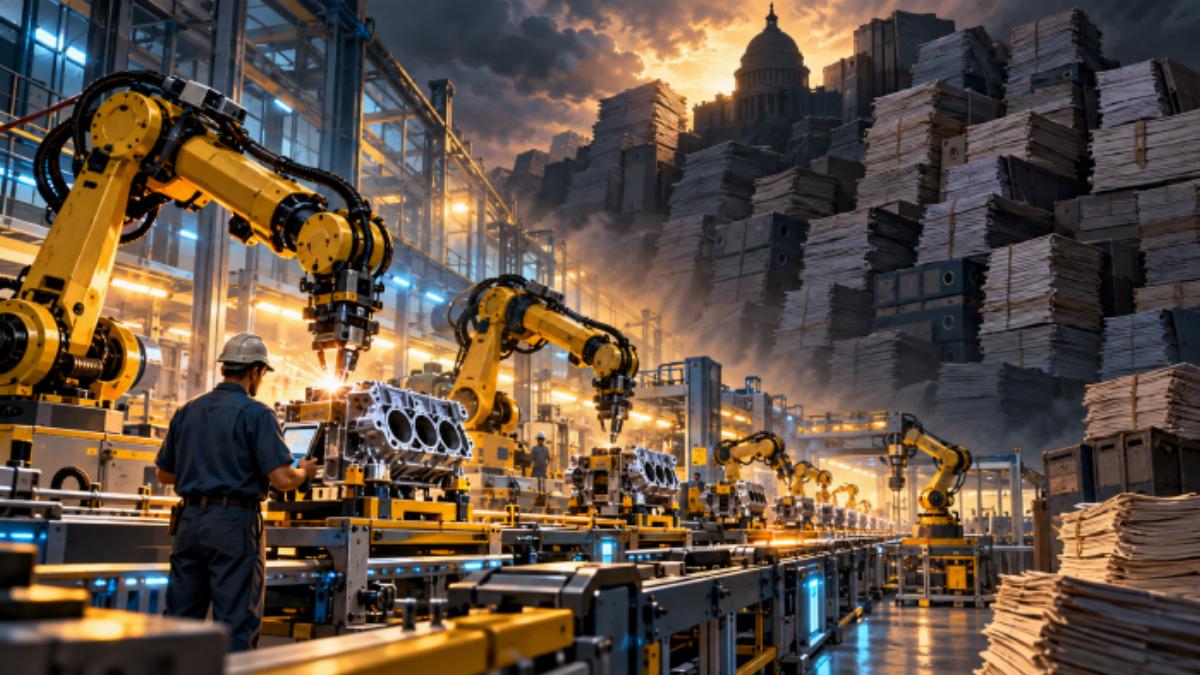
America’s mounting national debt presents a binary choice between economic disaster and default, and the only escape route runs through an unprecedented expansion of industrial automation and artificial intelligence. That is the argument advanced by David DeMay in a recent commentary for American Thinker, which frames the fiscal debate as an inescapable arithmetic problem that no combination of taxes, spending cuts, or legislation can solve.
DeMay’s central claim is that compound liabilities have created a systemic mathematical dead end. The trajectory of institutional fiscal mechanics, he writes, guarantees structural currency collapse, runaway inflation, and a terminal decline in living standards as debt service devours the economy’s productive capacity. Every other political debate, in his view, is a misplaced distraction from this core reality.
The Only Exit
If the debt cannot be taxed or legislated away, DeMay argues that the only viable path is to grow real physical productivity fast enough to outpace it. That capability, he contends, belongs exclusively to advanced automation and industrial artificial intelligence. By deploying intelligent robotics and autonomous systems across manufacturing, energy, and supply chains, the marginal cost of physical goods could be driven toward zero — flooding the market with tangible, low-cost wealth that dilutes the burden of legacy debt.
The op-ed does not treat this as a distant techno-utopian vision. It offers what DeMay calls a crude, practical map for bridging the gap between today’s fiscal cliff and a fully productive automated economy. The plan unfolds in a sequence of ordered priorities, beginning with the removal of regulatory and permitting blockages that currently paralyze domestic heavy industry, energy grids, and factory construction.
The logic here is blunt: one cannot deploy physical hardware if local and federal red tape stalls projects for decades. DeMay identifies permitting reform as job one, arguing that the construction of factories and grid infrastructure must be accelerated before any broader automation strategy can take root.
Redirecting Capital and Scaling Deployment
The second step calls for redirecting capital investment away from speculative financial asset bubbles and into domestic industrial robotics, edge-compute hardware, and automated logistics infrastructure. This is not merely a matter of industrial policy, according to the commentary, but a necessary reallocation of investment toward the physical economy rather than paper assets.
Third, DeMay outlines a phased deployment strategy. It would start with retrofitting existing baseline manufacturing with smart sensors and adaptive machinery. From there, the sequence moves to local machine intelligence running directly on factory floors to eliminate supply chain choke points, and finally links those hubs into regional coordination grids. Each stage builds on the last, creating a layered network of automated production rather than an overnight overhaul of the entire economy.
The commentary positions this approach as the only mechanism powerful enough to dilute the legacy debt burden. By putting machine intelligence directly into heavy industry and domestic production, the argument goes, the nation can generate enough real wealth to outgrow its obligations.
An Existential Threat Measured in Balance Sheets
DeMay also takes aim at what he describes as the widespread panic over science-fiction AI doomsday scenarios, calling such concerns a luxury the country cannot afford. In his framing, the real existential threat is not a rogue artificial intelligence but the federal balance sheet itself. Survival, he writes, requires abandoning paralyzing hypotheticals and committing entirely to the industrial transition before the debt destroys the nation.
The commentary acknowledges the stakes while offering little patience for alternative approaches. DeMay does not argue that automation will be painless or that the transition will solve every problem; he argues that the arithmetic leaves no other door open. The choice, as he presents it, is between a deliberate, managed expansion of productive capacity and a fiscal collapse that would erode living standards across the board.
Whether that map is sufficient remains an open question. The op-ed is long on strategic direction but short on specific policy mechanisms, funding models, or timelines. It does not address the capital gaps that would need to be filled, the workforce disruptions that would accompany rapid automation, or the political coalitions required to pass permitting reform through a divided government. Those omissions may reflect the space constraints of a commentary format rather than a lack of awareness, but they leave the practical path less defined than its author suggests.
Still, the core argument is difficult to dismiss out of hand. If the debt is indeed on an unsustainable trajectory — a point that fiscal analysts across the ideological spectrum have raised for years — then the question becomes whether productivity growth can outrun it. DeMay’s answer is that only an industrial AI revolution can achieve that feat, and that the window for acting is narrowing.
The commentary ends by returning to what it calls the republic’s need for open debate and free expression, a note that underscores the stakes as its author sees them. The debt is growing. The question, as American Thinker frames it, is whether America can build — factories, robotics, infrastructure — fast enough to stay ahead of it.
The op-ed does not pretend to offer a comprehensive blueprint. It offers a direction, a sequence, and a warning. The debt is real, the arithmetic is unforgiving, and the only proven engine of escape is the one that produces more with less. Whether that engine can be built in time is the question that will define the coming decade.
Source: www.americanthinker.com — https://www.americanthinker.com/blog/2026/09/the-debt-is-growing-can-america-build-faster/