
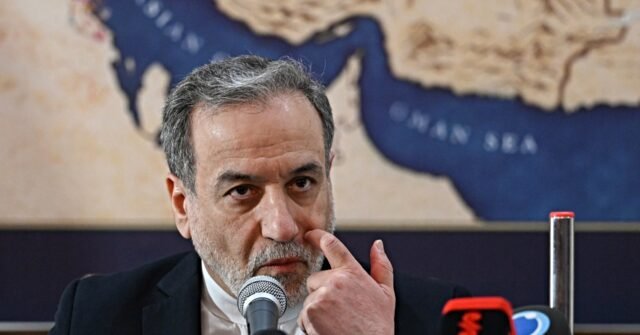
Iran’s top diplomat declared Sunday that direct negotiations with the United States remain off the table until Washington addresses Tehran’s demands related to the ongoing Strait of Hormuz crisis, signaling continued diplomatic deadlock between the two nations.
Foreign Minister Abbas Araqchi told reporters that while messages are being exchanged between Iran and the U.S., communication is occurring only through intermediaries rather than in direct bilateral talks, according to Reuters.
Araqchi reiterated Iran’s position that an agreement between Tehran and Muscat concerning the Strait of Hormuz has reached its “final stages,” though he emphasized the deal would not immediately reopen the strategic waterway to international shipping. According to comments reported by Iran’s Mehr news agency, the agreement would establish new shipping lanes to be implemented only after the United States meets additional Iranian conditions.
Revolutionary Guards Maintain Hard Line
Iran’s Revolutionary Guards have maintained a firm stance on the strait’s closure, declaring it will remain shut “until the enemy accepts all our conditions.” The Guards characterized the waterway as “actually a theatre of war for us and not just a waterway,” underscoring the military dimension Tehran has attached to the dispute.
The Strait of Hormuz serves as one of the world’s most critical maritime chokepoints, with roughly one-fifth of global oil supplies typically passing through the narrow waterway between Iran and the Arabian Peninsula.
Sweeping List of Demands
Araqchi’s comments came just hours after Mohammad Bagher Zolghadr, secretary of Iran’s Supreme National Security Council and a former senior Islamic Revolutionary Guard Corps commander, issued an extensive list of demands to Washington, according to Breitbart News.
Zolghadr’s demands include an end to U.S. military action in the region, complete withdrawal of all American military assets, cessation of threats against Iran and its regional allies, lifting of the U.S. naval blockade, compensation for what Tehran characterizes as war damages, removal of sanctions, and unconditional release of frozen Iranian assets.
“Until America corrects its behavior, the Strait of Hormuz will not be reopened,” Zolghadr said in a statement carried by Iranian state media.
U.S. Response: Pressure Campaign Continues
The Iranian statements came as Vice President JD Vance indicated the United States remains committed to its current strategy. According to Breitbart News, Vance described Washington as being in the “middle of the game” and continuing to apply diplomatic, economic, and military pressure on Tehran.
The standoff represents a significant test for U.S. foreign policy in the Middle East, with the closure of the Strait of Hormuz carrying potential consequences for global energy markets and international shipping. The waterway’s status has become a focal point in the broader tension between Washington and Tehran, with neither side showing signs of backing down from their respective positions.
The current impasse follows years of deteriorating relations between the two countries, marked by disputes over Iran’s nuclear program, regional influence, and various security concerns. The use of intermediaries for communication reflects the absence of formal diplomatic relations between Washington and Tehran, which have been severed since the 1979 Iranian Revolution.
Iran’s insistence on preconditions before direct engagement, combined with the Revolutionary Guards’ characterization of the strait as a war theater, suggests the diplomatic standoff may persist for the foreseeable future. The situation remains fluid as both sides continue maneuvering for advantage while the strategic waterway remains closed to normal commercial traffic.
Source: www.breitbart.com — https://www.breitbart.com/politics/2026/08/09/iran-refuses-to-engage-directly-with-u-s-until-its-demands-are-met/