
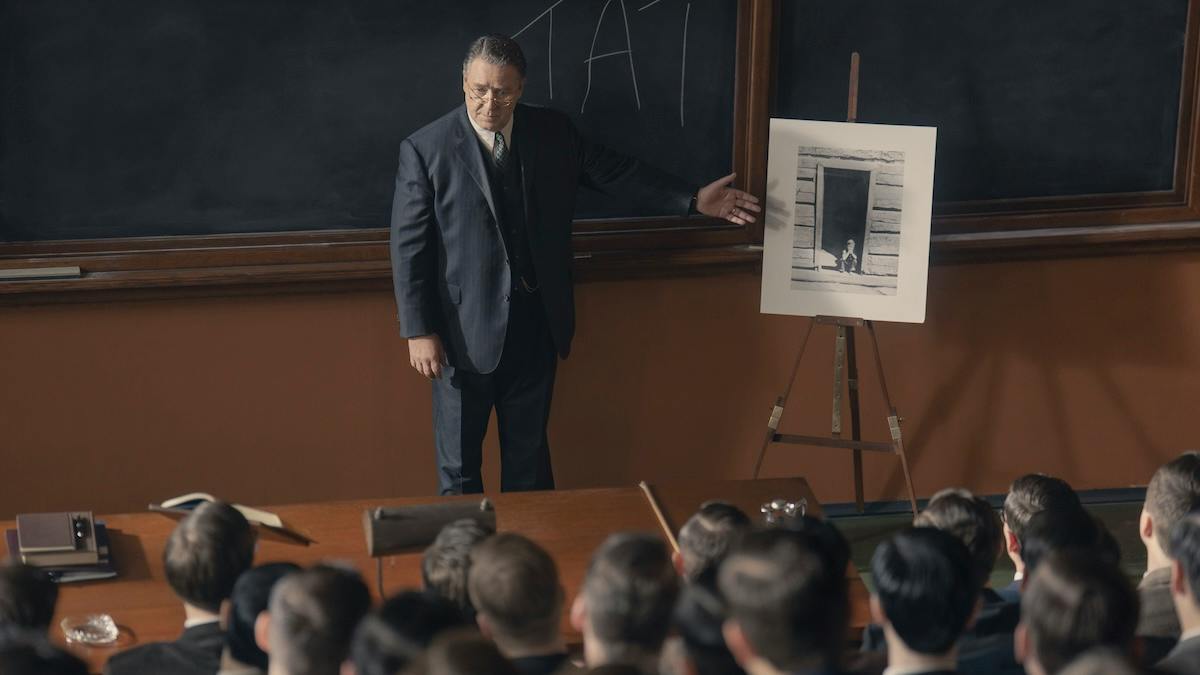
A new Netflix film about Ted Kaczynski has revived scrutiny of the years he spent as a teenage undergraduate at Harvard, where he fell under the influence of a psychology professor whose CIA-linked stress experiments and the era’s fashionable philosophical orthodoxies are drawing fresh attention, according to a Daily Wire essay on the film.
“Unabomber” — named for the FBI’s shorthand for “University and Airline Bomber” — toggles between the months before Kaczynski’s April 1996 arrest at a remote Montana cabin and his formative years at Harvard in the late 1950s. Kaczynski killed three people and injured more than 20 others with 16 homemade bombs over 17 years.
Shailene Woodley plays a fictional FBI task force member, but the movie’s dramatic center is the relationship between young “Teddy” Kaczynski (Jacob Tremblay) and Harvard psychology professor Henry A. Murray (Russell Crowe). Kaczynski, an academic prodigy from a working-class Polish immigrant family in Chicago, won a scholarship at 16 to study mathematics at Harvard.
The Murray experiments
Murray, a descendant of the fourth Earl of Dunmore who published “Explorations in Personality” in 1938, developed the Thematic Apperception Test with his collaborator and lover, Christiana Morgan. In the film, Murray invites undergraduates into what is presented as a study of personality development and belief formation. Students write detailed accounts of their deepest convictions, ostensibly for academic analysis.
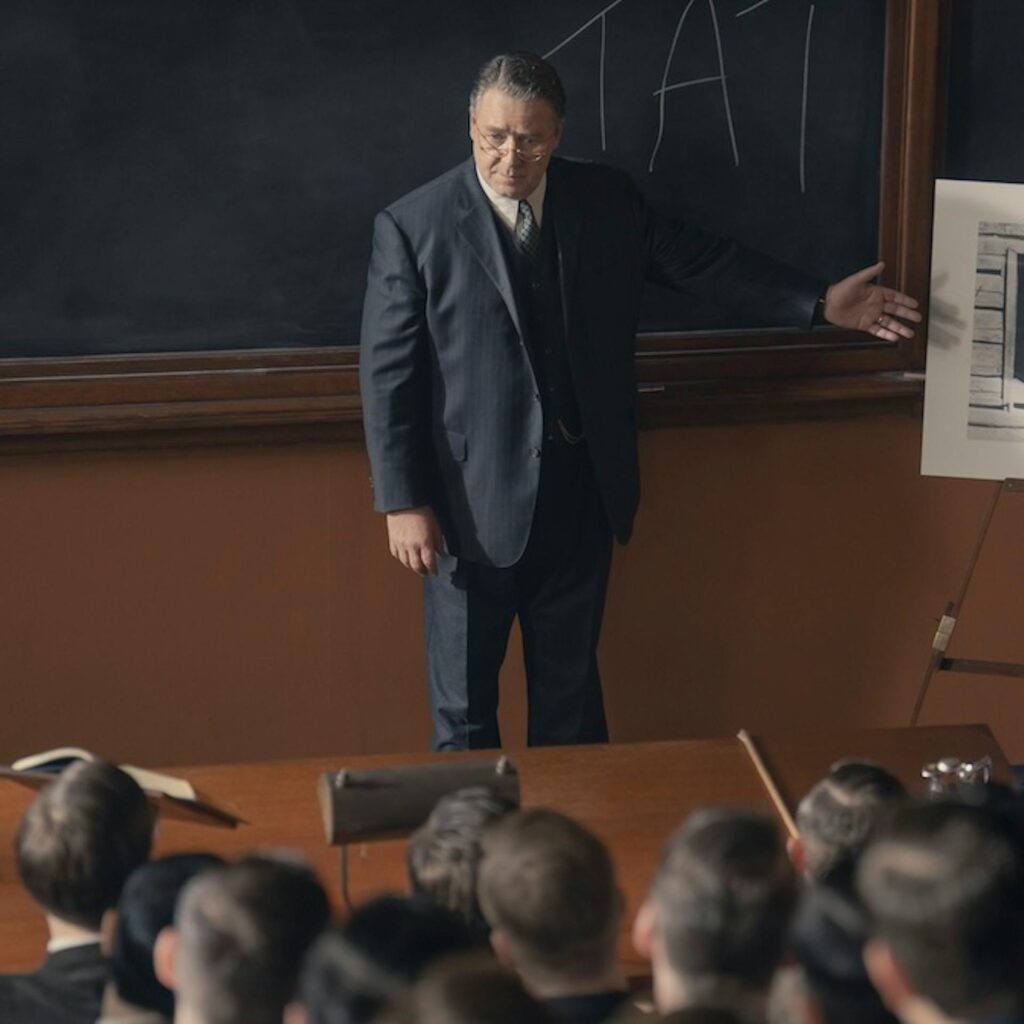
What they did not know, according to the account, was that their confessions would be used as ammunition in a program of sustained psychological stress. Murray’s team subjected participants to hostile interrogations, attacking their most cherished beliefs in what Murray himself described as “vehement, sweeping and personally abusive” confrontations. Their reactions were monitored, filmed, and replayed to them. The experiment is widely regarded today as deeply unethical. The codename Murray gave Kaczynski, the essay notes, was “Lawful.”
The study was devised in collaboration with the CIA, which sought to improve interrogation techniques during the Cold War and knew Murray from his World War II work with the Office of Strategic Services, the CIA’s precursor. The Henry A. Murray Research Archive still exists at Harvard.
Kaczynski later described the experiments as “a highly unpleasant experience.” The Daily Wire essay describes scenes of the young Kaczynski tied to a chair under bright lights, bullied and humiliated by an older student, as difficult to watch.
A darker record than the film shows
The essay argues that the full story, drawn from Alston Chase’s book “Harvard and the Unabomber: The Education of an American Terrorist,” is darker than the film suggests. Chase was a contemporary of Kaczynski at Harvard and later a philosophy professor. According to the essay, Murray and Morgan were addicted to amphetamines and LSD, with Murray’s longtime assistant describing them as being “on a weird combination of sedative and pepper-up pills.” Though married to other people, the two carried on a 40-year affair that included sadomasochistic sexual “experiments,” the essay says. Morgan drowned while on vacation with Murray in 1967, and at least one acquaintance held him responsible for her death.

The film also diverges from the family record on the question of consent. Netflix’s version shows Kaczynski’s parents balking at signing the consent form, with Teddy forging his mother’s signature. But David Kaczynski’s memoir, “Every Last Tie,” recounts that his mother willingly signed, writing that “Mom’s implicit faith in the university prevented her from asking questions.” David added that their mother knew Teddy “had adjustment issues and hoped these nice psychologists might help him.”
The essay asks how Harvard could allow reckless, drug-addicted academics so much power over impressionable students, and why Kaczynski’s mother placed such blind faith in the institution.
The philosophy angle
The essay also points to a second factor beyond the Murray experiments. Both Netflix’s “Unabomber” and the 2017 series “Manhunt: Unabomber” depict Kaczynski’s personality shift during the experiments as a sensational Jekyll-and-Hyde transformation. But Chase’s book argues that a subtler “permission structure” was absorbed at Harvard through logical positivism, a since-discredited philosophy then in vogue.
As an undergraduate, Kaczynski would almost certainly have encountered the central claim that meaningful statements must be either empirically verifiable or logically true by definition. Because moral statements like “killing is wrong” cannot be scientifically tested, positivists dismissed them as mere emotional preference. The worldview treated morality itself as an unscientific illusion, the essay says.

That exposure coincided with Harvard’s ambitious postwar General Education curriculum. Designed to foster responsible democratic citizens, the program exposed undergraduates to classic literary works on moral accountability, such as Dostoevsky’s novels. Yet the academic ethos elevated scientific empiricism and logical positivism as the supreme arbiters of truth. Students were left with a paradox: the humanities offered grand moral frameworks while the prevailing philosophy taught them to dismantle such frameworks as unscientific nonsense.
Logical positivism was eventually dismantled by critics. The claim that only empirically testable statements are meaningful is itself impossible to test empirically — by its own definition, the philosophy was meaningless. Christian thinkers including C.S. Lewis and Elizabeth Anscombe argued that rejecting objective moral truth destroyed the basis of human reason.
The essay concedes it is impossible to know how much Harvard’s philosophy curriculum contributed to Kaczynski’s later development, and that no serious observer would claim logical positivism turns students into terrorists. But ideas matter, it argues, especially when presented under the imposing authority of an institution that claims to educate future leaders responsibly.
The parallel with today’s universities, the essay concludes, is not that they are breeding future Unabombers. It is that they continue to promote fashionable and irresponsible moral assumptions while cloaking them in institutional legitimacy — with today’s reigning orthodoxy standing in for logical positivism.
Source: www.dailywire.com — https://www.dailywire.com/news/did-harvard-create-the-unabomber