
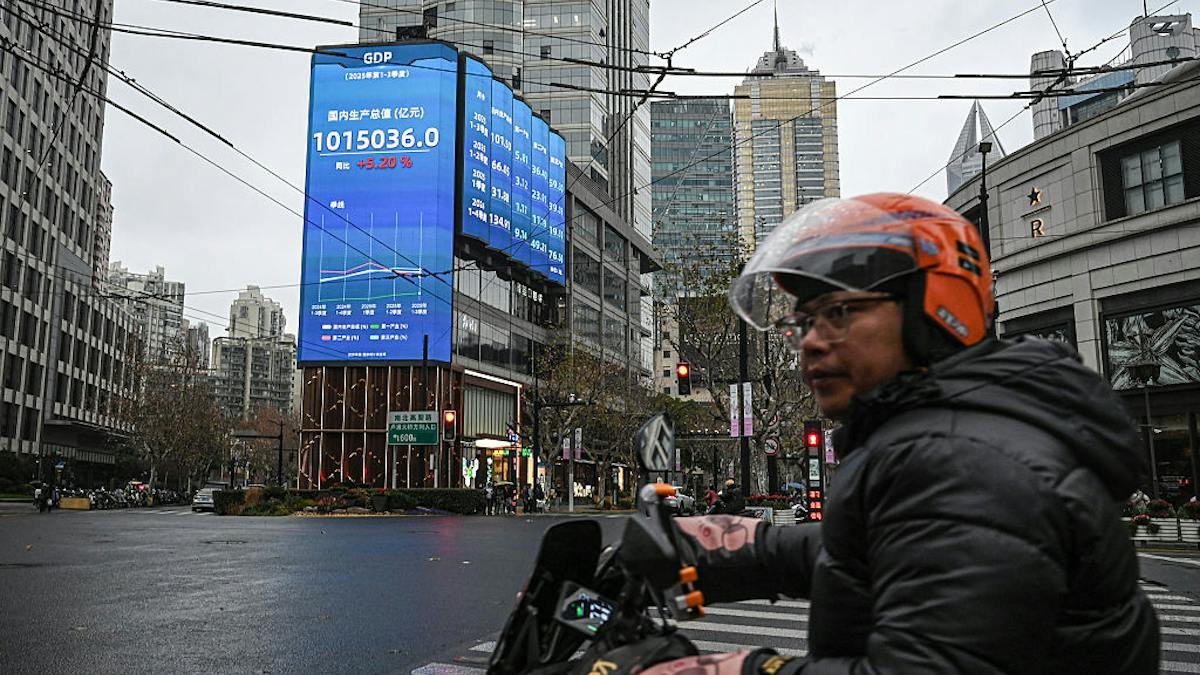
China’s economic advantage over the United States is narrowing fast, and the political bargain that has kept the Chinese Communist Party in power for decades is showing the strain. That is the argument made in a new Daily Wire column by Sam Brownback, the former U.S. ambassador at large for international religious freedom and co-chair of the International Religious Freedom Summit, who writes that China’s decline “has already begun.”
According to the figures cited in the column, China’s nominal gross domestic product stood at 70.2% of America’s in 2020. By 2025, that figure had dropped to 63.3%. Foreign direct investment tells a starker story: from a peak of $344 billion in 2021, it fell to roughly $19 billion by 2024 — a decline of more than 90%. Housing investment as a share of GDP fell by more than half between 2020 and 2025, and the International Monetary Fund estimates China’s housing inventory now equals roughly 30 months of sales.
“China is no longer a rising power,” Brownback writes, arguing that while Beijing’s military has expanded by some measures, the economic model underwriting its influence is in serious trouble.

The broken bargain
For decades, the unwritten deal between the CCP and the Chinese people rested on a simple promise: leave the Party in power, and living standards will keep improving. That arrangement held as long as the economy expanded rapidly — construction boomed, foreign investment flowed in, and government spending surged.
That era, according to the column, is over. China’s median age now stands at 40.6 years, a consequence of the one-child policy that Brownback describes as “diabolical and disastrous.” Official Chinese government data cited in the piece states that 336 million abortions were performed under the policy, while another 160,000 Chinese children — 90% of them girls — were placed for international adoption. In 2025, China’s population fell by 3.39 million, and nearly a quarter of the population is already 60 or older.
Urban youth unemployment reached nearly 19% in 2025. The export economy, per the column, is still functioning — but the challenge has shifted. The question is no longer whether China can produce goods, but whether it can generate enough domestic consumption and household demand to sustain growth.

Brownback invokes the phrase “Peak China,” attributed to Michael Beckley of Tufts University, to describe the moment.
Dissent and crackdowns
As economic pressure mounts, so does domestic unrest, according to the column. Freedom House’s China Dissent Monitor reports thousands of protests inside the country, driven by economic grievances — retirees demanding promised benefits, laborers striking over working conditions, and housing disputes spilling into the streets as developers fail.
Religious communities have absorbed some of the harshest treatment in this period, Brownback writes. He cites concentration and forced labor camps holding over a million Uyghur Muslims, the government’s assertion of authority to appoint the next Dalai Lama, and the continued detention of the Panchen Lama, taken as a child 31 years ago. He also points to documented torture and deaths among Falun Gong practitioners.

Chinese Christians feature prominently in the account. Catholics who refuse to align with the Communist Party — including ten bishops — are described as missing or in detention, while Protestant house churches that once operated with some tolerance now face what the column characterizes as dramatically increased harassment, imprisonment, and torture.
The case of Pastor Ezra Jin of Beijing’s Zion Church is offered as an illustration. According to the column, the government knew for years that his church operated outside official channels, but did not arrest him until October 2025, when, in Brownback’s telling, it became clear how rapidly China’s economy was falling behind. Jin was released in July 2026 following direct intervention by President Trump, though other members of the congregation remain imprisoned.
The diversionary-war risk
Brownback’s central warning is that decline does not make China less dangerous — it may make it more so. “Backed into a corner, declining powers with delusions of grandeur sometimes turn to diversionary wars,” he writes, describing a pattern in which states facing internal threats and rising dissatisfaction whip up nationalist sentiment through militarism to rally the public behind their leadership.
In China’s case, Taiwan has long served as that rallying cry, used to distract from a failing economy, harsh crackdowns, and high youth unemployment. Xi Jinping, meanwhile, continues to present China on the world stage as a true rival to the United States while, in Brownback’s assessment, trying to conceal the reality at home.
“A government that is losing its grip is a dangerous government,” Brownback concludes. “Xi’s rhetoric feeds his delusions, but it rests on a lie exposed by the desperate way his government is lashing out domestically and abroad.”
Source: www.dailywire.com — https://www.dailywire.com/news/why-xi-jinpings-spiraling-economy-signals-trouble-ahead