
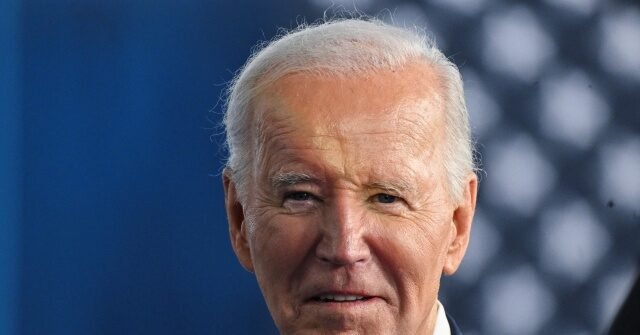
An executive order from former President Joe Biden that barred the federal Bureau of Prisons from contracting with private detention companies coincided with a rise in the cost to taxpayers of incarcerating noncitizens convicted of federal crimes, according to a Government Accountability Office report reviewed by Breitbart News.
Biden signed the directive just days after taking office in January 2021, reinstating an Obama-era policy to phase out BOP contracts with a small group of privately managed prisons that housed mostly foreign nationals convicted of federal offenses. At the time, the White House framed the move as part of its broader “racial equity” agenda.
What the GAO found
According to the GAO report, BOP’s spending on incarcerating noncitizens climbed 17 percent between fiscal year 2021 and fiscal year 2023 — from $935 million to $1.1 billion — even though the number of noncitizens held stayed roughly flat. Adjusted for inflation in fiscal year 2025 dollars, the GAO said, that works out to a 5 percent increase, $1.1 billion up from $1.15 billion.
The report noted a possible contributing factor to the higher costs: the period overlapped with the end of BOP’s contracts with privately operated criminal detention facilities, which the agency identified as its lowest-cost facility type. Those private facilities were used to house certain low-security individuals, including noncitizens, according to BOP records cited in the report.
The GAO was careful in its language, saying it identified a potential factor but did not review every possible cause or weigh their relative impact. Still, the report states that across those years, housing an individual in a privately operated facility cost between 22 percent and 35 percent less than housing that person in a BOP-run low-security facility.
When the January 2021 directive took effect, about half — 48 percent — of BOP-incarcerated noncitizens were held in BOP-operated low-security facilities by fiscal year 2023, the year the last private contract ended. That was a notable jump from before the executive order.
NICE says it warned of the outcome
Officials with the National Immigration Center for Enforcement (NICE) said they had flagged the consequences from the outset. In a post on X, the group pointed to prior warnings from Mark Morgan, who they said had cautioned that $250-per-day beds and side arrangements with states would “burn money” and squander the best opportunity in decades to build out real detention capacity.
“Nobody listened. GAO just put it in writing,” NICE executives wrote.
NICE President RJ Hauman told Breitbart News the findings should push the Department of Homeland Security toward investing billions in permanent detention space rather than what he described as temporary stunts, such as tents in Florida’s Everglades and facilities at Guantanamo Bay.
Hauman said traditional custodial detention runs a median of $92 a day and argued that GAO found Immigration and Customs Enforcement never weighed its experimental alternatives against that baseline. “Mass deportation doesn’t happen without permanent beds at scale, and that money runs out in 2029,” he said. “DHS can still get this right, but not if it spends another year relearning what every career official already knew.”
The broader policy fight
The report lands in the middle of a long-running dispute over how the federal government detains people in its custody, both in the criminal justice system and in immigration enforcement. Private facilities have become a flashpoint, with supporters saying they hold down costs and critics raising concerns about oversight and conditions. The GAO’s finding that private beds ran cheaper than BOP-run low-security beds adds a fiscal data point to a debate that has often centered on policy and ethics.
For now, the numbers in the report are narrow: a specific two-year cost comparison for a specific population. But they give ammunition to those who argued the 2021 directive would carry a price tag, and they set up a fresh question for DHS and its oversight committees about where the next detention dollars go. Whether the agency follows Hauman’s advice — and how quickly — is likely to be contested in the coming budget cycle.
Source: www.breitbart.com — https://www.breitbart.com/politics/2026/10/01/federal-watchdog-bidens-banning-private-detention-of-migrants-spiked-costs-for-taxpayers/