
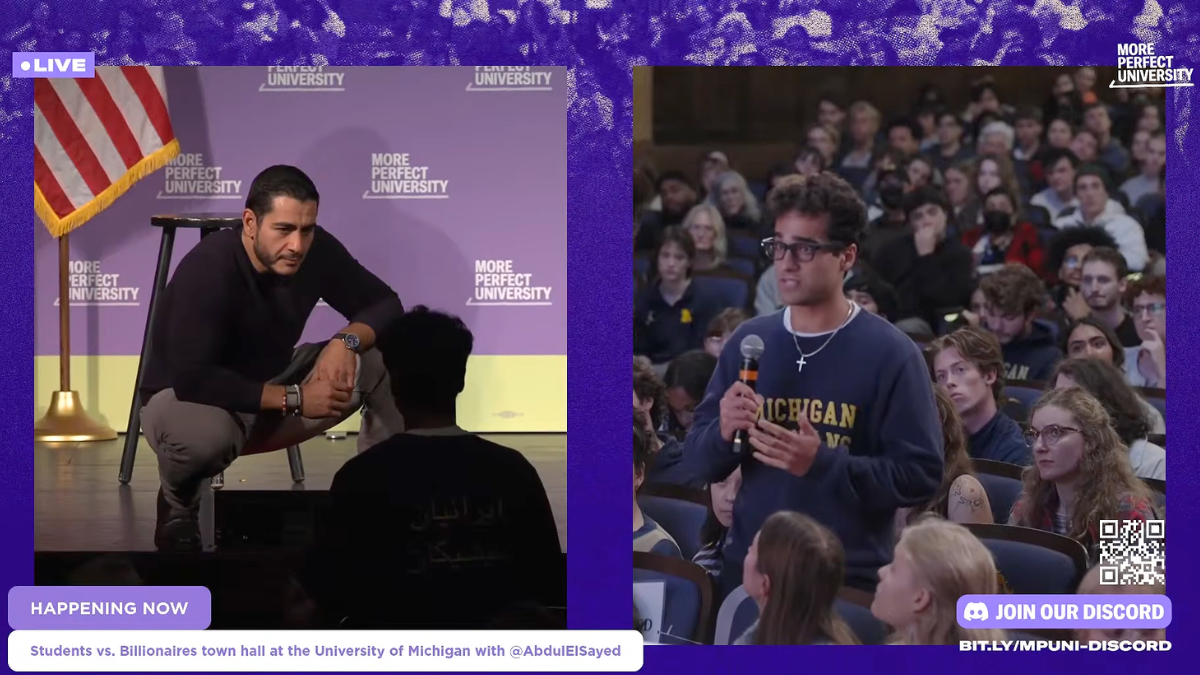
A Persian-American student confronted Michigan Senate candidate Abdul El-Sayed at a campus town hall, pressing him to condemn the Islamic Republic of Iran and its leadership — and walked away unsatisfied. The student recounted the exchange in a first-person account published by The Federalist, describing how El-Sayed declined to name Khamenei or the Islamic Revolutionary Guard Corps even when asked directly.
The account centers on three questions the student posed to El-Sayed after sharing the story of family members who suffered under the regime: whether he disavows his silence on the death of Supreme Leader Ali Khamenei, whether he rejects domestic supporters of Khamenei, and whether he stands against the IRGC and with the Iranian people.
Leaked Audio Set Off Months of Frustration
The student wrote that frustration had been building for months over El-Sayed’s handling of questions about Iran. That frustration intensified after joint U.S.-Israeli strikes killed Khamenei — a development the student said was followed by a leaked audio recording in which El-Sayed admitted he didn’t “want to comment on Khamenei at all” because “there are a lot of people in Dearborn who are sad.”
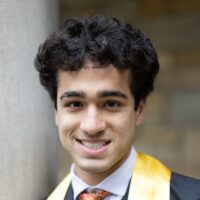
For the student, whose parents were born in Iran, the regime is not an abstraction. The student described a cousin chased through Iranian streets by the so-called Morality Police over her hijab, and an uncle lashed 50 times for peacefully protesting — who later fled the country rather than face execution.
“For 92 million Iranians, these issues are not abstract talking points,” the student wrote in The Federalist. “They are a part of the daily, recurring nightmare that is living under the Islamic regime.”
The Exchange Inside the Town Hall
After an introductory speech and pre-scripted questions, the student got the microphone as El-Sayed knelt to the student’s level in the second row. The student opened with the family history, then moved to El-Sayed’s silence on Khamenei’s death, and then asked the three questions.
El-Sayed’s answer, as quoted in the account, began with a broad critique of American foreign policy: “For too long and too often, when we think about our role in the world, we have turned ourselves into the world’s policeman.” He went on to express disagreement with the Iran war and said that “while I stand with freedom and democratic movements, I also worry that once you start putting our resources toward regime change in foreign countries, more often than not, the regimes that we seek to change are the ones in which there is a natural resource interest, and it becomes a ploy for the interests of our corporations.”
The student pressed him again. According to the account, El-Sayed spoke for several more minutes but never said he stood with the people of Iran, never disavowed his earlier silence, and never uttered the words “IRGC” or “Khamenei.” He referenced “movements for freedom and democracy” in general terms and argued the U.S. should not pursue regime change abroad. When challenged a final time, he said he wanted Iranians to be free but did not address the specific questions, the student wrote.
At one point mid-question, El-Sayed extended his hand toward the microphone the student was holding — stopping about six inches from the student’s face — before pulling it back, adjusting his sleeve, and settling into a neutral posture. The student described the moment with exasperation: “Is he really asking me for the mic back right now?”
A Wider Debate About Iran Policy
The episode reflects a broader tension in Democratic politics over how candidates should talk about Iran, particularly after U.S. military action there. El-Sayed, a former Michigan gubernatorial candidate and public health official, has drawn support from anti-war constituencies, and his reluctance to personalize criticism of Khamenei appears aimed at not alienating parts of his base in Dearborn, home to one of the largest Arab American communities in the country.
His critics argue that refusing to name the IRGC or Khamenei — even as a rhetorical matter — amounts to a moral dodge. His defenders counter that calling out a foreign government’s leaders by name does little for Iranians and risks deepening U.S. military entanglement in the region. The student acknowledged a degree of sympathy for that anti-war position but drew a distinction between opposing war and refusing to condemn a regime by name.
“I didn’t ask El-Sayed about the war. I didn’t ask him about our role in Iran’s future,” the student wrote. “I asked him to call out the evil of an Islamic terror state by its name.”
The student also addressed speculation about the question’s origins — theories that the student was a “Zionist plant” or was placed by El-Sayed’s opponent, Mike Rogers, with a script. “The reality is much less interesting,” the student wrote. “The truth is, I’m just a student with a family that has been through more than I can even begin to imagine.”
What Comes Next
El-Sayed’s campaign has not made the exchange a focal point of its public messaging, and the candidate’s remarks at the event, as described, stayed within his existing foreign policy frame rather than addressing the specific questions. The Michigan Senate race is among the most closely watched in the country, and Iran policy could surface again as a flashpoint on the campaign trail — particularly in a state with deep Middle Eastern and Iranian diaspora ties.
For the student, the confrontation was never about scoring a political point. It was about whether a candidate for U.S. Senate would say plainly what the Islamic Republic is, and what it has done to families like the student’s. On that, the answer, as the student told it, was no.
Source: thefederalist.com — https://thefederalist.com/2026/10/02/abdul-el-sayed-refused-to-condemn-the-islamic-terror-regime-that-persecuted-my-family-members/
Source: thefederalist.com
Related coverage
- Wisconsin Dad Trips 9-Year-Old Player During Touchdown Run, Police Say
- Jobs Report Shows Women Took 98% of New Jobs — and a Federalist Writer Says That’s a Crisis for Both Sexes
- Altman and Amodei Head to UN Security Council as Trump Blasts AI ‘Doomers’
- 20 Chabad Rabbis Chosen From 37 Applicants for Five-Day Firearms Training Camp in Los Angeles