
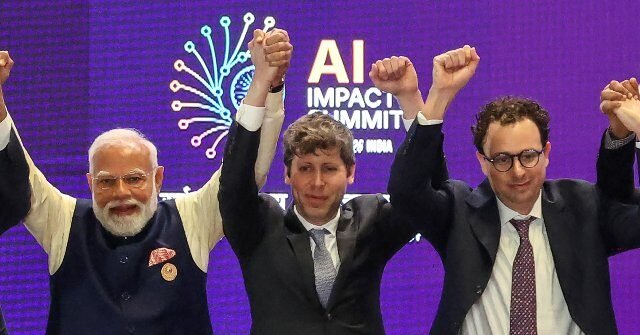
Two of the most prominent figures in American artificial intelligence will appear before the United Nations Security Council on Wednesday, as the global body turns its attention to the risks and governance of advanced AI systems. Anthropic CEO Dario Amodei is scheduled to brief the council remotely, while OpenAI CEO Sam Altman will attend in person, according to Bloomberg’s reporting on the meeting’s program and a company spokesperson who confirmed Altman’s appearance to Reuters.
The session marks an unusual convergence of industry leaders, academic voices, and — for the first time in this setting — a leading Chinese AI developer, all gathered under one diplomatic roof to discuss a technology that has become a central front in U.S.-China competition.
A Broader Guest List
Altman and Amodei will be joined by Yoshua Bengio, the co-chair of the UN’s panel on artificial intelligence, and Hugging Face CEO Clement Delangue. The council is also expected to hear from DeepSeek, the Hangzhou-based developer whose low-cost R1 reasoning model sent shockwaves through U.S. technology stocks in January 2025. Reuters reported that invitations went out to DeepSeek and other Chinese AI companies, including Moonshot, though DeepSeek founder Liang Wenfeng is not expected to attend in person. One source cautioned that the lineup could still shift at the last minute.
If it proceeds as planned, the appearance would be the first time one of China’s best-known AI developers has joined American research labs in the same UN discussion on the technology — a notable diplomatic first, even if the format is a briefing rather than a negotiation.
Amodei’s Slowdown Call
Amodei’s participation carries particular weight given his recent public posture. This month he called on companies to slow the pace of frontier model development, an appeal that drew support from Altman and Tesla’s Elon Musk while running into opposition from Meta’s Mark Zuckerberg and Nvidia’s Jensen Huang. The split reflects a broader and increasingly public argument inside the industry over whether the most powerful AI systems should be developed more cautiously — and who gets to decide.
The debate has not stayed confined to boardrooms. President Trump responded forcefully to the slowdown camp in a Truth Social post, writing that the only control or “guardrails” AI needs is a strong and smart president. He accused Amodei of “pretending to be a ‘perfect little angel'” and cited the administration’s regulatory and criminal enforcement powers over AI companies. He also pointed to the geopolitical stakes, arguing that a “sick conspiracy” against AI and data centers ultimately benefits China. “WHOEVER WINS AI, WINS!” Trump wrote, adding that the U.S. is leading China and others and will continue to do so. He closed by warning “Conspiracy Theorists, Treasonists, Traitors, and Leakers” to beware.
The president’s remarks underline how thoroughly AI policy has been absorbed into the broader political and national-security conversation. What might once have been a technical dispute over training runs and compute thresholds is now, in Washington and at Turtle Bay, a question of who sets the rules for the century’s defining technology.
Skepticism From the Right
Not everyone views the industry’s newfound enthusiasm for international regulation as altruistic. Breitbart noted that AI leaders frequently release powerful models while simultaneously calling for rules on the sector, and pointed to investor David Sacks’ argument that when figures like Amodei, Altman, and Musk call for a slowdown, they are motivated less by caution than by a desire to entrench their own positions and exempt themselves from antitrust scrutiny. Trump, according to the outlet’s framing, recognizes that dynamic.
The UN briefing also arrives amid ongoing scrutiny of DeepSeek’s role in the global AI race. Its R1 model, released at a fraction of the cost of comparable U.S. systems, prompted questions in Washington about export controls, compute access, and the durability of America’s lead in the field. Having DeepSeek at the table — even remotely, and even for a single session — gives the Chinese firm a platform it has not previously had at the UN.
What Comes Next
Security Council briefings of this kind rarely produce binding outcomes, but they can shape the terms of debate. Wednesday’s session will put the arguments of the slowdown camp, the accelerationists, and the Chinese developers in the same room at a moment when the Trump administration has made clear it intends to treat AI leadership as a matter of national power rather than a problem to be managed by international consensus.
For Amodei, the appearance caps a month in which he has staked out a public position at odds with the White House’s instincts. For Altman, it is another turn on the world stage. And for the council itself, it is a test of whether the UN can find a meaningful role in a technological competition that its most powerful members increasingly prefer to fight on their own terms.
Source: www.breitbart.com — https://www.breitbart.com/tech/2026/09/22/ai-doomers-unite-anthropics-dario-amodei-and-openais-sam-altman-to-address-un-security-council/