
Some of America’s loudest moral debates never make it to a protest sign. They hide inside paperwork instead.
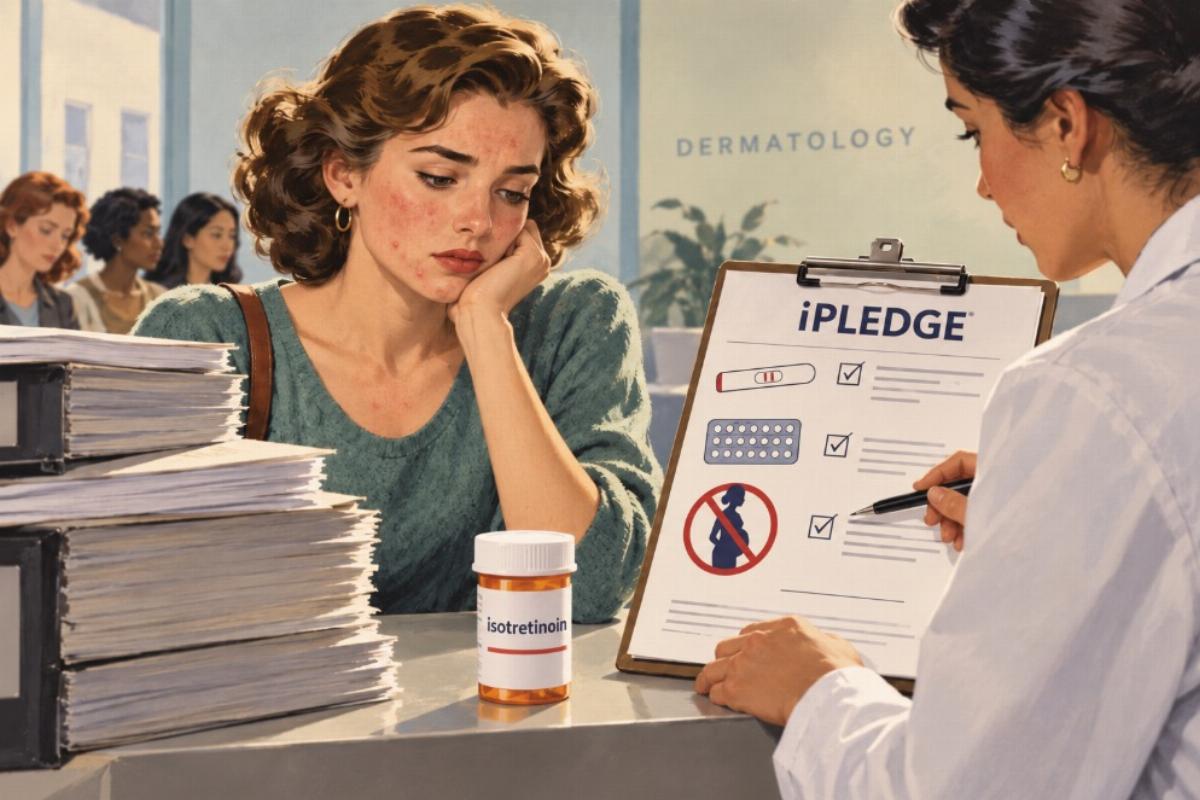
That is the argument Christian Vezilj makes in a commentary published by American Thinker, which points to an unlikely case study: iPLEDGE, the federal program that governs how patients can receive isotretinoin, the powerful acne medication once sold under the brand name Accutane.
Isotretinoin is effective — dermatologists prescribe it routinely because it can transform the lives of people with severe acne, Vezilj writes. It also carries a well-known risk of serious birth defects. In response, the U.S. government built iPLEDGE, a compulsory registry that every patient, prescriber, and pharmacy must join before the drug can legally change hands.
A Registry With Teeth
For women who can become pregnant, the rules are anything but gentle. According to the commentary, two negative pregnancy tests are required before the first pill. A negative test must follow every month. Patients must use two forms of contraception, with continuous abstinence offered as the only opt-out. And the system has teeth: a pharmacy cannot dispense the medication unless the federal database confirms compliance. Miss a test or skip a step, and the system locks the patient out until she satisfies the government’s reproductive requirements.

That enforcement holds even in cases where pregnancy is not on the table — when a woman is not pregnant, has no plans to become pregnant, or says outright that she would terminate any pregnancy that occurred. The federal machinery still intervenes, in Vezilj’s framing, to protect a potential fetus, even a hypothetical one.
The commentary notes that as of November 15, the FDA revised the requirements to make them somewhat easier to navigate, though the broad architecture is unchanged: the government still works to keep women on isotretinoin from becoming pregnant.
The Contradiction the Author Sees
For Vezilj, that is where the tension becomes impossible to wave away. The same culture that insists medical decisions belong between a patient and her doctor, and that the government has no business in reproductive choices, quietly accepts a federal registry that tracks monthly pregnancy status and contraception use. Nobody marches over iPLEDGE. Nobody calls it an intrusion.
He distills the inconsistency into a syllogism: the government treats causing a birth defect as a moral wrong that must be prevented, while treating the termination of the same fetus as morally fine and beyond government interference. If the fetus carries no moral weight, then preventing birth defects is a pointless exercise. If it does carry moral weight, then abortion cannot be a morally neutral act. Yet both positions coexist in public life without friction.
The explanation, as the commentary frames it, is not philosophical sophistication but convenience. When government involvement delivers something a person wants — access to a medication, in this case — the intrusion is tolerated without a second thought. When pregnancy enters the picture, the same person reaches for a different slogan because that position now serves her interests. Convictions, in this reading, are often less a fixed compass than a weather vane.
Vezilj reaches for scripture to make the point, citing Isaiah 7:9 — “If you do not stand firm in your faith, you will not stand at all” — alongside the familiar adage that a person who stands for nothing will believe anything.
He is careful about what the program does and does not prove. iPLEDGE, he concedes, settles no legal question and resolves no moral dispute. It does not tell anyone what the law should be. What it does, in his telling, is expose something about the country: that beneath the shouting of campaigns and slogans, Americans live with quiet contradictions every day, and those contradictions may describe us more accurately than the debates do.
Where the Argument Lands
Readers on either side of the abortion divide will find something to dispute in the piece. Supporters of abortion rights would likely reject the premise that opposing birth defects and supporting abortion access are logically incompatible — they can argue that a born child with a preventable disability and a pregnancy are different moral categories, or that harm reduction after conception does not imply fetal personhood. Backers of the pro-life position may find the article’s central observation more persuasive than its conclusion, since it declines to prescribe policy and simply asks why one form of government reproductive supervision provokes outrage while the other passes unnoticed.
What is harder to dispute is the mechanical reality the commentary describes. Isotretinoin remains one of the most tightly controlled outpatient medications in the country, and its distribution depends on a federal database that can stop a prescription in its tracks. The program is not a thought experiment. It is routine clinical practice for millions of patients — teenagers, young adults, and women of all reproductive intentions — who navigate its checkpoints each year without ever treating it as a political event.
That is precisely the point Vezilj wants to press. The most revealing moral statements a society makes may not be the ones it argues about. They may be the ones it enforces automatically, through forms, tests, and database flags, while everyone involved is thinking only about clearer skin.
Source: www.americanthinker.com — https://www.americanthinker.com/blog/2026/10/what-the-ipledge-program-reveals-about-us/