
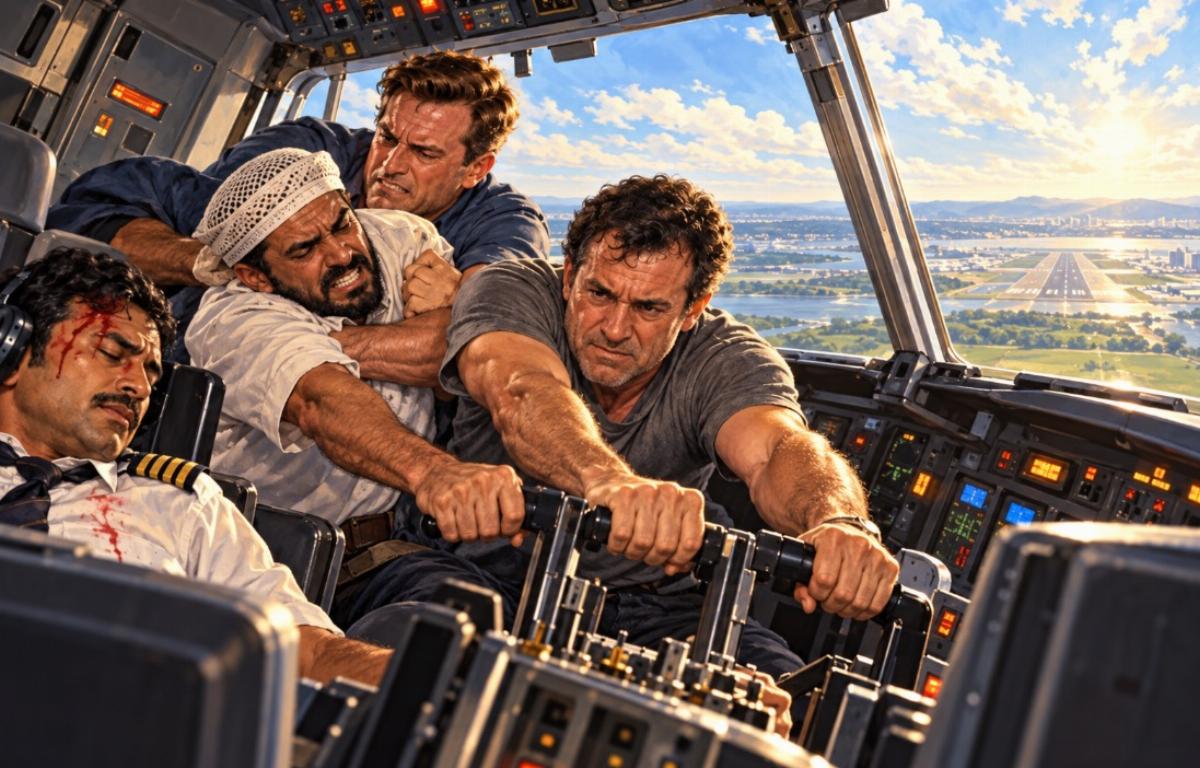
The co-pilot of Flydubai flight FZ1073 has admitted to interrogators that he planned to crash the aircraft into Ben Gurion Airport, according to reporting by American Thinker — a disclosure that recasts what was initially described in vague terms as a midair “altercation” as an intended mass-casualty attack.
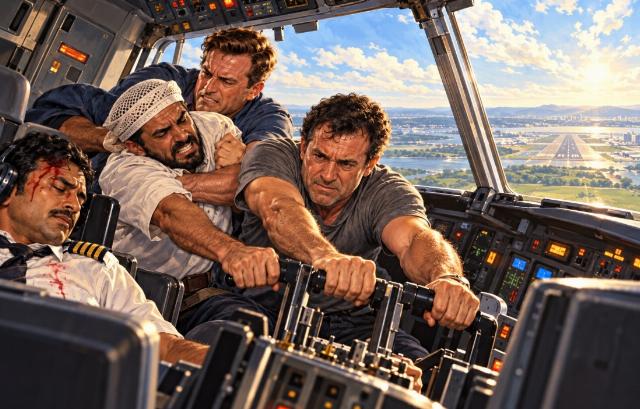
In an October 4 commentary, Andrea Widburg writes that new intelligence shows the Omani co-pilot intended to kill the flight’s captain, Smit Machchhar, quickly enough that the struggle would go unnoticed, then fly a normal approach into Israel and, in the final seconds — when interception would no longer be possible — drive the plane into the terminal.
That plan, per the account, is why the attack came only while the aircraft was over Jordan, close to Israel. It was foiled, Widburg argues, by Machchhar’s decision to force open the cockpit door despite serious wounds.
A narrow escape, and what it might have been
The piece leans on a passenger’s firsthand account and on an estimate of the potential toll. Asaf Rejuwan, an Israeli survivor of flight 1073, wrote on Facebook that he was among a group of passengers interviewed by an international broadcaster and that the process of comparing experiences revealed something he had not appreciated in the moment: every passenger on board had a role.
He described travelers who took on distinct tasks — one who handled communication with Israel’s security services and another who provided a mobile hotspot so others could stay connected; a woman who sat and recited Psalms; a passenger who passed headphone cords down the cabin to bind the attacker; passengers using GPS maps to track where the plane would land. An Australian passenger, Rejuwan recalled, was the only person aboard able to place calls back to Israel from Saudi Arabia.
Rejuwan also thanked the passengers who cooperated physically, naming several by first name, along with the cabin crew, and said the experience made him want to attend synagogue the following morning to recite Birkat HaGomel, the prayer of gratitude recited after surviving a life-threatening ordeal. He said he is not religious, but that the Torah reading that day — Deuteronomy 33:26, which speaks of God riding the heavens to help — left him and other worshippers covered in goosebumps. He closed by thanking God for the miracle and for the chance to tell the story.
Counting the potential dead
Widburg frames the escape as a sequence of improbabilities: the wounded captain’s strength in opening the door, and everything that followed from that act. She also considered the scale of what could have happened had the plot succeeded. Rather than cite an official figure, she asked ChatGPT to estimate how many people might have been at Ben Gurion at the time, based on the 90,000 to 100,000 passengers who move through the airport daily during busy periods and a rough estimate of 5,000 to 7,000 employees. The model’s answer, per the piece: 15,000 to 20,000 people could have been in the path of the aircraft.
That number is an estimate, not a confirmed accounting — the writer is explicit about that, and it should be read as a rough figure rather than a casualty assessment. The broader claim, however, is more significant than the arithmetic: that the intended target was not a symbolic strike or an in-flight disaster over the sea, but a crowded terminal taken at the last possible moment.
“Naturally, the obvious suspects were bewildered,” Widburg writes, recounting early characterizations of an “altercation” and a “fight,” with the co-pilot’s motives described as mysterious and possibly unknowable. Against that, she sets the interrogation account, which she says answers the question of what the co-pilot wanted to accomplish.
She argues for recognition of both Machchhar and Hayoun, and calls for them to receive the highest civilian honors Israel offers.
Why the framing matters
The dispute the piece engages is not really about the mechanics of the flight, which are difficult to contest when a cockpit struggle, a cockpit door, and a safe landing are all on the record. It is about language. In the days after such an event, official accounts tend to be spare, and spare becomes vague, and vague becomes a kind of neutrality that treats intent as unknown until someone says otherwise.
Once the co-pilot’s own account is on the table — as reported here — that neutrality becomes harder to defend. A person who plans to time a crash into a terminal for the seconds when interception is impossible is not an unstable employee having a bad day. The deliberation is the point: the attack over Jordan, the normal approach, the final-second turn. Each of those choices exists to defeat the defenses that a timely warning would bring into play.
The passenger testimony adds a layer that casualty estimates cannot. Rejuwan’s list is a reminder that the margin between a safe landing and a catastrophic one frequently comes down to small decisions made by ordinary people under pressure — a hotspot shared, a cord handed down the aisle, a row of parents staying between their children and a stranger, a woman reciting Psalms while the cockpit door was being forced open. None of that appears in aviation incident reports. None of it appears in the de-escalating language that surrounds events like this in their first week.
For Israeli readers, there is a further domestic sting. The flight was a short regional hop from Dubai, on an Emirati carrier, crewed by men from India and Oman, carrying travelers whose presence on that aircraft was unremarkable. Whatever security architecture exists around a flight like that was defeated at the point of the cockpit door, not by external intelligence. The value of this reporting, if accurate, is that it closes a gap — between what happened and what the public is told happened — at a moment when that gap tends to be filled by speculation, including the speculation that nothing much was attempted at all.
American Thinker’s account is one outlet’s rendering of sensitive interrogation material, and the specific planning details have not been independently confirmed in the piece’s own text. Still, the direction of the claim is unambiguous: what the co-pilot intended was a mass-casualty attack on Israeli soil, timed for the last possible second. The fact that thousands of people are alive to read the debate about what to call it is the only reason the argument over the word “terrorism” is being conducted in a comment section rather than in a hospital list.
The passengers who lived through it, on Rejuwan’s telling, came away less interested in the vocabulary than in the accounting. He recited a prayer of thanks for life, for the miracle, and for the privilege of being able to tell the story. That, at minimum, is what happened.
Source: www.americanthinker.com — https://www.americanthinker.com/blog/2026/10/of-course-the-flydubai-event-was-terrorism/
Source: www.americanthinker.com
Related coverage
- ‘Uncle Bernie’ and the woman who would be president
- After Lake America rename, pundit demands Canada drop canal tolls
- California’s New 3D Printer Law Is a ‘Prior Restraint’ on Every Vase, Figurine, and Tool Handle, American Thinker Argues
- Poland’s Constitutional Crisis: How a Judicial Power Grab Mirrors Global Pattern of Court Manipulation