
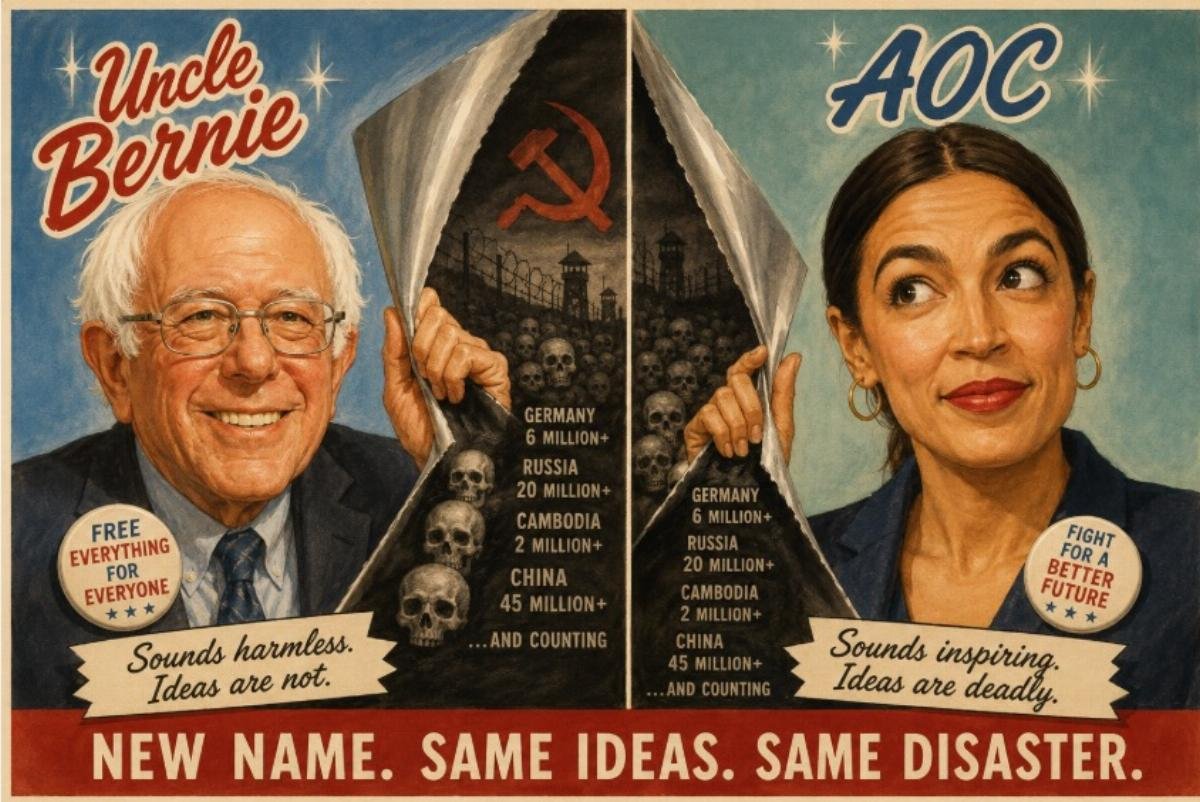
In a sharply worded opinion piece published Wednesday on American Thinker, columnist James Mullin draws a provocative historical parallel, urging conservatives to abandon the familiar nicknames “Bernie” and “AOC” in favor of the more formal “Sanders” and “Ocasio-Cortez.” His argument: language itself is a weapon in the political wars, and the left has wielded it with devastating effectiveness.
Mullin opens by invoking the 1930s moniker “Uncle Joe” for Soviet dictator Josef Stalin—a figure he calls “perhaps the greatest mass murderer in world history.” He notes that this intentionally slick nickname emerged precisely as the Gulags were being built and millions of Ukrainians were being starved, with Western sympathizers like Walter Duranty sending favorable reports to the New York Times and the Abraham Lincoln Brigades preparing to fight for communism in Spain. The lesson, as Mullin frames it, is that a warm, familiar nickname can launder the reputation of even the most brutal political figure.
The branding of ‘Bernie’
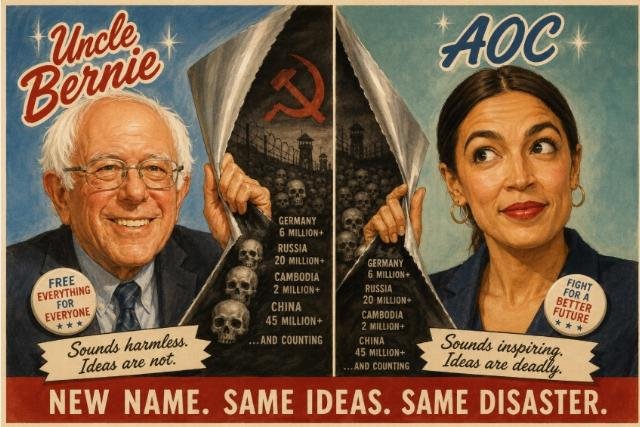
Mullin applies this lens to the current Democratic field, particularly Sen. Bernie Sanders of Vermont. He argues that the name “Bernie” conjures up “a folksy kibitzer whom one can’t help but smile at,” instead of what he describes as the first wave of a national movement now morphing into what he calls “the exceedingly creepy likes of Hasan Piker, Zohran Mamdani, and El-Sayed.” The columnist contends that this branding obscures a radical political project that, in his view, threatens the economic security of middle-class families.
The piece explicitly compares the use of “Bernie” to the historical “Uncle Joe” tactic, suggesting that both were crafted by political operatives to soften the public image of ideologues whose policies would prove harmful. Mullin is unambiguous in his recommendation: “Let us at least call this Trojan Horse ‘Sanders,’ just as Uncle Joe came to be called simply Stalin once we came to realize—rather late—the ruthless murderer he was.”
The ‘AOC’ brand
Rep. Alexandria Ocasio-Cortez of New York receives similar treatment. Mullin argues that the nickname “AOC” is a deliberate marketing invention, designed to recall the initials of iconic American leaders like JFK, RFK, and FDR—and to help her sell herself as “the new Evita, a star.” He asserts that this branding was “all planned by very slick leftist marketers.”
The columnist disputes the congresswoman’s personal narrative, writing that she “would have us believe she came up from the depths of poverty. She did not. Not even close.” He goes further, alleging that her agenda would send middle-class families into poverty even as she presents herself as their champion. For Mullin, the remedy is simple and pointed: call her “Ocasio-Cortez,” a name he says is “more fitting with the beret-and-ammunition-belt motif of her communist guerrilla reality.”
Why names matter in political discourse
At its core, the column is an argument about the power of naming in politics. Mullin points to other examples of language manipulation on the left, including the phrases “mostly peaceful protests” and “women’s health clinics,” as instances where comfortable phrasing has been used to sanitize or reframe contentious realities. He even draws a dark comparison to the Nazi slogan “Arbeit Macht Frei,” noting that its author was a National Socialist—a rhetorical flourish intended to underscore his conviction that language can be used to disguise cruelty.
The author’s plea is directed squarely at conservative media, podcasters, and everyday conversationalists. He frames the rejection of these nicknames as an act of political resistance, writing, “There is nothing ‘folksy and affable’ or ‘hip’ about a person who is helping to forge the chains that our children and grandchildren will wear.”
A call to action for conservatives
Mullin acknowledges that the proposal may seem like a small thing, but he insists it is not. He closes with a broader appeal about the importance of free speech and clear thinking, writing, “Now more than ever, the ability to speak our minds is crucial to the republic we cherish.”
The piece is unquestionably opinionated—a feature, not a bug, of the American Thinker’s opinion section. Whether readers agree with Mullin’s historical comparisons or his characterization of the politicians in question, the column raises a legitimate question about how nicknames shape public perception. The use of “Bernie” and “AOC” in everyday conversation may feel automatic, but as Mullin makes clear, those labels were not accidents. They were choices—and he is arguing that conservatives should make different ones.
Source: www.americanthinker.com — https://www.americanthinker.com/blog/2026/08/uncle-bernie-and-the-woman-who-would-be-president/