
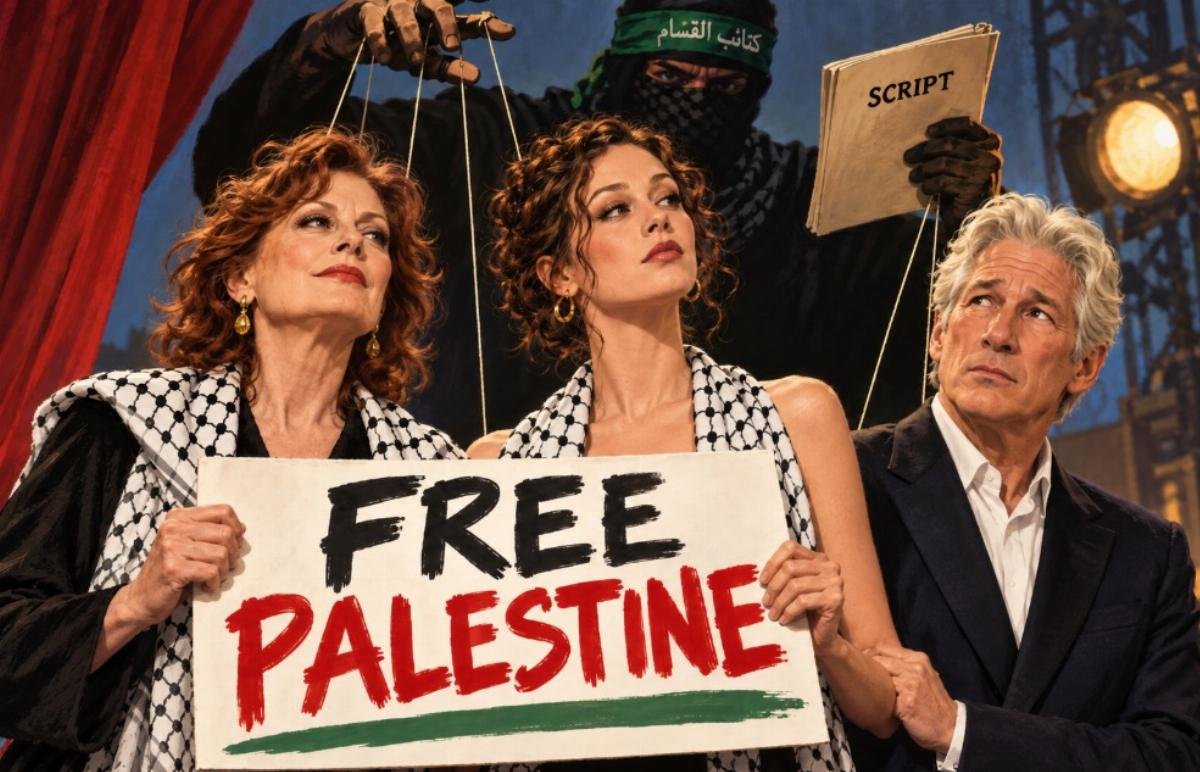
The celebrity activist and the geopolitical argument have always made for a combustible pairing, and a new essay in American Thinker wants to test just how combustible. Writing under the pen name Civis Americanus in an October 5, 2026, piece, the contributor argues that the Israel-Hamas debate is being fought on the wrong linguistic terrain — and that the well-meaning famous people who wander into it end up shilling for terrorists rather than for peace.
The piece opens with a claim about power: whoever names the thing controls the argument. From there, the author accuses Hamas and its sympathizers of having mastered the inversion, calling Israel genocidal when, in the author’s rendering, that label better fits Hamas’ own record. The essay extends the charge to Turkey’s Recep Erdogan, citing the Ottoman-era treatment of Pontic Greeks and Armenians between 1915 and 1922 — crimes, the author notes, that Erdogan’s government still refuses to recognize — as well as the historical treatment of Kurds.
That weaponization of language, the author says, should be turned back on the people cheering for the other side.
Naming Names — and Renaming Them
The central device of the article is a set of nicknames. Susan Sarandon becomes “Sinwar Suzy,” a play on Axis Sally, the wartime propagandist Mildred Gillars who was convicted of treason for broadcasting for Nazi Germany. Hannah Einbinder becomes “Hamas Hannah.” Richard Gere, similarly, gets a “Gaza” prefix. The author credits a different nickname — “Susan Saranwrap” — to talk radio host Michael Savage and says his own version works better.
The nicknames might read as schoolyard stuff, but the essay is making a legal and moral point underneath them. Because the United States is not in a declared state of war with Hamas, the author acknowledges, the Americans who amplify the group’s message cannot be charged with treason — not even though Hamas killed 43 American citizens on October 7, 2023. So the correct term, in the author’s framing, is not traitor but dupe: stooge, useful idiot, water-carrier.

Crucially, the author insists that intent is beside the point. Someone could have opposed Lend-Lease or distributed anti-British propaganda before Germany declared war on the United States without ever expressing support for Hitler, the essay argues — and that person would still have been a useful idiot for Hitler. The same logic, the author says, applies to calls to stop arms shipments to Israel, to claims that Israel commits genocide or intentionally targets civilians, and to the slogan “Free Palestine,” regardless of whether the people making those calls actually support Hamas.
The Arrests and the Org Behind Them
The article grounds its argument in a recent event: Sarandon and Einbinder were arrested during a Jewish Voice for Peace protest against Benjamin Netanyahu. The author is careful here, noting that the two were not detained merely for demonstrating — protesters blocked an intersection and failed to comply with police orders to disperse. The New York Post, the piece relays, reported that Einbinder had been marched away from the Jewish Voice for Peace demonstration, where banners read “Stop Arming Israel” and “End the Genocide.” The author calls that second banner a blood libel and notes that Einbinder publicly associated herself with it.
The essay also takes aim at Jewish Voice for Peace itself — not only for organizing what the author characterizes as unlawful civil disobedience, but for doing so while enjoying 501(c)(3) tax-exempt status, a combination the author finds inexplicable and suggests should raise questions about whether the exemption should continue. The piece points readers to JVP Action’s own list of supporters, singling out Michigan Democrat Abdul El-Sayed as leading the pack. It also notes that Netanyahu himself pushed back on Einbinder and her fellow demonstrators by asking where they had been when Iranian security forces killed unarmed Iranian protesters.
On Sarandon’s complaint that she is losing movie roles over her advocacy, the author offers little sympathy, drawing a parallel to Jane Fonda — “Hanoi Jane” — whose career also cooled after she posed in a North Vietnamese anti-aircraft emplacement. The loss of roles should not come as a surprise, the essay concludes.
The Barghouti Signatories
The piece then widens its lens to a longer roster of celebrities — among them Cate Blanchett, Tilda Swinton, Daniel Brühl, Rebecca Hall, Emma Corrin, Ian McKellen, Brian Cox, Riz Ahmed, Elliot Page, Benedict Cumberbatch, and Hugo Weaving — who have called for the release of Marwan Barghouti, a Palestinian leader the article describes as a convicted terrorist. Barghouti, the author writes, was convicted in connection with attacks that killed five people. The essay acknowledges that there are claims he was treated unfairly and allegedly tortured, though it notes those claims are not proven, and that an Israeli court acquitted him of 21 other murder counts for lack of proof.

Here the author makes a distinction meant to be concessive: even granting that Barghouti might not have received a fair trial, the appropriate demand would be a new trial or a judicial review — not outright release. That some of these same celebrities had previously signed statements calling for the safe release of Israeli hostages, the essay argues, makes the demand for Barghouti’s release rather than a retrial even more striking.
What Actors Are For, and What They’re Not
The essay’s broader thesis has less to do with any single name and more to do with craft. An actor’s job, the author writes, is to tell a story somebody else wrote — and playing the villain is a normal, necessary part of that work. The piece offers a list of performers who did it well: Jerome Flynn as Bronn in Game of Thrones, Christopher Lee as Scaramanga and Saruman, Basil Rathbone as Tybalt, Douglas Fairbanks Jr. as Rupert von Hentzau, Pierce Brosnan in Yellowstone 1923, and Lucy Lawless and John Hannah in Spartacus.
Trouble starts, the author argues, when the storytellers behind the script are real villains — and here the essay names D. W. Griffith’s Birth of a Nation, Leni Riefenstahl’s Triumph of the Will, and Fritz Hippler’s The Eternal Jew as historical precedents, before asserting that Hamas and its supporters now occupy that role. Celebrities advocating for Palestinian causes, in this reading, are acting out a screenplay the author attributes to Hamas.
The essay reserves particular scorn for a suggestion involving Ian McKellen and Transportation Secretary Pete Buttigieg. It quotes Buttigieg saying he would have signed onto Senator Bernie Sanders’ proposed arms embargo against Israel, would recognize Palestine as part of a two-state solution, and believed the U.S. should not pass another ten-year military aid agreement with Israel carte blanche. The author’s response is a hypothetical: send McKellen and Buttigieg to Tel Aviv to talk about their partners, where, the piece predicts, the reaction would range from indifference to a warm “the best to both of you” — then send them to Gaza to do the same and report back. The point is to contrast the society they are, in the author’s view, helping to advance. The same critique is extended to Queers for Palestine and Jewish Voice for Peace.
As a parting image, the author considers comparing JVP to kapos — the concentration camp trustees — and then decides against it, on the grounds that kapos collaborated under duress and the comparison would be unfair to them. The closing charge is that people whose profession is to act out other people’s stories need to be selective about which stories they choose, and that McKellen, other LGBT actors for Palestine, and Buttigieg appear to lack that self-respect.
What the Essay Is Really Asking
Strip away the nicknames and the rhetorical heat, and the argument in American Thinker lands on a question that has been simmering since October 7, 2023: what responsibility do public figures bear when their words align with the goals of an organization they may not support? The author’s answer is that responsibility does not depend on sympathy. It depends on effect. On that view, the celebrities in question are not traitors — the author concedes they cannot be — but something the author considers almost as damaging: volunteers in someone else’s propaganda war.
Whether readers accept that framing likely depends on whether they accept the essay’s premise that intent is irrelevant. That is the load-bearing beam of the whole argument, and the piece never wavers from it.
Source: www.americanthinker.com — https://www.americanthinker.com/articles/2026/10/meet-sinwar-suzy-sarandon-hamas-hannah-einbinder-and-gaza-richard-gere/