
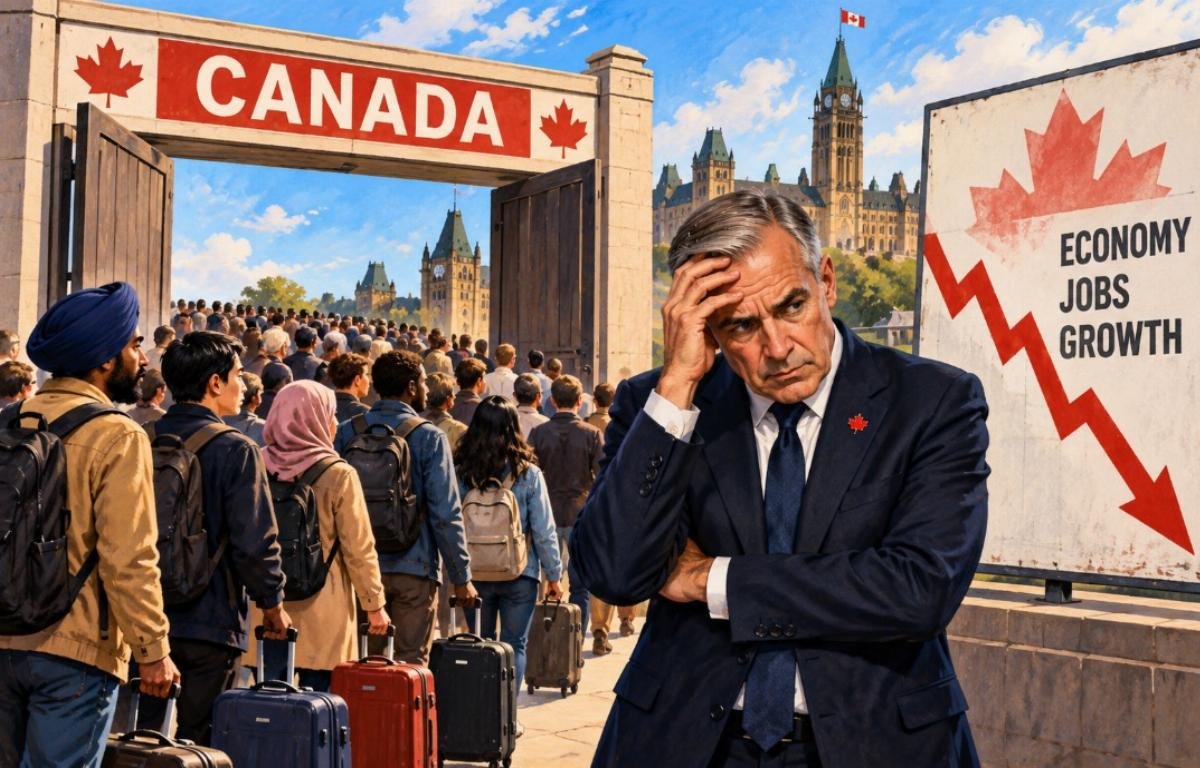
There is a genre of American commentary that treats Canada less as a foreign policy file and more as a cautionary tale, and a new piece at American Thinker fits squarely in that tradition. Written by Silvio Canto, Jr. and published October 5, 2026, the article is framed as an open letter of sorts to Canadians — one that opens by dispatching two assumptions at once: that the United States actually wants Canada as a fifty-first state, and that the trade relationship between the two countries is beyond repair.
Instead, Canto argues, the real obstacle is located north of the border, in the person of Prime Minister Carney and what the author characterizes as a “crazed personal vendetta” against President Trump.
An unlikely starting point: Canadian podcasts
Canto admits he occasionally listens to Canadian podcasts, and he describes the experience as confirming that “Trump Derangement Syndrome” — the shorthand his publication uses for what it considers reflexive anti-Trump hysteria — is thriving among Canada’s commentariat. He calls it comical, though he adds that it reflects genuine thinking rather than mere performance.
His first concession is to the President himself. Canto writes that Trump took the “51st state” joke too far, and that the Canadian response has been “totally hysterical.” But his explanation for why statehood was never a serious proposition is worth noting because it is more institutional than emotional: the President cannot simply add a state, and voters in red states — Canto places himself among them — have no appetite for an Electoral College addition that would bring “two liberal Senators and 40-something House Democrats.” That is not a diplomatic argument. It is a domestic political one, and the author offers it unapologetically.
Trade talks and the Quebec objection
On trade, Canto identifies what he sees as a deliberate distortion: the claim that the United States wants to erase French culture in Quebec. He calls that “crazy,” notes that most Americans find Quebec charming — he confesses a fondness for hearing a hockey goal call in French — and speculates that Prime Minister Carney is driven by nervousness about Quebec separatism rather than by any real cultural threat from Washington.
That diagnosis sets up the argumentative turn of the piece. Rather than rehash the trade file himself, Canto defers to Professor Victor Davis Hanson, quoting a passage in which Hanson lists a series of policies he says Canada was never instructed to adopt by Washington.
Hanson’s list, as reproduced in the column, runs as follows: the United States did not tell Canada to admit immigrants equal to 45% of its current population, nor to assume they would not be assimilated and integrated “in melting-pot fashion.” It did not tell Canada to forgo its fossil fuels, halt pipelines running from Alberta to other provinces, or bet on solar power in a frigid climate. It did not tell Canada to engineer the lowest per-annum GDP growth among the thirty-some industrial Western nations. And it did not, Hanson argues, tell Canadians they had to be $30,000 to $40,000 poorer per person and per family than their American counterparts.
The sharpest passage concerns assisted suicide. Hanson notes that Canada, which he calls a “strongly moral and ethical” people, leads the world in the practice — 5.1% of all deaths, or 19,000 people a year — a phenomenon he ties to a healthcare system strained by people who may be terminal, in an economy he says cannot support the costs. The rhetorical point is a blunt one: the economy cannot sustain open borders, cannot fulfill national defense needs, and cannot support symmetric fair trade with the United States — but none of that, in Hanson’s telling, was imposed by Washington.
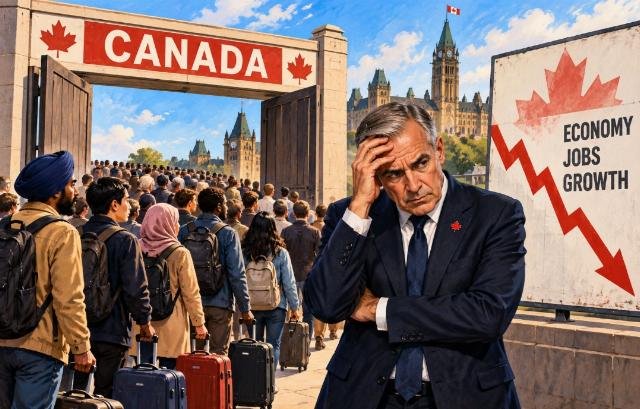
“Your leaders did,” the quoted passage concludes, with former Prime Minister Trudeau singled out as the primary author of these choices.
The comparison Canto wants Canadians to notice
From there, the argument shifts to leverage. The Trump administration, Canto writes, has negotiated deals with the European Union, South Korea, Japan, and other major economies, with a Mexico agreement reportedly in the offing. The implicit question he puts to Canadian readers is straightforward: if those deals were possible, why not one with Canada?
His answer returns to the man in Ottawa. Canada remains outside a deal, in his account, because Prime Minister Carney is “banging the drums of TDS for internal reasons” — that is, using anti-Trump sentiment as domestic political fuel rather than as a basis for negotiation.
It is worth being clear about what kind of article this is. Canto is not reporting from trade talks or citing anonymous officials. He is a commentator making a case, and the piece functions as an argument aimed over the heads of the Canadian government and directly at Canadian voters. The rhetorical strategy is deliberately inverted from the usual framing of Canada as the aggrieved party: the joke about statehood is dismissed, the trade war is reframed as a negotiating posture, and the substantive problems afflicting the Canadian economy — sluggish growth, stalled pipelines, migration pressures, the assisted-suicide numbers — are reassigned to Canadian policymakers rather than to American pressure.
Whether that case lands is, of course, for readers to decide. What is notable is the closing note of the piece: an appeal from the publication for donations so it can, in its own words, keep paying staff and keeping its ideas heard. For a column ostensibly addressed to Canadians, it is a reminder of the audience that actually sustains this kind of commentary — American readers who already share its premises and are looking for the sharpest available formulation of them.
Canto’s parting instruction is the one that carries the headline: Canadians should get Trump out of their heads and read Victor Davis Hanson. It is a suggestion that assumes the diagnosis is psychological before it is economic — and that a change in reading habits might, in itself, be a form of policy.
Source: www.americanthinker.com — https://www.americanthinker.com/blog/2026/10/dear-canadians-listen-to-the-great-victor-davis-hanson/