
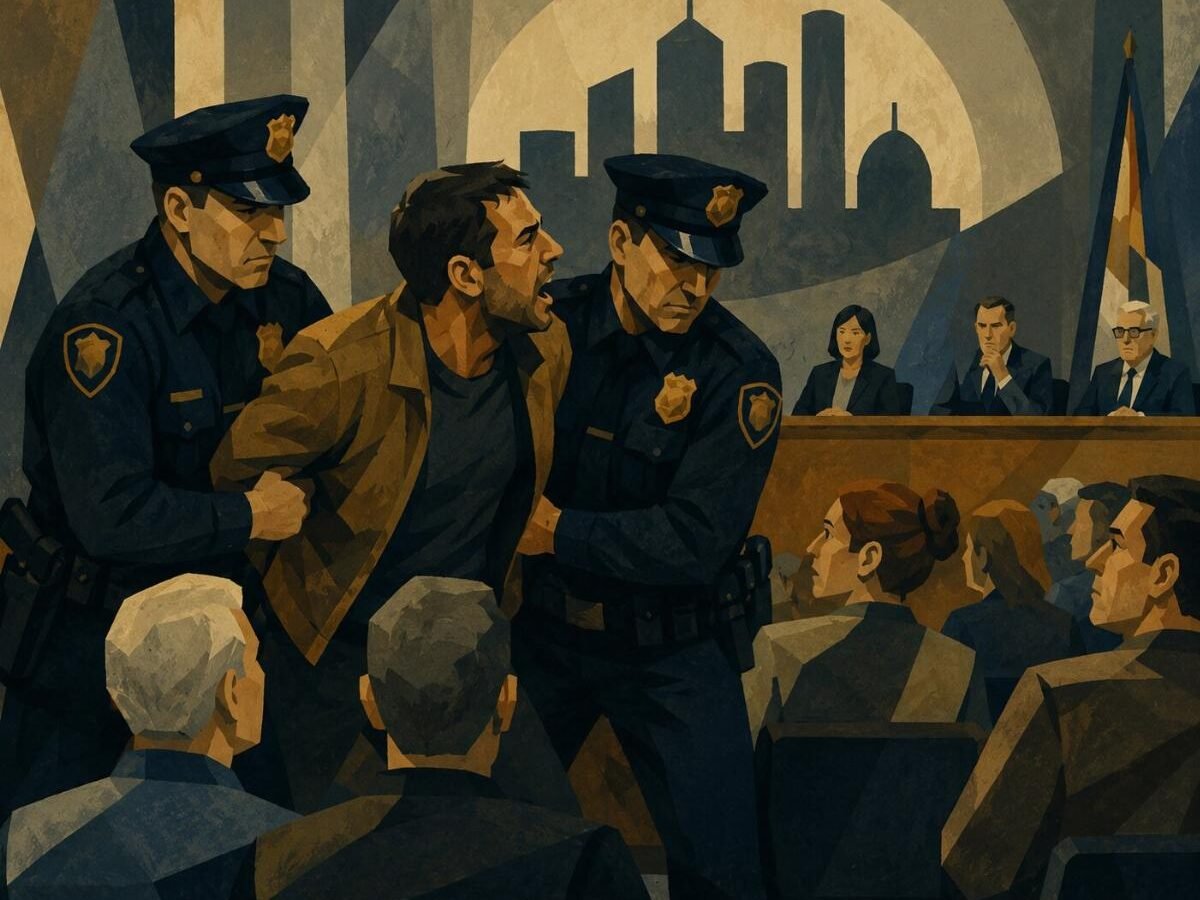
Across the United States, a growing backlash against data centers has collided with law enforcement in ways that critics say threaten the First Amendment. According to a report by American Thinker, over the past year, dozens of people have been silenced or arrested for criticizing data centers in public forums—an approach the publication calls “un-American.”
The tensions come as data center opposition surges. A March Gallup survey found that 70% of Americans hold NIMBY (Not In My Backyard) views on the issue. Protests have spread, local governments imposed moratoriums, and political resistance is widening to question cloud computing and AI itself, which relies on these facilities as infrastructure.

Cases of Arrests and Removal
Among the incidents detailed are:
- Darren Blanchard (Claremore, OK): In February, Blanchard, a farmer opposing Beale Infrastructure’s Project Mustang data center complex, was arrested at a city council meeting. He had refused to give his name, exceeded the three-minute speaking limit by a few seconds, and was taken to Rogers County jail on a criminal trespass charge within 30 seconds. He had no criminal record. A reporter seeking bodycam footage was initially quoted $1,750, later reduced to $120 after public criticism.
- Unnamed 14-year-old (Lowell, MA): During a public hearing last fortnight, a teenager was removed and detained by police after addressing the crowd. As she was led away, she said, “I’m not hurting anyone. We just don’t want data centers.” Police cruisers with flashing lights were parked in the lot, as if violence were expected.
- Pablo Payan and Angelita Soriano (Hobart, IN): At a May planning commission meeting, Payan, a maintenance manager, was arrested on criminal trespassing and disorderly conduct charges after refusing to give his name and declining to leave. He plans to sue, saying, “I was kicked out to prove a point that the law is on their side.” Soriano, a member of No Data Centers Hobart, was escorted out for speaking over two minutes but not charged; she joined a lawsuit to block the projects.
- Lux Claridge (Emporia, KS): In July, physics teacher Claridge was arrested for clapping in support of opponents of the proposed Flint Hills Digital Campus. Officials had prohibited clapping and snapping. He refused to leave and was carried out, planning to sue for “unjustified infringement of free expression.” His brother David called the incident “authoritarian behavior that undermines public trust.” Afterward, the city council moved meetings online and eliminated public comment, citing “death threats.”
- Three women (Port Washington, WI): In December, three women were arrested for “disorderly conduct” during a city council meeting about a $15 billion data center project. Environmental group Clean Wisconsin has filed legal action to prevent higher energy rates and launched a petition to halt approvals.
- Ismael Arvizu (Imperial County, CA): Arvizu was arrested for applauding when someone threatened a recall of the board chair at a meeting about a 950,000-square-foot data center. Not In My Backyard Imperial posted a $5,000 bond for his release.
- Harley DeLander (Dixon, IL): In May, DeLander was arrested for Facebook posts calling for a protest outside the home of former state representative Tom Demmer, who heads an association pitching farmland for a data center.
Growing Concerns About ‘Anti-Tech Extremism’
These incidents occur amid a reported shift in law enforcement focus. American Thinker cites over 1,000 pages of unpublished reports from the FBI, Department of Homeland Security, and fusion centers indicating that dissenters at data centers are being viewed as an emerging threat. A New York Intelligence and Counterterrorism Bureau report, accessed by Wired, warns that “the chaotic atmosphere that may result from emergent AI technology in the next five years may fuel large-scale protests that devolve into civil unrest.”
Tennessee Representative Justin Pearson, a longtime data center opponent, said, “What I am witnessing is a computer being given more care and concern than a human being by elected officials, corporations, leadership, and the United States federal government. That is wrong, and it should terrify people that a data center is being protected more than the people who live near it.”
The article argues that such portrayals run counter to the nation’s constitutional principles, where free debate allows citizens to shape policy and hold leaders accountable. As the backlash against data centers grows, the question of how to balance development, security, and the right to dissent becomes ever more pressing.
Source: www.americanthinker.com — https://www.americanthinker.com/articles/2026/08/freedom-dies-when-legitimate-dissent-is-branded-anti-tech-extremism/