

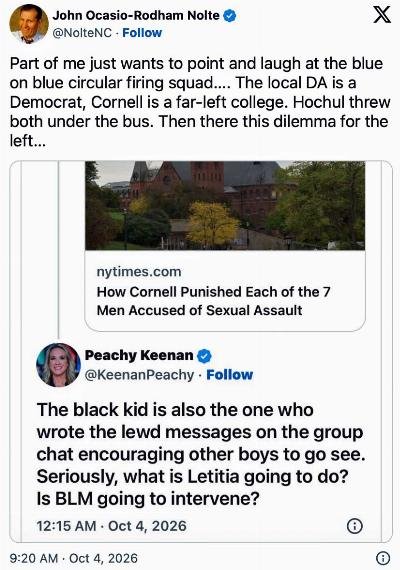
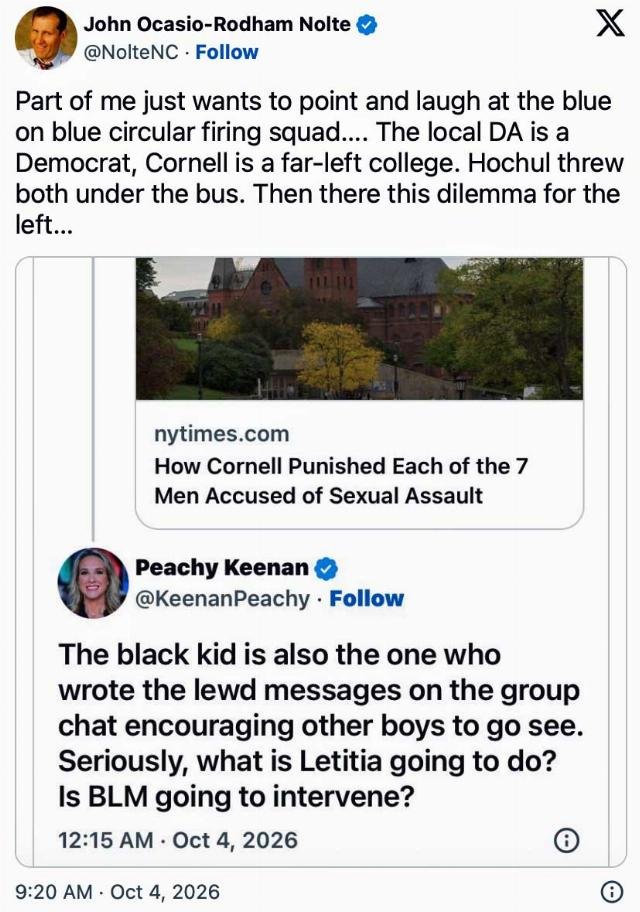
Two years after a Cornell University fraternity-house allegation ended without charges, the case is open again — and the reason, according to the local district attorney, is that the accuser’s story has shifted substantially since she first told it.
Writing in American Thinker, retired police officer Mike McDaniel recounts that a woman identified in a civil suit as “Jane Doe” reported a gang rape at a Cornell frat house in October 2024. After what McDaniel describes as a complete police investigation, prosecutors declined to bring charges, concluding that whatever sexual contact occurred was voluntary and consensual. Now she has filed a civil suit, and Tompkins County District Attorney Matthew Van Houten has reopened the criminal matter in light of what the DA characterizes as new information. According to McDaniel, Van Houten says Doe’s account has changed “dramatically” since she first spoke with investigators.
McDaniel, a former officer who says he investigated many rape cases and specialized in stalking, uses the episode to revisit a long-running campus debate: the “believe all women” doctrine and the statistic, common on college campuses, that one in four women will be raped before graduation. He calls that figure “ridiculous” and leans on the work of Heather Mac Donald, relayed via Powerline, to argue the point.
The One-in-Four Math
Mac Donald’s argument, as McDaniel presents it, is straightforward arithmetic. If the one-in-four figure — sometimes softened to one-in-five — were accurate, campus rape would represent a crime wave without precedent. No crime, however serious, approaches a victimization rate of 20 to 25 percent, even measured across many years. Mac Donald contrasts the campus claim with Detroit’s 2006 violent crime rate, which stood at 2,400 murders, rapes, robberies, and aggravated assaults per 100,000 residents — 2.4 percent — in one of the country’s most violent cities. A genuine one-in-four rate, she argues, would mean millions of young women graduating each year having suffered the most terrifying assault short of murder, a crisis that would demand a state of emergency rather than Take Back the Night rallies and hotlines.
McDaniel pairs that statistical skepticism with his own experience. During his police career, he writes, roughly half of the rape reports he encountered in a substantially sized town were false — not, he insists, because investigators were unwilling to protect women, but because the evidence was not there and the complainants, in nearly every instance, admitted they had lied.
Why the Case Fell Apart the First Time
The author is careful to note the limits of his knowledge. He has no access to police files and knows the Cornell matter only through media accounts, which he acknowledges are often wrong. What he says he can assess is the general architecture of a rape prosecution — and why this one apparently faltered.
In the Cornell case, McDaniel notes, there was apparently physical evidence, and the men involved have apparently admitted to sexual contact with Doe. But there was apparently no evidence beyond Doe’s two-year-old recollection to satisfy the elements of the state rape statute, and likely the contrary testimony of seven young men. Prosecutors can only bring charges when every element of the crime can be proved. Missing elements, he writes bluntly, means no rape charge.
He also flags a problem he says is common and apparently present here: some victims make terrible witnesses. Their accounts may not be corroborated by facts and evidence, or their character may undermine their credibility. If media reports are accurate, Doe’s initial account and the version supporting her lawsuit differ “dramatically” — a word McDaniel argues is not the kind of minor discrepancy that comes from misremembering an address or an eye color.
Beyond Reasonable Doubt, and the Civil Standard
This is where the burden of proof matters, McDaniel argues. Even if a prosecutor privately believes Doe was raped two years ago, a conviction requires proof beyond a reasonable doubt — a standard he says cannot be met for all the reasons above. That helps explain the civil suit: the civil standard is essentially “more likely than not,” and there is money to be made. But even that lower bar may prove hard to clear, he suggests, when Doe has to explain point by point why her two accounts diverge so sharply.
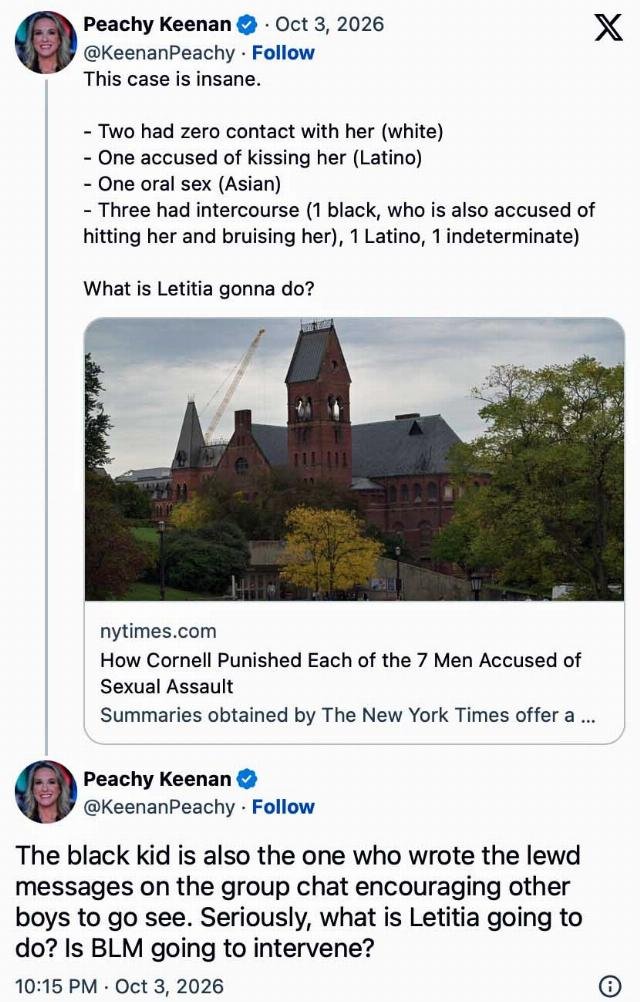
McDaniel does not claim to know whether Doe was gang raped. He says he argues only that due process must play out, and that political motivations — he names New York Attorney General Letitia James — and human nature should be kept firmly in mind.
The Political Subtext
There is a broader political frame to McDaniel’s piece. He contends the renewed attention fits a familiar pattern in which “believe all women” functions less as a principle than as a weapon, and he suspects Democrats are eager for an issue that will help them with female voters heading into the midterms and the 2028 election cycle.
Yet the piece’s core is narrower than its politics. The reopening of a closed investigation, driven by an accuser’s changing story, raises questions that cut across partisan lines: what standard should govern when a prosecutor revisits a case the evidence once could not support, and how should the public weigh an allegation that has been tested once and failed?
McDaniel’s answer is procedural rather than declarative. Rape cases, he writes, are not easy. The Cornell matter, on his reading, presents physical evidence, admissions of sexual contact, a statute with specific elements, and an accuser whose account has moved. Whether a jury ever hears it — criminal or civil — will depend on whether the evidence can carry the burden the law assigns it. In the meantime, he argues, the slogan and the statute are not the same thing, and treating them as interchangeable does neither accusers nor the accused any favors.
Source: www.americanthinker.com — https://www.americanthinker.com/blog/2026/10/cornell-believe-all-women-again/