

Walk through Madison, Wisconsin, or the Twin Cities on a fall afternoon and you’ll see tidy streets, friendly faces — and, according to one conservative columnist, a whole lot of signage. In a piece for American Thinker, Andrea Widburg argues that the density of progressive flags and posters in these two Democratic strongholds is not ordinary political enthusiasm but something closer to compelled performance.
Widburg, writing after a recent trip to both Madison and Minneapolis–St. Paul, describes the cities as visually striking in autumn and, in the neighborhoods she visited, clean and well-kept — with one exception she dismisses as a “skeezy” stretch she drove through in Minneapolis. The friendliness, she writes, was familiar Midwestern stuff. The virtue, in her telling, was of the very, very, very explicit variety, advertised in store windows and on front lawns.
Signs Everywhere, and a Question of Purpose
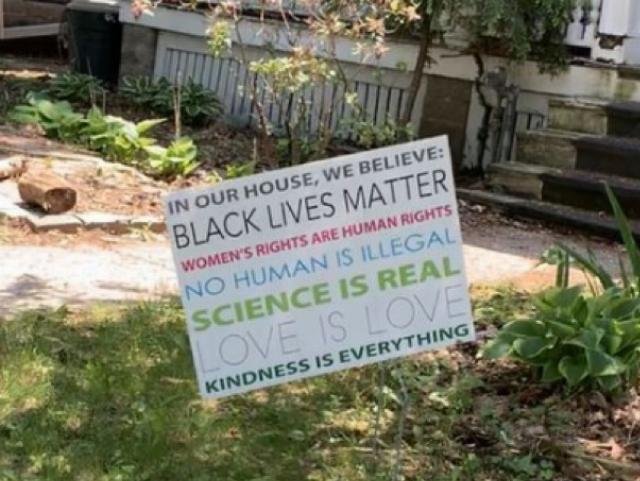
Her inventory is broad: posters, books, flags, and pamphlets in shops declaring solidarity with LGBTQ+ people, Black people, undocumented immigrants, and Palestinians — with, she notes pointedly, particular emphasis on LGBTQ+ causes. Residential signs carrying the familiar “in this house” formula are still on display, she writes, just as they were when she photographed one in 2019.

What bothers Widburg is not the sentiment so much as what she sees as its redundancy. Citing Kamala Harris’s roughly 83% vote share in Madison and about 80% in Minneapolis and St. Paul, she argues that residents are “preaching to the choir” — that the signs can’t be read as a persecuted minority’s quiet signal to fellow travelers, because nearly everyone around them already agrees.
Then she flips her own premise. Maybe the ubiquity isn’t pointless at all, she suggests, because the left demands purity and fealty, and public, constant demonstrations of loyalty are the safest way to avoid being “unpersoned.” That word choice signals where the essay is headed.
Two Historical Comparisons
Widburg reaches first for Solzhenitsyn. In The Gulag Archipelago, she recounts, a newly appointed chairman at a 1930s district committee meeting led a round of applause for Josef Stalin — and nobody dared stop. The clapping went on for 11 minutes until a factory director finally sat down. The NKVD arrested him, she writes, and he was sentenced to ten years. She also points readers to a short film, Applause, by Ivan Zabazhanov, that reenacts the episode, and to 1938 footage of Stalin addressing the Moscow District Soviet in which he had to use a bell to halt the ritual applause so his speech could proceed.

Her second example is more recent: the crowds weeping at the death of Kim Jong-il. That display, she argues, was not organic grief but abject fear — the terror of being identified as the person who cried less than the neighbor standing beside you.
A Gulag Caveat, and a Claim About Fear
Widburg is careful, at least rhetorically, to concede the limits of her analogy. Local governments in Madison and Minneapolis, she writes, are not going to haul dissenters off to a “frozen Midwestern gulag” — “at least not yet.” But she insists there is “a whiff of fear in the air” as each left-leaning Midwesterner works to appear holier than the next, wary of falling into bad odor with what she calls the nomenklatura.
The piece closes with the outlet’s standard fundraising appeal, framing open political speech as essential to the republic and asking readers to support American Thinker’s staff and work.
What the Essay Is Actually Arguing
Stripped of the historical flourishes, Widburg’s core claim is about motive. The signs, in her reading, are not instruments of persuasion aimed at the unconvinced, nor a minority’s coded reassurance. They are tokens of membership in a consensus so complete that visible compliance becomes the price of belonging. It’s a familiar conservative critique of progressive cultural signaling, though the Soviet and North Korean framing pushes it toward a starker register — one that treats the yard sign as a small, voluntary act of self-protection rather than an expression of conviction.
Readers on the left would likely counter that visible support carries real weight for people who don’t feel safe or welcome, and that voting patterns in a city say little about the private views of any given household. Widburg doesn’t engage that possibility directly; her interest is in what the sheer volume of signage implies about social pressure inside communities that already lean heavily one way.
The essay also sits within a broader genre of post-election travel writing in which commentators read a region’s politics off its lawns, storefronts, and bumper stickers. Widburg’s contribution is less reportage than interpretation — an argument that in the Upper Midwest’s bluest enclaves, the friendliness on the surface and the uniformity of the messaging underneath are two sides of the same coin.
Whether that reading lands depends on whether you see the signs as an invitation or a test. Widburg has no doubt which one she encountered.
Source: www.americanthinker.com — https://www.americanthinker.com/blog/2026/10/urban-midwestern-virtue-signaling-has-a-soviet-or-north-korean-flavor/