
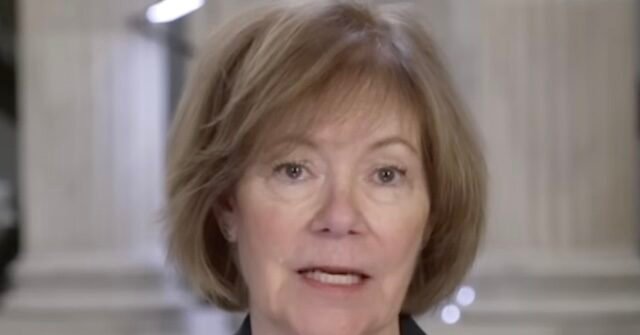
Sen. Tina Smith (D-MN) on Thursday offered a blunt assessment of her own party, acknowledging that a significant share of Democrats are seen by voters as part of the establishment rather than as agents of change.
Appearing on CNN’s The Source with anchor Kaitlan Collins, Smith addressed polling that shows nearly 6 in 10 Democrats and Democratic-leaning independents believe the party needs major changes or total reform. Asked whether she agrees with that sentiment, Smith did not hesitate.
“I actually do,” Smith said. “I actually think that there are too many in my party that sort of go along to get along, that they are not really talking about making bigger changes. Voters see too many in my party as just being part of the status quo and not independent minded.”
Smith pointed to the recent Democratic primary in Minnesota, where Lt. Gov. Peggy Flanagan emerged victorious, arguing that her success was driven by a perception that she was willing to challenge the party’s conventional approach.
“I think that is one of the reasons why our lieutenant governor, Peggy Flanagan, won the primary in Minnesota, because she was seen as standing up to that,” Smith said.
The senator also highlighted a broader political current that she believes Democrats must tap into, particularly in rural areas and the Midwest.
“I want to just say, in rural parts of this country and especially in the Midwest, there is a strong historical thread that is sort of anti-establishment, populist little guys against the big guys,” Smith said.
Smith’s comments come as the Democratic Party grapples with internal debates over messaging, strategy, and leadership heading into future election cycles. The polling cited by Collins reflects growing frustration among the party’s base with its direction and its ability to connect with working-class voters on economic issues.
Collins had framed the discussion around voter anger over the cost of living, noting that such discontent is not solely aimed at the president and his party but also at Democrats who are perceived as failing to deliver meaningful change.
Smith’s remarks signal a willingness among some Democratic figures to embrace a more populist and reform-minded identity, even if it means breaking with the party’s more centrist establishment wing.
Her acknowledgment that voters see many Democrats as “part of the status quo” underscores a recurring theme in recent political analysis: that the party’s brand has suffered among those who feel left behind by economic and political systems.
The Minnesota primary result, as described by Smith, offers a case study in how candidates who position themselves as outsiders or reformers can gain traction within the party.
Flanagan’s victory, according to Smith, was not merely a local story but a reflection of a national mood that rewards politicians who are perceived as independent-minded and willing to take on entrenched interests.
Smith’s comments also echo a broader debate within the Democratic Party about how to respond to populist appeals that have historically benefited Republicans in rural and Midwestern regions.
By invoking the “little guys against the big guys” narrative, Smith suggested that Democrats must reclaim that language and apply it to their own policy agenda.
The senator’s willingness to criticize her own party on a national platform is notable, as it aligns with a growing chorus of voices within the Democratic coalition calling for structural changes and a more aggressive approach to economic inequality.
Whether Smith’s critique translates into concrete policy shifts or electoral strategies remains to be seen, but her comments add to the pressure on party leadership to address the dissatisfaction that polls have captured.
For now, Smith’s message is clear: Democrats cannot afford to be seen as defenders of the status quo, especially in regions where anti-establishment sentiment runs deep.
“Too many in my party are not independent minded,” she said, urging a more confrontational stance that resonates with voters who feel the system is stacked against them.
The interview comes at a time when both major parties are wrestling with internal divisions over how to appeal to a restless electorate, and Smith’s remarks are likely to fuel further discussion about the Democratic Party’s identity and future direction.
Source: www.breitbart.com — https://www.breitbart.com/clips/2026/08/13/dem-sen-smith-too-many-in-my-party-are-not-independent-minded/