
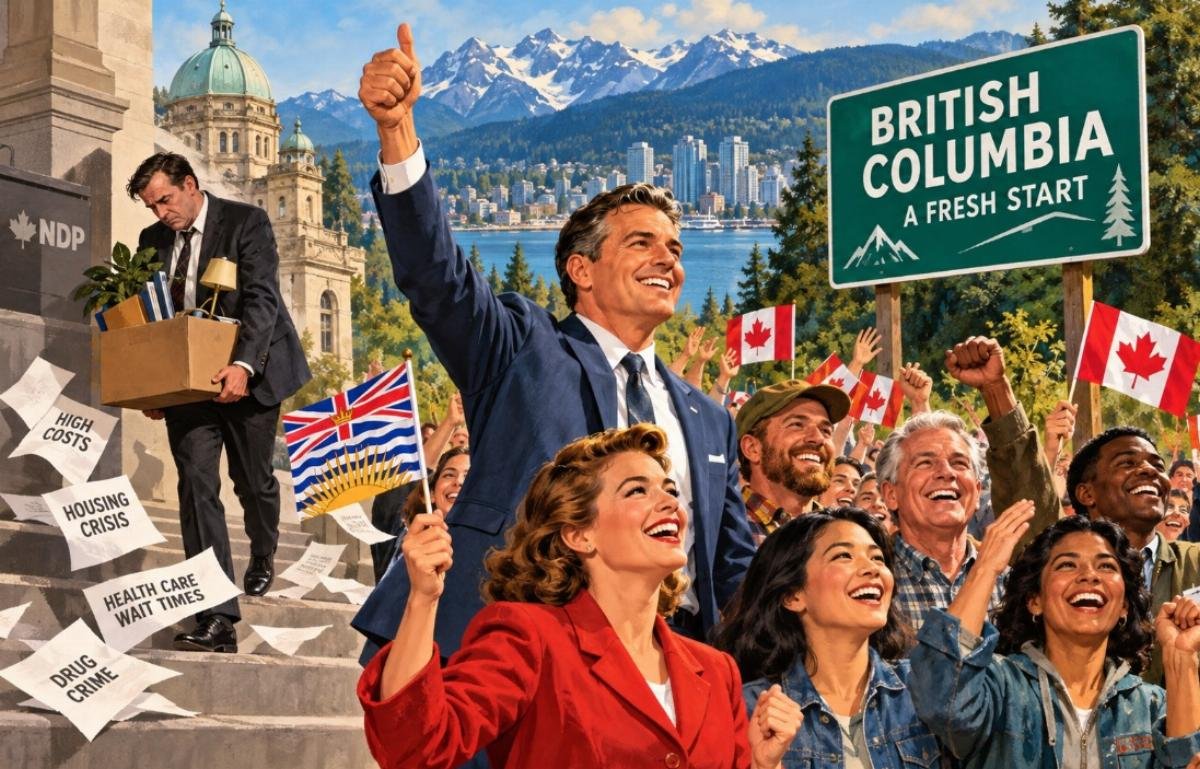
British Columbia just witnessed what many are calling the most improbable political earthquake in Canadian provincial politics. The BC Conservative Party has swept to power with preliminary results showing leads in 63 of the province’s 93 seats, transforming a province long dominated by left-wing politics into conservative territory.
To put this in perspective, imagine Republicans suddenly winning supermajorities in California and New York state legislatures. That’s the scale of shock reverberating through Canadian political circles right now.
The October 24, 2026 election marks a dramatic reversal from just two years ago, when the BC Conservative Party barely existed as a political force. In the 2024 provincial election, the New Democratic Party (NDP) under Premier David Eby scraped together a razor-thin 47-44 seat victory over the surging Conservatives, with the Green Party holding two seats. That single-seat majority proved to be the NDP’s undoing.
How the Mighty Fell
According to American Thinker, Premier Eby made a fatal miscalculation. Sensing opportunity after internal turmoil within the Conservative ranks, he called a snap election to expand his precarious one-seat majority. The gambit spectacularly backfired.
The Conservative Party’s path to this moment was anything but smooth. After their near-miss in 2024, internal divisions emerged. Original leader John Rustad, a former BC Liberal MLA who had joined the Conservatives in 2023 and led them to within three seats of victory, was ousted. His replacement, Kerry-Lynne Findlay, represented a more conservative stance but was forced to resign within months amid concerns she would alienate swing voters. Lorne Doerkson stepped in as interim leader while some members defected to become Independents or joined the populist OneBC party.
This infighting appeared to hand Eby the perfect opening. Instead, it became the catalyst for Conservative unity. Facing a common threat, the BC Conservative factions set aside their disputes and rallied behind Doerkson’s leadership. The result speaks for itself: a commanding majority that few political observers saw coming.
What Drove Voters to Revolt
British Columbians didn’t flip their political allegiance on a whim. An October Ipsos poll identified the issues driving voter discontent: 57% cited cost of living as their primary concern, 39% pointed to health care, and 30% identified housing affordability as critical.
Under NDP governance, the province experienced what many residents described as a perfect storm of policy failures. Food and energy prices soared. Housing costs became prohibitive for working families. The provincial health care system buckled under strain, with long wait times, rural hospital service disruptions, and difficulty accessing basic medical care becoming the norm rather than the exception.
But economic concerns weren’t the only factors. Voters expressed frustration over open-air drug use in urban centers, rising crime rates, mass immigration policies, and what critics characterized as LGBT-dominated education curricula. The NDP’s regulatory approach discouraged private investment and resource development, leading to economic stagnation in a province that could otherwise capitalize on abundant natural resources.
The Property Rights Powder Keg
Perhaps most controversially, British Columbia became ground zero for a legal battle over private property rights that sent shockwaves through homeowners and businesses alike.
A 2025 British Columbia Supreme Court ruling involving the Cowichan Tribes recognized Aboriginal title to approximately 732 acres of land in Richmond, holding that this Aboriginal title takes precedence over certain fee-simple property interests. While the ruling didn’t immediately transfer entire neighborhoods to Indigenous ownership, it raised profound questions about the security of private property titles throughout the province. Both the City of Richmond and the provincial government appealed the decision.
The controversy deepened with the province’s Declaration on the Rights of Indigenous Peoples Act (DRIPA), which aimed to align provincial laws with the United Nations Declaration on the Rights of Indigenous Peoples. Critics argued the legislation created legal uncertainty and complicated economic development. Supporters viewed it as essential for reconciliation with First Nations.
Premier-designate Doerkson has pledged to repeal DRIPA while pursuing economic partnerships with First Nations—a position that OneBC pushed the Conservatives to adopt during the campaign. As one local leader put it, the province cannot survive on “coffee shops and whale-watching” alone.
When Trump-Bashing Fails
The NDP deployed what had become a reliable weapon in progressive political arsenals: linking their opponents to President Trump. The strategy attempted to paint a BC Conservative government as bringing “extreme right-wing tyranny and disaster” to the province.
It didn’t work. An early-October Angus Reid Institute poll found that only 10% of British Columbians considered Trump, U.S. tariffs, and related trade issues among their leading concerns when deciding how to vote. Cost of living, health care, jobs, and housing ranked far higher.
According to American Thinker, BC voters refused to be distracted by “Orange Man Bad” rhetoric when their own homes, families, and communities faced economic hardship and declining public services. The NDP’s Trump-bashing couldn’t overcome dissatisfaction with its provincial record.
This represents a potential inflection point in progressive political strategy. For years, associating conservative opponents with Trump has been considered a virtually guaranteed winning formula in Canada and other Western democracies. British Columbia suggests that playbook may be losing its effectiveness when voters face immediate, tangible problems in their daily lives.
What Comes Next
Premier-designate Doerkson campaigned on cutting red tape, reducing taxes, increasing energy and resource production, and making the province business-friendly. He has announced plans to prioritize pipeline development, resource extraction, and a comprehensive audit of provincial finances.
On education, Doerkson has promised changes to the province’s approach, including its LGBT curriculum—a stance that energized conservative voters while alarming progressive activists. Local leaders across the province are expressing optimism about economic growth after years of what they describe as stagnation under NDP policies.
Premier Eby won his own riding (the Canadian term for electoral districts) but announced his resignation as NDP leader the same night results came in. The abrupt end to his tenure underscores the magnitude of the NDP’s defeat.
Implications Beyond British Columbia
This result reverberates far beyond provincial borders. Canada has drifted steadily leftward over the past decade, with Conservative victories largely confined to Alberta and Saskatchewan. Even Manitoba, another prairie province, is governed by the New Democratic Party, which sits further left than the national Liberal Party.
British Columbia was considered one of Canada’s most reliably progressive provinces. If conservatives can win there—and win decisively—it raises questions about whether a broader political realignment is underway across Canada.
The victory also offers lessons for conservative movements across Western democracies. According to American Thinker, the conservative ecosystem “from the United States to Latin America and throughout Europe” should recognize this as a possible sign of resurgence against left-wing policies and increasingly intrusive government.
The most important message, the outlet argues, is that when the pain becomes unbearable, when voters grow tired enough, and when independent media and political organizations demonstrate sufficient courage, an oppressed populace can oust what they view as tyrannical governance and restore what they consider proper rule.
Whether this marks a permanent shift or a temporary correction remains to be seen. But for now, British Columbia has delivered a political shock that few predicted and that will resonate throughout Canadian politics for years to come.
Source: www.americanthinker.com — https://www.americanthinker.com/articles/2026/11/british-columbia-s-conservative-earthquake-shakes-canada-s-political-landscape/