
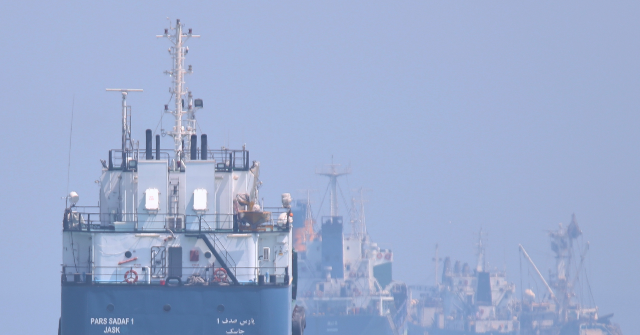
Saudi Arabia appears to be daring the Strait of Hormuz again. Trade industry sources said Tuesday that Saudi Aramco has resumed loading tankers at its Juaymah and Ras Tanura oil terminals, both located within the contested waters of the strait — the first such loadings in three weeks.
The move signals that Aramco believes it can move its product through the vital chokepoint, either in coordination with Iran or in defiance of Tehran’s threats. Some analysts suggest the Saudis may even consider Hormuz safer than the alternative route via the Red Sea, where Iran’s Yemeni proxy, the Houthi insurgents, have effectively banned Saudi shipping through the Bab el-Mandeb Strait.
According to ship tracking services, three Saudi supertankers loaded two million barrels of crude oil apiece from Juaymah and Ras Tanura over the past week. Six more Very Large Crude Carriers (VLCCs) are positioned to load from those ports in the near future, and all of those vessels would need to transit the Strait of Hormuz to reach their customers in Asia, predominantly China.
Economic Pressure to Move
Emma Li, a market analyst at Vortexa, told Reuters on Tuesday that the Saudis may have concluded they have little choice but to resume using Hormuz. Their only other route to ship oil to Asia involves a lengthy voyage through the Mediterranean, and Aramco’s Asian customers are reportedly “not happy with the long voyages and high freight cost.”
Aramco made a public offer of crude cargoes to Asian buyers on Monday, proposing to deliver the oil via ship-to-ship transfers off the port of Fujairah in the United Arab Emirates, which sits on the Gulf of Oman side of the strait. The offer includes heavier grades of crude that can be refined into high-quality fuels — a product increasingly sought by Chinese refiners.
Bloomberg News, citing industry sources, reported that some details of the proposed sales are being kept under wraps for security reasons. Most prospective buyers are Chinese refiners hungry for the heavier Saudi grades, and Aramco may be planning to sail its tankers “dark” through the strait — with transponders off — to avoid Iranian attack.
Pre-Positioned Crude in UAE
Other market sources said Saudi Arabia has already transferred a substantial amount of heavy crude to the UAE and is ready to hand product off to buyers through ship-to-ship transfers near Fujairah almost immediately, reducing the need for tankers to enter the Gulf proper.
The resumption of loadings comes despite repeated Iranian threats to disrupt shipping through the strait, which handles roughly a fifth of global oil consumption. U.S. Energy Secretary Chris Wright said last week that despite those threats, almost 9 million barrels per day are still flowing through Hormuz, with an additional 5 to 7 million barrels leaving the region via newly upgraded pipelines and export facilities.
Long-Term Diversification
Over the longer term, the Saudis, Emiratis, and other Gulf oil producers are working to develop alternative export routes that cannot be threatened by Iran or its proxies. If those projects come online as planned, the strategic importance of the Strait of Hormuz could diminish significantly over the next few years.
For now, though, the Saudis are betting that the strait is open for business — or at least that it is a better bet than braving the Houthi blockade in the Red Sea. Whether that bet holds will depend on Iran’s next move, and on whether the Houthis follow through on their threats against Saudi-linked vessels in other waters.
Source: www.breitbart.com — https://www.breitbart.com/middle-east/2026/08/18/report-saudi-arabia-resumes-loading-oil-in-strait-of-hormuz/