
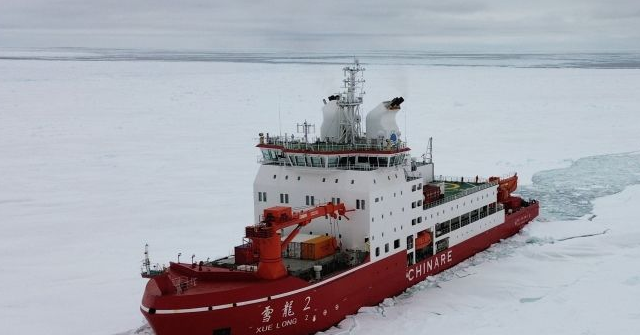
China’s state-run Global Times this week declared the Arctic “Ice Silk Road” a booming success, touting “soaring demand” for the new trade route that links the Chinese port of Ningbo with several European destinations via Russia’s Northern Sea Route. The same editorial lashed out at Western media for what it called “sour grapes” concerns about the environment, Chinese territorial ambitions, and the risks of weaponized supply chains.
According to the Global Times, the route’s early sailings have been fully booked, and orders for future voyages are “pouring in.” The paper framed the service as a vital new option for Asia-Europe trade, arguing that global shipping depends too heavily on a handful of strategic chokepoints, such as the Suez Canal and the Strait of Malacca. “China’s Arctic shipping route provides a new option for Asia-Europe trade, helping diversify risks and improve efficiency,” the paper said.
But the timing of the boast raised eyebrows. The regular service was only announced last week by Chinese shipping firm Sea Legend, and the first container ship left Ningbo on Saturday evening. The Global Times’s triumphant tone, some analysts note, appears designed to counter growing international skepticism—and to distract from the more immediate threat to global shipping: repeated attacks on commercial vessels in the Strait of Hormuz and the Red Sea, carried out by Iran-backed forces, which China has been reluctant to publicly condemn.
An Ambitious Gamble in the Arctic
The Ice Silk Road is not a new idea. Chinese planners have floated the concept for nearly a decade, initially as a hedge against potential disruptions in the Strait of Malacca, through which a large share of China’s energy imports pass. The current iteration uses the Northern Sea Route, which runs along Russia’s Arctic coast, to cut transit times between China and Europe by as much as half, according to Chinese officials. They also argue that shorter voyages mean lower carbon emissions per trip.
Yet the route remains severely limited. The Arctic is only navigable in the summer months, and the current service is projected to operate only from July through October. Traffic volumes are minuscule: just 15 ships made the full transit in 2024 and 23 in 2025—a fraction of the traffic that passes through the Suez Canal or the Strait of Hormuz in a single week. For all the talk of a revolution in global logistics, the Ice Silk Road is, for now, a niche experiment.
Skepticism from the West and Beyond
The Global Times’s attempt to dismiss Western criticisms as “sour grapes” has not convinced everyone. The UK’s Guardian reported on Sunday that while countries like Japan, South Korea, and India are exploring the route, their enthusiasm is tempered by serious environmental and security concerns.
Shipping and insurance companies worry about ships suffering mechanical breakdowns or getting trapped in ice along the lonely polar route—a scenario that would dramatically increase the risk of spills of heavy fuel oil, which large cargo vessels still rely on. The route is also heavily dependent on Russian infrastructure: nuclear-powered icebreakers are needed to keep the passage open, and Russia controls the entire operation. For many European nations, the idea of relying on a trade lane controlled by Vladimir Putin’s government is unpalatable, given Moscow’s invasion of Ukraine and its history of weaponizing energy supplies.
“So can the northern sea route be used as a substitute for the Strait of Hormuz and the Suez Canal? The short answer is no, not for the moment,” said Vinh Thai, a professor of logistics and management at RMIT University.
A Shadow Fleet in the Ice
Another major sticking point is the presence of Russia’s “shadow fleet”—aging, poorly maintained cargo ships and tankers that use deceptive paperwork and stealth tactics to evade Western sanctions. According to a report by the Bellona Environmental Foundation, up to a third of the traffic along the Northern Sea Route consists of sanctioned vessels, and experts believe the share may be even higher this year. Environmentalists are alarmed by the higher risk of oil spills from these creaky ships, while legitimate operators are wary of sharing crowded waterways with them.
The Global Times, for its part, doubled down on its defense of the project, insisting that China is merely exercising its “freedom of navigation” and that Western companies are eyeing Arctic shipping as well. It accused critics of hypocrisy, noting that global logistics routes are “becoming increasingly vulnerable.” But the paper’s editors were notably silent on the elephant in the room: the fact that the most immediate threat to international shipping comes from Iran, a close ally of Beijing, which has been attacking commercial vessels in the Strait of Hormuz and the Red Sea.
A Long Way from a Game Changer
For now, the Ice Silk Road remains a symbol of Chinese ambition more than a practical alternative to traditional shipping lanes. Its limited seasonal window, minimal capacity, and dependency on Russian goodwill make it a risky bet for any nation that values supply chain security. As professor Thai put it, the route is not ready to replace the Strait of Hormuz or the Suez Canal—and likely won’t be for some time.
Source: www.breitbart.com — https://www.breitbart.com/asia/2026/08/18/china-touts-success-of-arctic-ice-silk-road-to-bypass-strait-of-hormuz/