
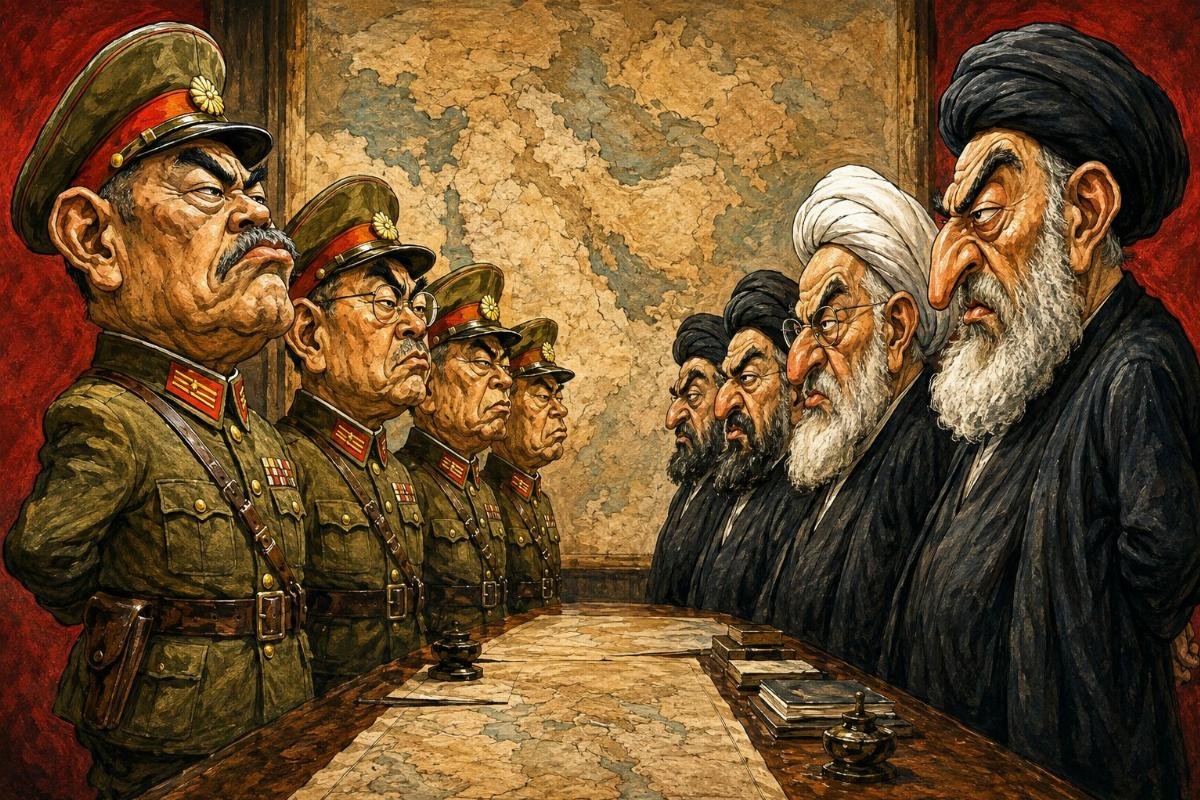
As President Donald Trump announced on August 18 that peace talks with Iran had terminated, a new analysis by James Zumwalt at American Thinker draws an unsettling parallel: Iran’s mullahs, he argues, mirror the mindset of Japan’s World War II generals—committed to fighting to the last man rather than surrendering. But unlike the Japanese example, where a civilian emperor ultimately broke the deadlock, the question now is whether a backchannel to Iran’s military elite can achieve what diplomacy hasn’t.
The historical comparison is vivid. After the U.S. dropped two atomic bombs on Japan, it was Emperor Hirohito—not the military—who sought an end to the war. His generals pleaded to fight on, but their loyalty to the emperor overrode their “never surrender” ethos. General Douglas MacArthur, representing the Allies, understood that Japan’s military remained unrepentant. So he orchestrated a surrender ceremony designed to break their spirit—not through humiliation, but through symbolism.
On September 2, 1945, just eleven Japanese delegates, mostly senior military, boarded the USS Missouri in Tokyo Bay. MacArthur chose the battleship because it was named for President Truman’s home state. Overjoyed sailors had to contain their excitement, and 250 Allied ships lay at anchor nearby. Standing directly behind MacArthur were two gaunt, aged-looking men: General Jonathan Wainwright and British Lieutenant General Arthur Percival, both captured in 1942 after surrendering Corregidor and Singapore. They had spent over three years as POWs. MacArthur positioned them so the surrendering Japanese generals had no choice but to meet their gaze—reversing the roles of victor and vanquished.
As the signing concluded, the sky filled with over 450 U.S. carrier planes, followed by bombers. Though the Japanese delegation tried to hide their emotions, witnesses saw tears. MacArthur had achieved his purpose, reflecting later: “You do not need a man to kneel if you have already built the room that makes him small.” But even he acknowledged that without Japan’s civilian leadership, an Allied invasion would have been necessary.
Iran’s parallel structure
Zumwalt draws a direct line from Tokyo to Tehran. Iran is led by a Supreme Leader—an “emperor equivalent”—currently Mojtaba Khamenei, who, according to the piece, was elevated after the premature death of his father in an Israeli bombing attack. Alongside the mullahs, there is a parallel military structure: the Islamic Revolutionary Guard Corps (IRGC), established in 1979 to counter the regular army’s loyalty to the deposed Shah. The IRGC now operates with a constitutional mandate to protect the Islamic Republic’s integrity, and it has been the primary tool of the mullahs ever since.
The challenge for any peace effort is the uncertainty over who actually commands. The piece notes that Supreme Leader Khamenei may no longer even be alive—he has remained out of public view, and a 15-second undated video was released, but without a verifiable date, his status is unclear. Regardless, Zumwalt argues, the mullahs show no desire to surrender. Their ideology demands submission to Islam, a war they’ve framed as lasting 1,400 years. Like Japan’s generals, they prefer to see the country fight to the last man.
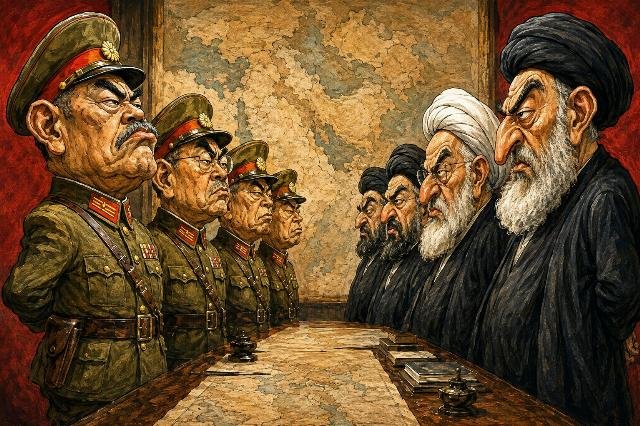
What worked in 1945, he contends, is not working now. That’s why Trump has embarked on a new diplomatic tack—one that goes through military rather than civilian channels. Reports indicate the administration has opened a direct backchannel to the IRGC.
The logic is simple: The IRGC is the institution through which the mullahs live and breathe. And while the surviving mullahs might turn a blind eye to the devastation heaped on Iran, it is the IRGC that has firsthand witness to the destruction. Exhausted from the conflict, the IRGC may “huff,” but it’s too tired to “puff” much. In that, Zumwalt sees a parallel to Hirohito: those who’ve seen the face of war are more likely to seek an end than those who only hear its guns.
Whether this backchannel can produce a surrender—or any peace at all—remains uncertain. But the historical echo is impossible to ignore: In both cases, the path to ending a war ran through the military’s realization that it could not win. For Japan, it took atomic bombs and an emperor. For Iran, the question is whether an exhausted IRGC can convince the mullahs to face reality before it’s too late.
Source: www.americanthinker.com — https://www.americanthinker.com/blog/2026/08/iran-s-mullahs-mirror-world-war-ii-japanese-generals-mindset/