
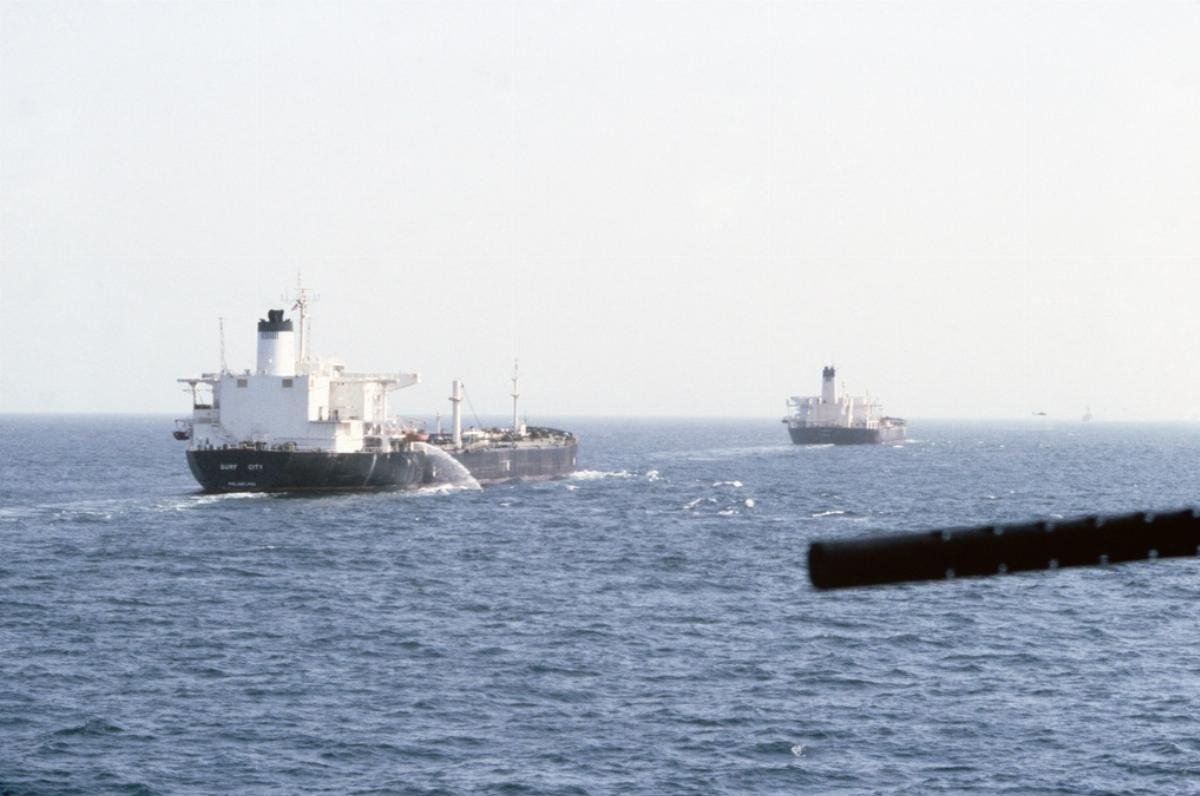
The Strait of Hormuz, the world’s most critical oil chokepoint, appears to be reopening under a U.S. Navy-led operation that has largely escaped the headlines. According to Energy Secretary Chris Wright, the Navy has established a stealth convoy system that is now moving 9-15 million barrels of oil per day out of the Persian Gulf. When combined with the 7-8 million barrels flowing through the Hormuz bypass pipelines, the Gulf is nearly back to its pre-war output of about 20 million barrels daily.
Wright’s announcement last week drew sharp mockery from mainstream media, but as subsequent reporting has begun to concede, the claim appears to be grounded in fact. While national and international outlets focused on what they described as a hopeless U.S. position in the region, the stalemate was quietly being reversed behind the scenes.
Targeting Iran’s Anti-Ship Capabilities
The strategy, as detailed by Wright and corroborated by recent developments, centered on systematically dismantling Iran’s ability to threaten shipping. Over the past two months, the U.S. military reportedly targeted Iran’s anti-ship capacity, including coastal radar installations and the small lookout boats that Iran has used to harass tankers. With those assets degraded, the calculus has shifted: hitting a fast-moving tanker with a missile is far more difficult than striking a fixed land target, especially when the tankers are shielded by Navy jammers and interceptors.
President Trump had brokered a deal in June that got oil flowing and stripped Iran of leverage, but the Islamic Revolutionary Guard Corps (IRGC) reneged on that agreement within weeks, resuming attacks. Now, with the stealth convoy system operational, the dynamic has changed. As one observer put it, “We can now move a lot of oil without them being able to do much about it.”
Iran’s Internal Disarray
The ball is now in the Iranian court, and Tehran’s response is complicated by its own internal structure. While the IRGC maintains firm control over the country, each commander reportedly exercises near-autonomy over their own forces. This fragmentation slows decision-making, and the commanders in charge of Iran’s dwindling missile forces may not agree with Tehran’s leadership on how to proceed. The result is a leadership paralysis that leaves Iran with increasingly limited options.
If Iran chooses not to escalate, the market could see a significant drop in oil prices, returning to something like the situation in 1988, when Iran threw in the towel after President Reagan destroyed its navy, ending its first attempt to block the Gulf. But there is a darker scenario: if the IRGC decides to play a losing hand, it could strike the oil fields and desalination plants of its neighbors, attempting to take the entire region down with it.
A Delicate Standoff
So far, Iranian rhetoric has been bellicose, but some analysts wonder if that is more for show. An all-out war would leave President Trump and the Arab states with little choice but to mount an Allied ground invasion to end the regime, similar to the campaign against ISIS in Iraq and Syria in 2017. The Iranian regime likely suspects that most ordinary Iranians would side with the invaders if it came to that.
For now, the key takeaway is that the United States has found a way to restore the flow of oil without a full-scale conflict. Whether Iran will accept this new reality or lash out remains the open question. As the stealth convoys continue their runs, the world watches to see whether Tehran’s next move is a strategic retreat or a desperate gamble.
Source: www.americanthinker.com — https://www.americanthinker.com/blog/2026/08/trump-quietly-reopens-hormuz/