
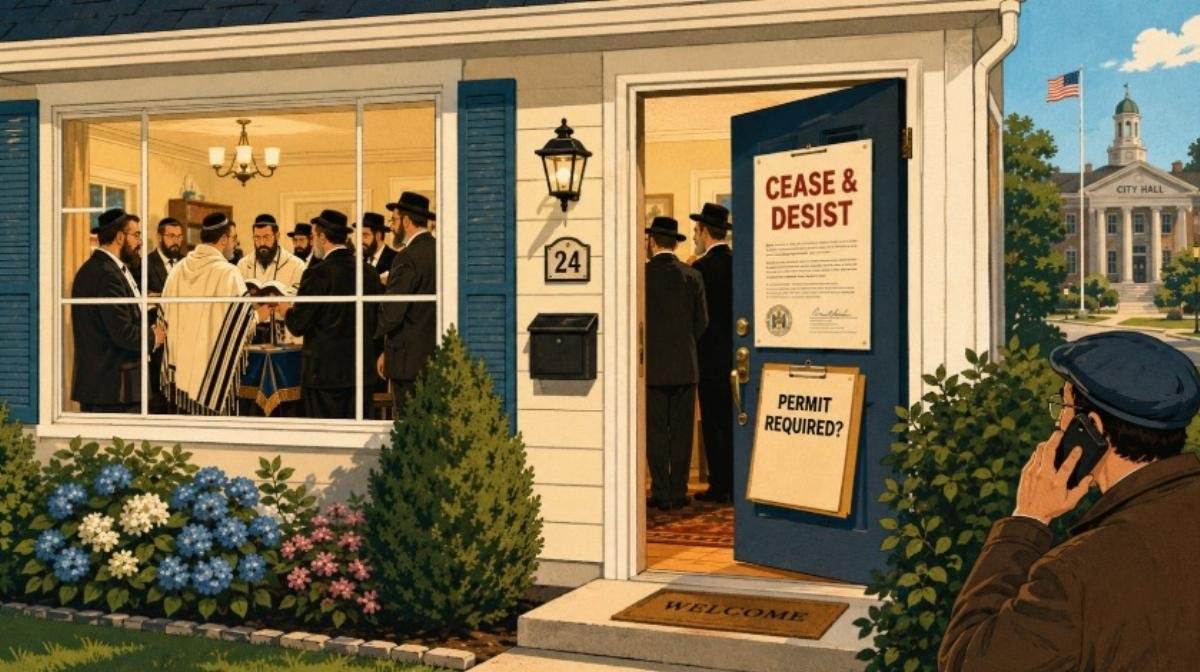
When Daniel Grand sent an email in January 2021 inviting roughly a dozen friends to his University Heights, Ohio home for a Shabbat minyan—a Jewish prayer gathering—he didn’t expect it would trigger a legal battle reaching all the way to the Supreme Court. Yet five years later, Grand remains barred from hosting such gatherings, caught in what critics characterize as bureaucratic gamesmanship that raises fundamental questions about religious freedom in America.
According to the Washington Post, a neighbor intercepted Grand’s invitation and complained to the mayor, explicitly asking him to “put a stop to this.” What followed reads less like municipal governance and more like selective enforcement: the mayor personally called Grand about what he termed an “urgent matter,” and a city official ordered him to “immediately cease and desist” using his home as a “place of religious assembly” until he obtained a special-use permit required for “houses of worship” under local zoning ordinances.
Grand complied. He canceled the gathering and applied for the required permit. Then things got strange.
Bureaucratic Limbo as Enforcement Tool
More than 100 people attended a virtual public hearing on Grand’s permit application, after which the city’s planning commission simply tabled it—where it has remained ever since. For five years, Grand has been prohibited from hosting prayer gatherings in his own home. The mayor reportedly encouraged neighbors to report any suspected violations so the city could take Grand to court. Police surveillance of his home allegedly followed.
Rather than wait for criminal charges, Grand sued, alleging First Amendment violations. The case has since languished in various courts, bogged down in technical legal arguments that have never addressed the core constitutional question: Can a government require homeowners to obtain permits before inviting friends over for prayer?
The Supreme Court agreed last month to hear the case, finally forcing that question into the open. The technical legal issues that have kept lower courts from addressing the merits—precisely the procedural maze Grand’s attorneys argue constitutes unconstitutional burden—are now themselves the subject of high court scrutiny.
When Does a Home Become a House of Worship?
The city’s position hinges on classifying Grand’s home as a “place of religious assembly” requiring special permits. Grand has maintained throughout that hosting a minyan—which requires ten adult Jews for certain prayers—does not transform his residence into a house of worship any more than a dozen friends gathering for any other purpose would transform it into whatever venue that purpose might typically occupy.
This distinction matters immensely. Americans routinely host gatherings of a dozen or more people for birthdays, holidays, game watching, book clubs, and countless other purposes without municipal permits. Many such gatherings, particularly around Christmas, Easter, Passover, and other religious holidays, include prayer as a component. Yet University Heights chose to intervene specifically when Orthodox Jews planned to pray together.
The timing is telling. According to reports, the neighbor complained and the mayor acted before the gathering even occurred—suggesting the objection wasn’t to noise, parking congestion, or any actual disturbance, but to the nature of the gathering itself. How else would the neighbor and mayor have known to invoke “house of worship” regulations based solely on an email invitation?
The Selectivity Problem
Would a neighbor have complained about an email announcing a Christmas dinner that would include grace? Would 100 people attend a public hearing if someone wanted to host carolers singing “Oh Holy Night” in their home? Would police surveil a house where families gathered for Easter brunch and prayer?
These questions aren’t rhetorical flourishes—they cut to the heart of equal protection under the law. If municipalities can selectively enforce permitting requirements based on the religious nature or denominational identity of private gatherings, the First Amendment’s protections become functionally meaningless. The freedom to observe one’s faith collapses into the freedom to observe one’s faith only when local officials and busybody neighbors approve.
The Indefinite Process as Punishment
Perhaps most troubling is what Grand’s attorneys identify as “bureaucratic gamesmanship”—the city’s ability to avoid judicial review of the underlying constitutional question by indefinitely extending administrative processes. More hearings. More information requests. More procedural hurdles. All while no federal court addresses whether any of this is constitutional.
This strategy, if upheld, would hand local governments a roadmap for circumventing constitutional protections: simply create enough bureaucratic hoops that religious observers must jump through, then keep adding hoops whenever judicial review threatens. The process itself becomes the punishment, and the constitutional violation.
Five years is a long time to be prohibited from practicing one’s faith as one sees fit in one’s own home. It’s long enough to make the point that challenging local authority comes with costs—costs measured not just in legal fees and stress, but in years of one’s religious life constrained by government decree.
A Test Case for Religious Freedom
The Supreme Court’s decision to hear this case signals recognition that something has gone seriously wrong in University Heights. The question before the Court isn’t particularly complex from a constitutional perspective: Americans have the right to freely exercise their religion, and governments cannot impose substantial burdens on that exercise without compelling justification.
Hosting a dozen friends for prayer in one’s home—producing no more disturbance than hosting a dozen friends for dinner or cards or football—hardly seems like the kind of activity that requires government permission. That it has taken five years and a Supreme Court case to establish this point says something unsettling about how easily constitutional protections can be eroded through administrative action.
Grand’s case will test whether religious exercise receives genuine protection or merely theoretical protection that evaporates when local officials decide to enforce zoning codes selectively. It will determine whether Americans need permission slips from city hall to practice their faith with friends in private homes.
The constitutional answer should be obvious. Whether the current Supreme Court will provide it remains to be seen, but the very fact that this case has consumed five years of Grand’s life while he remains unable to host prayer gatherings demonstrates how vulnerable religious freedom can be to bureaucratic hostility—even in 21st century America.
Source: www.americanthinker.com — https://www.americanthinker.com/articles/2026/07/a-permit-to-have-friends-over/