
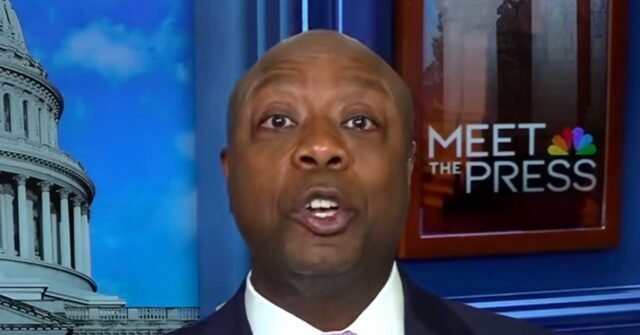
Sen. Tim Scott (R-SC), chairman of the National Republican Senatorial Committee (NRSC), expressed strong confidence that Republicans will retain control of the Senate after the November midterm elections, despite recent moves in nonpartisan race ratings that have favored Democrats.
Appearing Sunday on NBC’s “Meet the Press,” Scott pushed back on host Kristen Welker’s framing of the electoral landscape, which cited the Cook Political Report’s findings that six key battleground races had shifted away from Republicans since April, including Texas and Iowa moving from “Lean Republican” to “Toss Up” just this week.
“Well, I am very confident that we will be in the majority at the end of November this year,” Scott said. He attributed his optimism not to polling but to what he characterized as the weakness of Democratic candidates running in competitive states.
“We are facing the most dangerous, radical, and frankly, Kristen, weird Democrats I’ve seen in my lifetime,” Scott said, repeating a line of attack that Republicans have increasingly used against their opponents in the 2026 cycle.
Scott spotlighted races in Texas, Michigan, and Iowa, painting Democratic contenders as out of step with voters in their states on issues ranging from religion to taxes.
In Texas, Scott targeted James Talarico, the Democratic nominee for the Senate seat currently held by retiring Sen. John Cornyn. Scott claimed that Talarico “believes that God is non-binary,” a statement he said shows the candidate is “so out of step with Texans” that a bipartisan coalition is forming behind Republican candidate Ken Paxton.
“We’re seeing a coalition building around our candidate, Paxton, Republicans and Democrats and independents coming together to make sure that James Talarico never seats the Senate floor,” Scott said.
Turning to Michigan, Scott described Democratic nominee Abdul El-Sayed as “the same kind of dangerous, radical, weird candidate,” without elaborating further. He said such candidates are appearing “all over the country,” and that Republicans “feel really good about where we are.”
In Iowa, Scott praised Republican candidate Ashley Hinson as “a strong, powerful candidate running very strong in her state.” He contrasted her with Democratic opponent Josh Turek, whom he accused of supporting tax increases.
“Josh Turek has never seen a tax increase he didn’t like,” Scott said. “We’re talking about someone willing to take resources out of the pockets of people working overtime. We’re talking about someone who believes that raising taxes will help people in Iowa meet their needs and buy their groceries.”
The NRSC chair did not address the specific reasons cited by the Cook Political Report for the shifts in race ratings, which often reflect changes in candidate quality, fundraising, or demographic trends. Instead, Scott’s remarks leaned on cultural and fiscal attacks designed to frame Democratic candidates as outside the mainstream.
Scott’s confident prediction comes as Republicans defend a narrow Senate majority, with several open seats and incumbents facing competitive challenges. The NRSC has poured resources into battleground states, but recent ratings changes suggest a more volatile environment than the committee’s public messaging might imply.
Political analysts note that midterm elections historically favor the party out of power, a dynamic that could put Republicans on defense despite their current majority. However, Scott’s remarks suggest the NRSC sees the Democratic candidates themselves—rather than national headwinds—as the key vulnerability to exploit.
The “Meet the Press” interview is part of a broader Republican strategy to define Democratic hopefuls early, particularly in states where they may be less well-known. Whether that message will resonate with moderate voters—including the independents and Republicans Scott claims are uniting behind Paxton—remains to be seen.
Neither Talarico, El-Sayed, nor Turek have responded publicly to Scott’s characterization of their positions. Their campaigns have previously emphasized kitchen-table issues like healthcare, wages, and economic opportunity.
With the election now roughly three months away, both parties are expected to escalate their messaging in the coming weeks. For Scott, the path to retaining the majority runs through Texas, Michigan, and Iowa—states where he insists the battle is already being won.
Source: www.breitbart.com — https://www.breitbart.com/clips/2026/08/23/tim-scott-i-am-very-confident-that-we-will-be-in-the-majority-at-the-end-of-november-this-year/