
Nearly a century ago, a heartbroken young boy supposedly pleaded with Shoeless Joe Jackson, “Say it ain’t so, Joe!” after the baseball star admitted to throwing the 1919 World Series. Today, critics of Britain’s Royal Yachting Association (RYA) are echoing that same plea — but this time, the scandal is over words, not bribes.
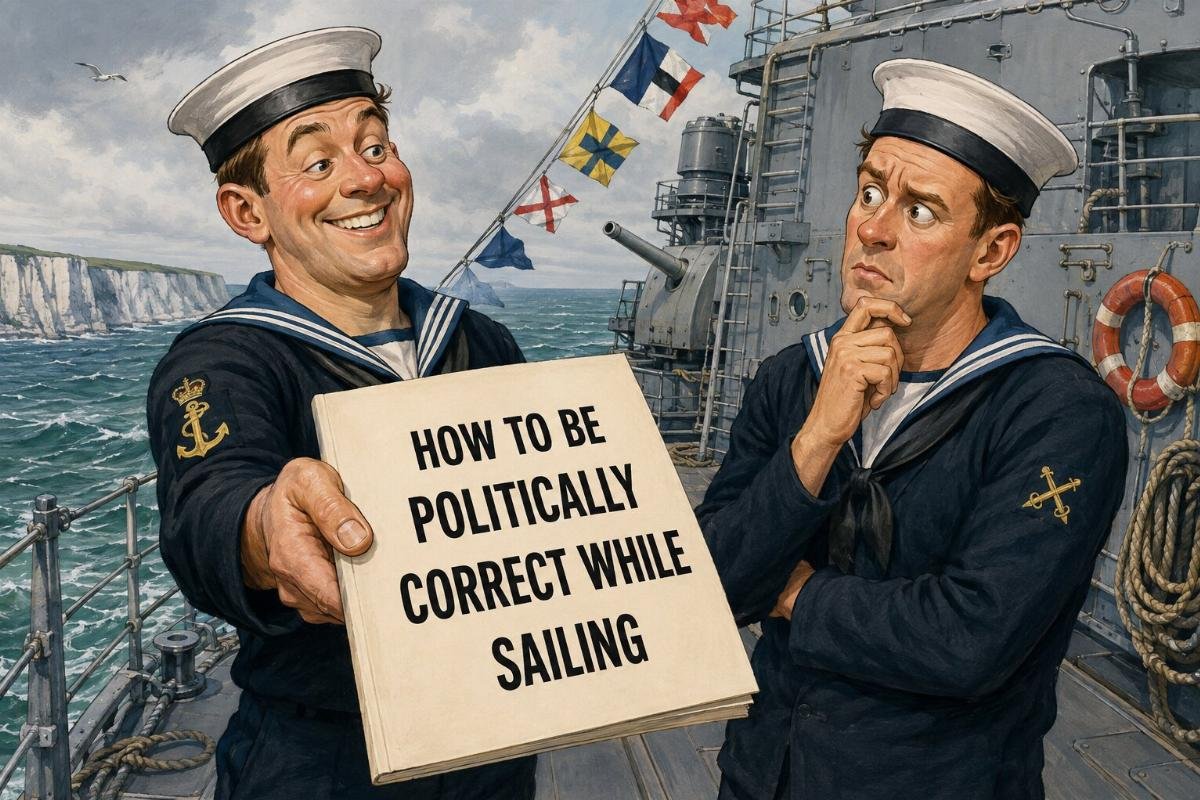
According to a recent commentary in American Thinker, the RYA — the UK’s national governing body for recreational sailing, dinghy, motor, and sail cruising — has issued guidance urging sailors to replace historically gendered terms with more inclusive alternatives. Among the most eyebrow-raising changes: “man overboard” should now be called “person in water.”
A 150-year-old institution wades into the culture wars
The RYA, founded in 1875, is tasked with overseeing operational safety rules for the country’s waterways. But its newest recommendations go beyond life jackets and right-of-way rules. The organization argues that more inclusive language is needed to recognize the “honours and values” of women and non-binary people involved in sailing.
That reasoning has drawn sharp criticism from commentators who see the move as a prime example of overreach. James Zumwalt, writing for American Thinker, called the changes “ridiculous” and suggested that the “hardened sailors of yesteryear would be turning in their graves.”
The critique also takes aim at the practical side of the change. “Man overboard” is four syllables; “person in water” is five. In an emergency, every second counts — and critics argue that adding even a single syllable to a distress call could be a matter of life or death.
More than just a phrase: a full vocabulary overhaul
The RYA’s guidance doesn’t stop at “man overboard.” The organization has reportedly recommended replacing “seamanship” with “boat handling,” “navigation,” “deck work,” or “maintenance.” “Sportsmanship” would become “sporting behaviour.” “Winchman” gives way to “person on the winch” or “winchperson.” And “helmsman” — a term as old as sailing itself — simply becomes “helm.”
Even the phrase “mother duties” is on the chopping block, with the RYA suggesting “cooking and cleaning duties” as a more inclusive alternative. That change aims to avoid implying that onboard cooking and cleaning fall only to women.
Zumwalt was quick to lampoon the effort, noting that the term “balderdash” — a favorite insult among critics — could itself be seen as excluding women because it contains “bald.” The line is jokey, but it underscores the broader concern: when language policing goes too far, even the language used to criticize it becomes fair game.
A pattern of ‘woke’ overreach or a step toward inclusion?
The RYA’s move is part of a larger trend, per the American Thinker piece, in which leftist groups have stretched the concept of “woke” far beyond its original mid-20th-century meaning of keeping alive the claim of racism toward Black America. That term now encompasses everything from gender-neutral job titles to maritime vocabulary — and, in the author’s view, has developed a negative connotation because it undermines common sense.
Supporters of inclusive language would likely counter that words matter, and that updating terminology to reflect the diversity of who participates in sailing is a simple courtesy. They might argue that “person in water” is more accurate anyway — after all, not everyone who falls off a boat is a man.
But the American Thinker piece frames the RYA’s guidance as an attack on tradition and practicality. The author notes that old seafarers would not recognize the sport they loved, and that the new terms, longer and less precise, could hamper emergency communication.
Whose tradition, whose safety?
The debate raises a perennial question: how much should tradition bend to accommodate changing social norms? Maritime language is steeped in centuries of history — “seamanship” evokes the craft and skill of those who have navigated the world’s oceans. But it also, in its very construction, defaults to the masculine.
For the RYA, the answer appears to be that inclusivity trumps heritage. By issuing guidance that its members are expected to follow, the organization is signaling that the future of sailing will be one where gender is less visible in the language of the water.
Critics, meanwhile, see a slippery slope. If “man overboard” is now offensive, what’s next? Will “fisherman” become “fish harvesting technician”? Will “starboard” need a gender-neutral alternative because it contains “board” — a word that could be seen as excluding women who aren’t on boards of directors?
Zumwalt’s piece leans into that absurdity, inviting readers to laugh at the RYA’s lengths. But it also issues a serious warning: “more than ever, the ability to speak our minds is crucial to the republic we cherish.”
A storm in a teacup or a sign of the times?
It’s easy to dismiss the RYA’s language guidance as a minor bureaucratic quirk — the kind of thing that makes good fodder for editorials but has little real-world impact. After all, no one is going to be fined for saying “man overboard” during a real emergency, and the RYA has no authority to police casual conversation.
But the controversy speaks to a deeper cultural divide. On one side are those who see language as alive and evolving, a tool that should be molded to reflect values of equality and respect. On the other are those who see it as a vessel of heritage, carrying the lessons and traditions of the past — and, in this case, the very principles of safety that govern life at sea.
For now, the RYA’s guidance stands as a recommendation, not a mandate. But the backlash is a reminder that, for many, certain words are more than just sounds — they’re the anchors of identity.
As the American Thinker piece concludes, the phrase “man overboard” may one day go the way of other archaic terms, replaced by the more neutral “person in water.” But if that day comes, don’t expect the old salts to go quietly. They’ll be too busy shouting “balderdash!” — and hoping no one calls them out for the “bald” in it.
This article is based on a commentary originally published by American Thinker on August 24, 2026.
Source: www.americanthinker.com — https://www.americanthinker.com/blog/2026/08/another-ridiculous-wokeism-rant-say-it-ain-t-so/