
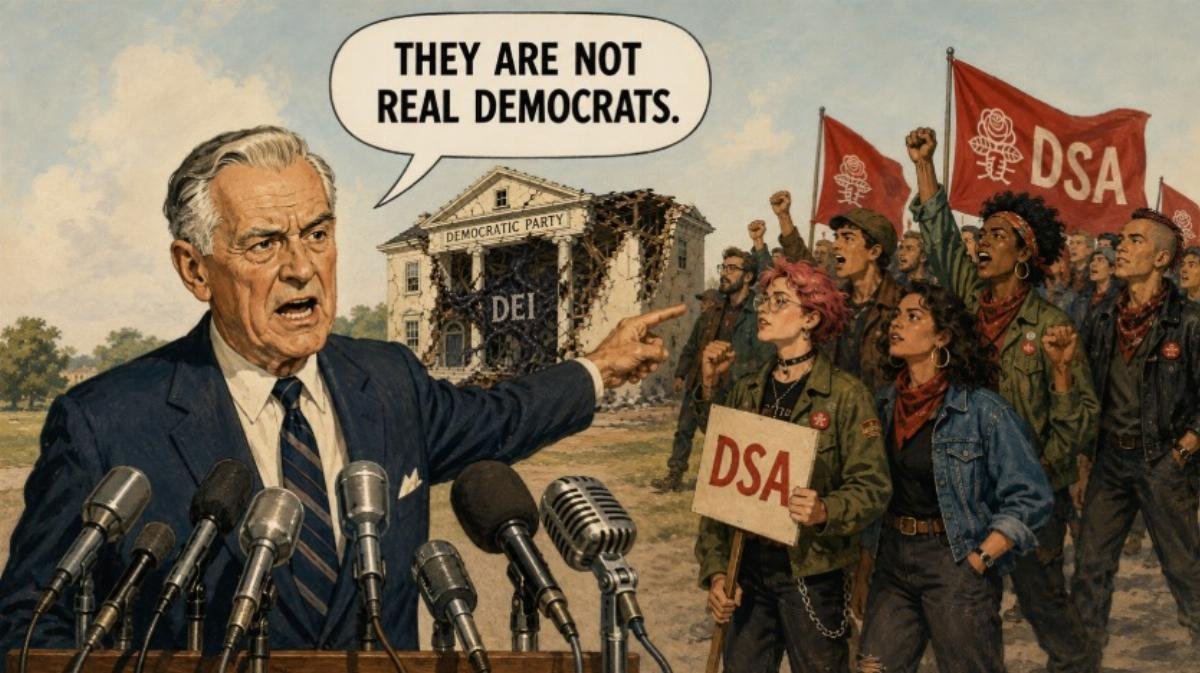
For years, the standard Democratic response to questions about socialist candidates has been a familiar refrain: ‘They’re not real Democrats.’ But according to a new column at American Thinker, that talking point is wearing thin — and the party may have already passed the point of no return.
Writing for the conservative outlet, columnist Silvio Canto Jr. argues that the Democratic establishment’s reflexive denials about Democratic Socialists of America (DSA) candidates are no longer credible. He likens the situation to trespassers driving with someone else’s license — people who have somehow claimed the ‘D’ label while pushing for ideas far outside the party’s traditional mainstream, including eliminating the Senate and legalizing activities currently prohibited under the law.
The column leans on analysis from Harrison Berger, who contends that ‘there’s a rot in this party deeper than the ocean.’ Berger’s argument, as summarized by Canto, is that the modern Democratic Party has undergone a fundamental transformation over the past three decades — moving from a big-tent coalition of working-class voters into an elite-driven institution obsessed with diversity, equity, and inclusion, commonly known as DEI.
A Party Transformed
The shift described in the column is not subtle. Where the party once courted a broad swath of Americans across economic lines, it now prioritizes identity-based politics above nearly everything else. This evolution, according to the piece, hasn’t just changed the party’s platform — it has changed the way its members relate to one another and to the country as a whole.
Canto draws on personal experience to illustrate the fallout. He recalls a longtime friendship where political discussions were once possible, even when the two disagreed. Now, he writes, every conversation inevitably turns to Trump or skin color. Every issue is blamed on Trump. Every story features a victim of color or a villainous white Trump voter. The result, in his telling, is a political culture that has destroyed friendships and generated pervasive ill will.
He goes further, suggesting that DEI has turned the human resources professional into ‘an obnoxious jerk’ dictating how people should talk and what they should say to colleagues. The critique extends beyond the workplace, framing DEI as a societal poison that has ‘killed our society and the Democrats too.’
The DSA Question
The core political claim is that the Democratic Party can no longer plausibly disown its most radical wing. As the column frames it, DSA members running with a ‘D’ next to their name are not anomalies or infiltrators — they are the next generation of the party.
Canto suggests that merely denying association won’t fix what ails the party. In his view, the damage is structural, embedded in the party’s very approach to identity and inclusion. He calls for replacing DEI with ‘USA’ and urges Democrats to ‘love their country again.’
Whether one agrees with that prescription or not, the column taps into a broader observation that has echoed across political commentary in recent years: the Democratic coalition has grown more ideologically diverse — and more visibly inclusive of socialist-adjacent figures — even as its leadership insists such figures represent only a fringe.
That stretch, per this analysis, is becoming impossible to maintain. Voters, the piece argues, can see the seams. When a candidate with a ‘D’ next to their name supports abolishing the Senate or decriminalizing currently illegal acts, the distinction between ‘real’ Democrats and DSA-backed insurgents becomes a matter of semantics rather than substance.
Beyond the Headlines
The American Thinker column is unabashedly conservative in its framing and its conclusions, and it should be read as an opinion piece rather than an objective news report. But its central question — what does it mean to be a Democrat in 2026? — is one that political observers of all stripes have been asking with increasing frequency.
Canto’s answer is stark: the party has been broken by its own ideology, and no amount of behind-the-scenes distance from the DSA will repair it. Whether the party will ultimately heed that warning or continue to dismiss it as conservative wishful thinking remains to be seen. But the frustration it captures among former Democrats and independent voters is not something the party can simply wave away.
For now, the column concludes with a simple plea: that Democrats rediscover a love for their country and abandon the identity-driven framework that has, in this telling, pushed them to the political and cultural margins. It’s a call that will resonate with some and enrage others — but it highlights a real tension that the party has yet to resolve.
Source: www.americanthinker.com — https://www.americanthinker.com/blog/2026/08/will-the-real-d-please-stand-up/