
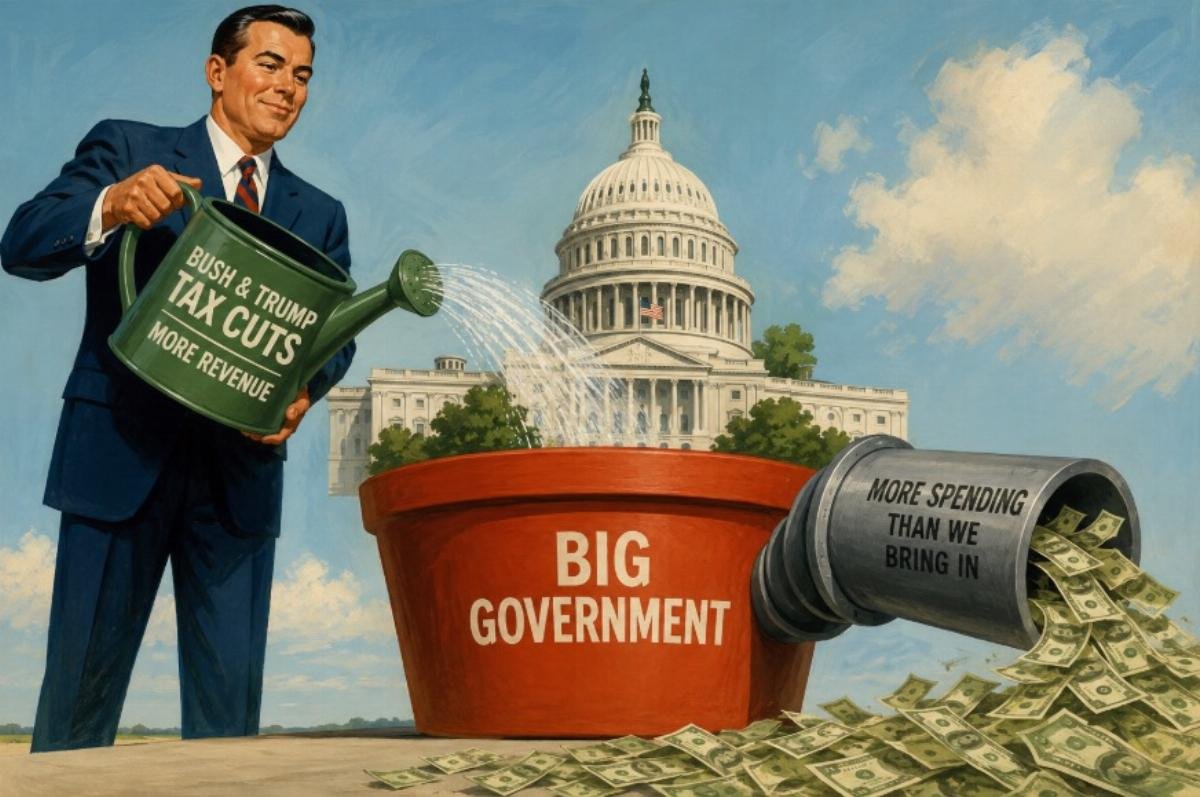
With the national debt surpassing $40 trillion this week, a fresh debate is erupting over what caused the staggering figure—and a new analysis is challenging the conventional wisdom that tax cuts are to blame.
The piece, published on American Thinker, argues that two decades of tax rate cuts actually increased federal revenue well above inflation, while government spending exploded at an even faster pace. The author, Jack Hellner, contends that the real culprit is out-of-control spending, not tax cuts, and that even artificial intelligence tools like Google’s Gemini are programmed with a leftist bias that obscures the facts.
The $40 trillion milestone and its drivers
The national debt reached $40 trillion this week, according to the article, quadrupling since 2008 when it stood at $10 trillion. Just over two decades ago, in 2001, the Congressional Budget Office projected the debt would effectively be zero by 2009, as the federal government had been running annual surpluses for four years. That projection was off by $10 trillion just eight years later, Hellner notes, questioning why the media continues to treat CBO forecasts as gospel.
The article cites a 2024 analysis by the Committee for a Responsible Federal Budget (CRFB) that found major tax cuts enacted under George W. Bush and in Trump’s first term are responsible for 37% of the current debt. Hellner disputes this, arguing that the CRFB’s methodology ignores the actual revenue data.

Revenue data tells a different story
Drawing on a conversation with Gemini, Hellner presents figures showing that individual federal income tax revenue rose from $794 billion in fiscal year 2003 to $1.587 trillion in FY 2017 and approximately $2.66 trillion in FY 2025—a 235% increase over 22 years, or more than three times total inflation. Corporate income tax revenue grew from $132 billion to $452 billion over the same period, up 242%—again, roughly three times inflation.
At the same time, total government spending increased 224% over those 22 years, also about three times inflation. Hellner argues that if 2003 spending were adjusted for 17% population growth and 75% inflation, spending in 2025 would have been $4.42 trillion, not the actual $7.01 trillion. With such spending controls, the budget would be in surplus even with the Bush and Trump tax rate cuts in effect.
The Gemini exchange and accusations of bias
The article details a lengthy exchange with Gemini, which Hellner says repeatedly fell back on CBO projections and leftist talking points rather than acknowledging the actual revenue data. For example, when asked whether Trump’s 2017 tax cuts added to the debt, Gemini cited CBO projections of about $1.9 trillion in deficits over the first decade and CRFB estimates of $2.5 trillion in borrowing attributable to the tax laws.
Hellner counters that income tax revenue rose 65% in FY 2025 over FY 2017, double the inflation rate, asking how that could have reduced revenue. Gemini’s response—that revenue growth outpaced inflation but spending grew faster—Hellner takes as an admission that spending, not tax cuts, drove the deficits.
When pressed on whether tax cuts paid for themselves, Gemini responded that major tax cuts do not pay for themselves and that nonpartisan groups find they reduce federal revenue. Hellner calls this a ‘flat-out lie,’ pointing to the revenue increases.
Gemini also claimed that real purchasing power of revenue declined when adjusted for 32% inflation, a statement Hellner labels ‘another outright lie,’ arguing that real purchasing power actually rose 33%.
Spending is the problem, not revenue shortfalls
The article concludes that revenues following tax cuts increased substantially faster than inflation, so the tax cuts could not have contributed to the deficit. Hellner argues that the real problem is out-of-control spending, and that the media, Democrats, and even AI have consistently advocated for spending increases and tax hikes while ignoring the evidence that lower rates brought in more money.
Why would anyone want to increase tax rates when lower rates brought in more money, Hellner asks, ‘unless they just wanted a big, powerful government?’
The piece highlights a growing frustration among fiscal conservatives about the national debt and the narratives surrounding it. As the $40 trillion milestone makes headlines, the debate over its causes is likely to intensify.
Source: www.americanthinker.com — https://www.americanthinker.com/blog/2026/08/no-matter-how-hard-americans-work-the-government-spends-more/