
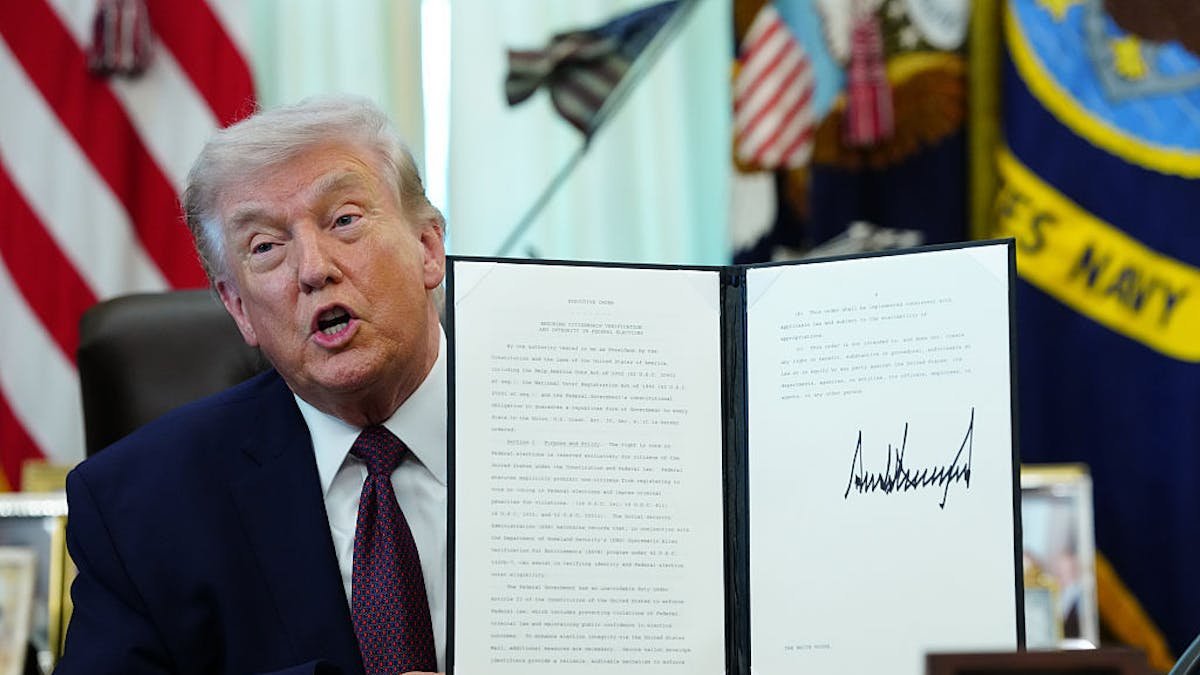
The Trump administration is moving to dramatically raise the cost of hiring skilled foreign workers, proposing a new $103,265 fee on most H-1B visa petitions that would make it far more expensive for U.S. employers to bring talent from abroad.
The Department of Homeland Security unveiled the proposed rule Monday, targeting petitions subject to the program’s annual 85,000-visa cap — including those filed on behalf of foreign graduates with advanced degrees from American universities. The charge would stack on top of existing filing fees, which typically run from hundreds to thousands of dollars depending on company size and petition type.
The administration argues the fee is necessary to curb what it calls systematic abuse of the program, claiming employers have used H-1B visas to replace American workers with cheaper foreign labor. Officials also contend the current system fails to prioritize the most highly skilled applicants.
“The proposed rule would encourage employers to hire and train American workers rather than relying on foreign labor,” the administration said in a statement accompanying the proposal.
But the measure has already drawn sharp opposition from business and immigration groups, which warn it could disrupt hiring at hospitals, tech firms, and research institutions that depend on H-1B workers to fill specialized roles.
Scope and Impact
The new fee would apply to all H-1B petitions subject to the annual statutory cap, regardless of whether the worker is currently in the U.S. or applying from overseas. That marks a shift from previous proposals, which primarily targeted new entrants to the labor market.
The distinction matters because many employers use H-1B visas to transition foreign students and workers already legally present in the United States into long-term employment. Under the proposed rule, a company hoping to sponsor a foreign graduate of a U.S. university — who is already working in the country — would face the same six-figure fee as one recruiting from abroad.
The H-1B program is capped at 85,000 new visas each year: 65,000 under the regular cap and an additional 20,000 for advanced-degree holders from U.S. institutions. Demand far outstrips supply, with U.S. Citizenship and Immigration Services reporting more than 211,000 registrations in the most recent lottery — meaning fewer than half of applicants received a visa.
Under the proposed fee structure, DHS estimates it would raise approximately $8.8 billion annually. The revenue would not be earmarked for H-1B processing alone; instead, it would help fund the broader legal immigration system, including immigration courts, enforcement operations, and visa processing across multiple agencies.
“The fee is intended to recover the costs of administering the legal immigration system, not just adjudicating H-1B petitions,” a DHS official said.

Exemptions and Reactions
The rule includes a carve-out for employers whose petitions are not subject to the annual cap, such as universities, nonprofit research organizations, and government research institutions. That exemption is expected to shield many teaching hospitals and academic medical centers from the fee, as they routinely recruit H-1B workers for medical and research positions.
Business and immigration advocacy groups have nonetheless voiced alarm, arguing the fee could price smaller companies out of the H-1B program and harm American competitiveness.
“The H-1B program allows American companies to access specialized talent that is not always available domestically,” said a spokesperson for a tech industry coalition. “Adding a six-figure surcharge would make it nearly impossible for many employers to fill critical roles.”
India’s largest technology industry association, Nasscom, also urged the administration to consider the H-1B program’s role in addressing U.S. labor shortages.
The proposal follows a rejected attempt by the Trump administration to impose a $100,000 H-1B fee last year. In June, Judge Leo Sorokin of the U.S. District Court for the District of Massachusetts struck down that effort, ruling that the White House had effectively imposed an unauthorized tax without congressional approval.

The administration appealed that decision, but the First Circuit declined to pause the judge’s ruling while the appeal proceeds. The new proposal is an attempt to sidestep the earlier legal defeat by implementing the fee through the federal regulatory process rather than through a presidential proclamation.
Broader Agenda and Next Steps
The H-1B fee is part of a broader administration push to restrict employment programs for foreign graduates. DHS is also considering a separate $100,000 fee on Optional Practical Training (OPT), which allows international students to work in the United States for up to three years after graduation.
Administration officials say making foreign labor more expensive will force companies to invest in American workers instead.
“American workers deserve a level playing field,” one official said. “The government shouldn’t be subsidizing foreign labor at the expense of U.S. employees.”
Critics counter that such fees would only raise costs for businesses and consumers while failing to address the underlying skills gap.
The proposed rule enters a 30-day public-comment period after its publication in the Federal Register. It could still be altered, withdrawn, or challenged in court before taking effect.
For now, the fate of the H-1B program — a linchpin of U.S. tech hiring — hangs in the balance, with the administration and its opponents gearing up for another legal and regulatory battle.
Source: www.dailywire.com — https://www.dailywire.com/news/trump-plans-to-throw-massive-new-wrench-into-h-1b-regime