
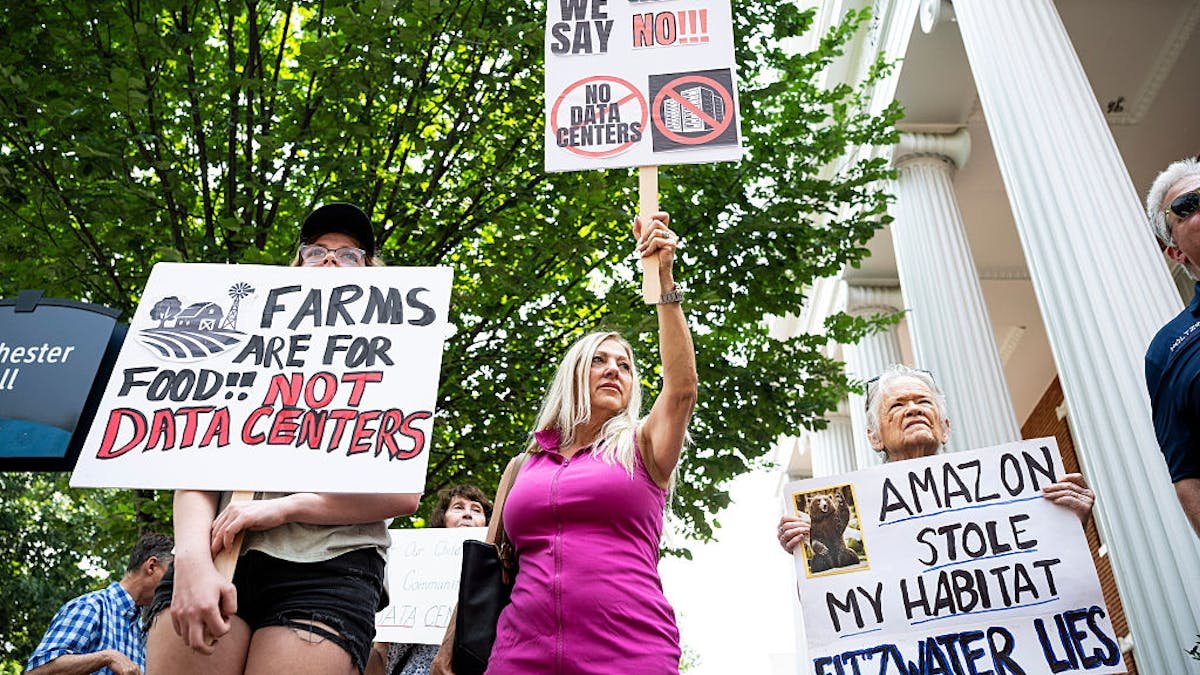
For years, data centers were the quiet workhorses of the digital economy — massive, windowless buildings humming in exurbs and industrial parks, powering everything from streaming video to cloud storage. They were rarely the subject of political controversy. That has changed dramatically over the last year, according to a new analysis from The Daily Wire’s tech correspondent, who argues that data centers have become a new front in the culture war — with strange political bedfellows on both sides of the aisle.
Pennsylvania Governor Josh Shapiro this week signed an order imposing what his office called the strictest data center rules in the country. New York Governor Kathy Hochul announced a statewide moratorium on hyperscale data centers. And Texas Governor Greg Abbott — long a champion of deregulation and business-friendly growth — ordered a pause on new approvals while the state audits how data centers will affect the Texas electrical grid.
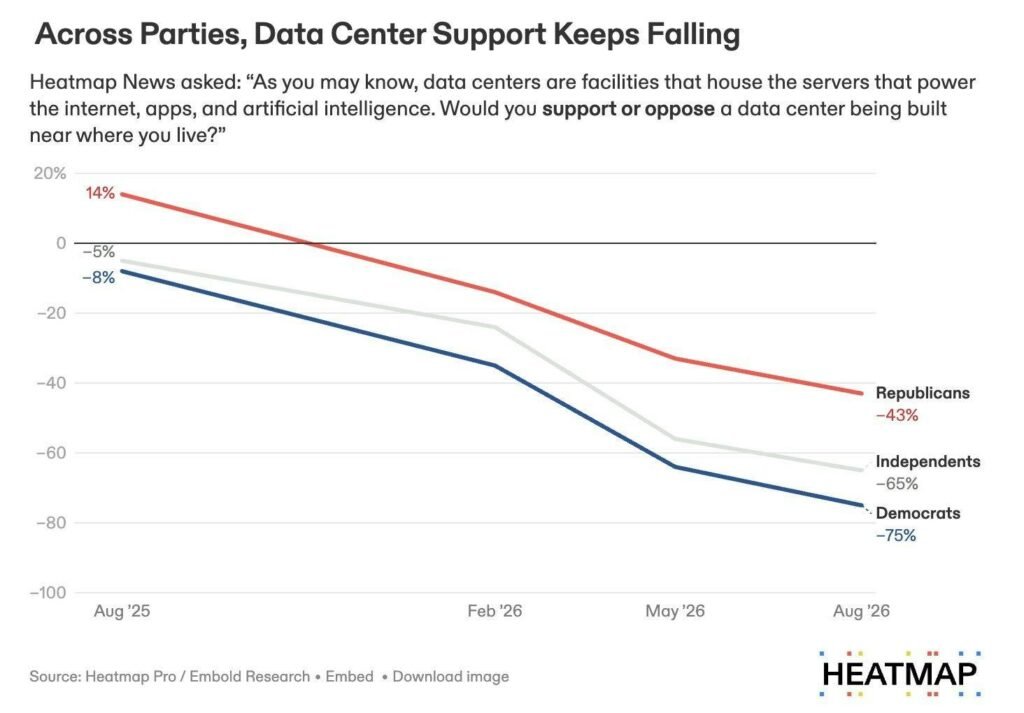
The moves are not isolated. Dozens of state and local governments have considered or enacted restrictions on data center construction over the past year, and the pattern is not partisan, according to the reporting. If there is a pattern, it is that the overall mood has turned sharply negative toward new data centers across the ideological spectrum. Polling cited by HeatMap shows public support for data centers has collapsed among both Democrats and Republicans.
Beyond the usual suspects
On the surface, the objections to data centers are familiar: they consume enormous amounts of water and electricity, generate noise and light pollution, and often require tax subsidies that local communities are increasingly reluctant to hand out. But the author, who writes from a tech-industry perspective, argues that these stated concerns are not the real driver of the backlash.
Citing a well-researched overview by the pseudonymous blogger Cremieux, the article notes that many of the commonly cited objections — from water usage to noise — don’t hold up to scrutiny, and that correcting misinformation doesn’t seem to change opponents’ minds. Cremieux’s conclusion was essentially: do whatever it takes to placate the opposition and just build. The Daily Wire piece suggests that approach is unlikely to work because the real grievances go deeper.
Jasmine Sun’s reporting for the piece “No Data Centers In My Backyard” gets closer to the heart of the issue. Sun, writing from Wisconsin and Michigan, documents the tension between local leaders who see data centers as a natural fit for otherwise undevelopable land, and residents who fear that big tech companies are making empty promises, manipulating local politicians, and planning to roll over the community.
The skepticism is rooted in experience. Sun points to the Foxconn deal in Wisconsin, where the company was offered $4 billion in tax incentives in exchange for a plant that was supposed to create 13,000 jobs. A decade later, only about 1,000 jobs have materialized.
Few jobs, big promises
Data centers, the article notes, are different from traditional manufacturing in one crucial way: they offer almost no permanent employment. A hyperscale data center can operate with just 100 to 200 employees after construction — fewer than a typical Buc-ee’s gas station. A review of permit filings for 17 data center projects in 2025 showed plans for only 1,547 permanent operations jobs.

Meanwhile, the same tech companies building these data centers have laid off 170,000 of their own employees in the last year, with many citing AI as the reason. For computer science graduates, the picture is particularly grim: unemployment rates for new graduates in computer engineering and computer science are now higher than for graduates in art history, according to data cited in the piece.
The author — who says they moved from Seattle to Chattanooga in 2021 — describes the disconnect between the tech world’s self-image and the reality in the rest of the country. In Seattle, a job at Amazon was a ticket to wealth and prestige. In Chattanooga, Amazon is the warehouse down the road, run by a demanding employer with a history of labor lawsuits. The two Amazon worlds have almost nothing in common.
A cultural clash
The core argument of the piece is that opposition to data centers is not really about megawatts or water rights. It’s about resentment toward a tech industry that wants to build in the heartland without actually joining the community. Tech companies will spend billions on a data center outside a Wisconsin town, the author writes, but won’t sponsor a Little League team, support the local Girl Scouts, or build a park.
The cultural gap is visible even within the tech industry itself, the article argues. The author points to Cremieux’s post urging data center supporters to persuade skeptics — the first thing a reader sees is an AI company sponsor offering $300,000 for junior software engineers, all in-person in San Francisco. That, the author says, is what the world looks like from inside the tech bubble: a social club with expensive prizes for those in the right cities.
The venture capital pouring into AI startups, the author contends, is not purely merit-based. It’s cultural. People who live in the South or Midwest can’t easily raise millions for an AI startup, not because their ideas are worse, but because they’re outside the orbit of the tech establishment.
Benevolence from on high
The article also takes aim at the tech industry’s self-image as a benevolent force. The author, who identifies as a tech optimist and AI enthusiast, admits that the optimism they see in their own circles is mostly about how good things are for the builders. Others outside tech, the author writes, are viewed not as participants in the future but as recipients of whatever good things tech deigns to create for them.
That attitude, the piece argues, is exactly what’s driving the backlash. Communities are being asked to host data centers that will employ a few hundred people at most, strain local resources, and enrich companies whose leaders openly say that AI will replace jobs. It’s no wonder, the author says, that even conservative states like Texas are starting to pump the brakes.
The piece ends with a warning: the tech industry may not realize it, but the culture war over data centers is really about the broader culture gap between the tech elite and everyone else. And that gap, the author argues, is not going to be closed by building more data centers. It’s going to be closed by changing the way tech companies treat the communities they enter.
Until then, the author suggests, the backlash will continue — and it may not matter how many studies show that the water and power concerns are overblown.
Source: www.dailywire.com — https://www.dailywire.com/news/how-data-centers-became-the-new-culture-war-provocation