
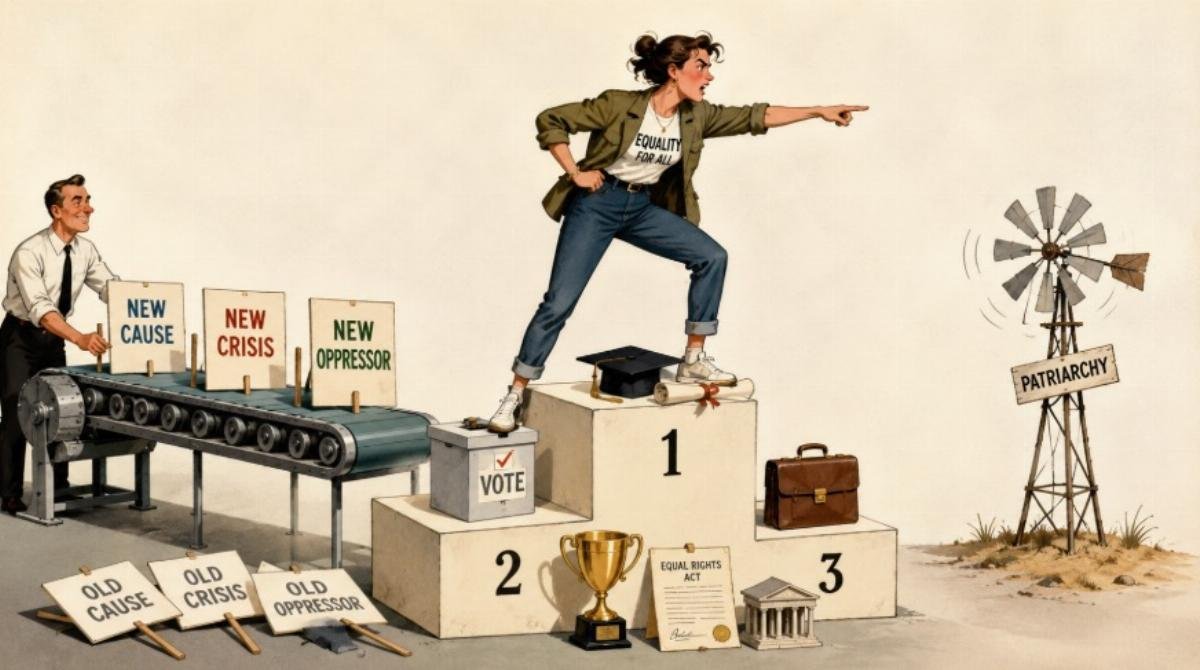
Conservative columnist Steve McCann is asking a provocative question in a new American Thinker piece: Why are so many liberal white women angry when, by many objective measures, they’ve won?
McCann points to a recent social media post by commentator Peachy Keenan, who listed a litany of gains: women make more money, hold the majority of jobs, are the majority of college graduates, and outnumber men on campuses like UCLA’s undergrad program, which is 60% female. Women live longer, have lower rates of suicide and addiction, and have broken into previously male-dominated spaces from combat roles to the Boy Scouts. Marriage is optional, no-fault divorce is law, women win the vast majority of custody battles, and they can’t be drafted. Keenan’s conclusion: “They won.”
McCann’s response is that winning hasn’t changed the core mindset. He argues the movement relies on a permanent victim-oppressor framework, with white men cast as the eternal villain. Because the goal is less about tangible achievement and more about finding “meaning” through a perpetual struggle against imagined demons like “the patriarchy,” there is no endpoint where victory is declared and the anger subsides.

As evidence, McCann recounts watching a panel discussion a year ago at a prestigious university, where feminist academics told a largely white female audience that the “civil rights movement” now encompasses everything from DEI and the LGBTQ movement to the plight of immigrants, Gaza, and Third Wave Feminism. What struck him was the absence of any acknowledgment of past accomplishments. Instead, the panelists painted the United States as an irredeemably racist and oppressive nation and received raucous applause for claiming that white privilege demands urgent cultural transformation. The young women in the audience, he writes, wore expressions of reverential discovery, as though they had finally found purpose.
McCann’s historical argument is that American civil rights crusades—abolition, suffrage, and desegregation—were rooted in Judeo-Christian values and succeeded over nearly two centuries. By 1970, he argues, there were no more overarching national civil rights issues to resolve. That left the Baby Boom generation, increasingly agnostic and narcissistic, without a grand moral cause. Into that void stepped the radical left, which manufactured new crusades—starting with Second Wave Feminism in the 1960s and 1970s—to exploit female emotion and keep the cycle going.
The result, McCann writes, is a movement that can never declare victory. It must continually invent new, increasingly radical causes to sustain its sense of purpose. He lists several: transgenderism redefined as a protected civil right, including unfettered access for minors to irreversible medical interventions without parental consent; a view of abortion that he characterizes as treating a baby as non-human until fully exiting the birth canal; a “corollary” that he claims permits infanticide when a mother claims postpartum depression; antisemitism disguised as anti-Zionism; open-borders immigration policies that refuse deportation even for violent criminals; government censorship of “hate speech”; and a permissive attitude toward crime as a byproduct of an unjust society.
McCann’s piece is deliberately provocative and likely to draw sharp criticism from the left and from feminists who would dispute his characterization of the movement’s goals and tactics. But his core observation—that the energy behind modern progressive activism seems sustainable only by continuously finding new battlefields—is a recurring theme in conservative commentary.
Whether one agrees with his diagnosis or not, McCann’s essay reflects a broader conservative frustration with a political opposition that appears, to them, to be motivated less by concrete policy wins and more by identity-driven grievance. It’s a view that resonates within the right, even as it risks caricaturing a diverse and deeply held set of beliefs.
The piece concludes with a call to action, urging readers to support American Thinker in the name of free speech, but the enduring question it raises—What would make the anger end?—remains unanswered, perhaps intentionally so.
Source: www.americanthinker.com — https://www.americanthinker.com/articles/2026/08/why-are-liberal-white-women-so-angry/