
When a scholar accused British professor Jason Arday of plagiarism, Cambridge University dismissed the allegation as “vile” and closed ranks. After the evidence became undeniable, the university promised a thorough investigation into how Arday was hired and how his misconduct went undetected. Following his death, Cambridge has now said it will not investigate those questions at all, opting instead to examine whether it supported Arday adequately after he was unmasked, according to the New York Times.
The Daily Wire reported that the Cambridge episode is not an outlier. A review of three plagiarism cases at American universities found a consistent pattern: institutions protected the accused, retaliated against those who raised concerns, and shielded their internal processes from scrutiny.
Maryland: A President, a Dissertation, and a Lawsuit
The most detailed case involves the University of Maryland Eastern Shore. More than a year ago, Sandeep Gopalan, then the university’s vice president for research and a former Rhodes scholar, filed a report with the state alleging that university president Heidi Anderson had committed large-scale plagiarism in the doctoral dissertation on which her career rests. The Daily Wire reported that Anderson kept her job, while Gopalan was stripped of his government grants and demoted to professor.
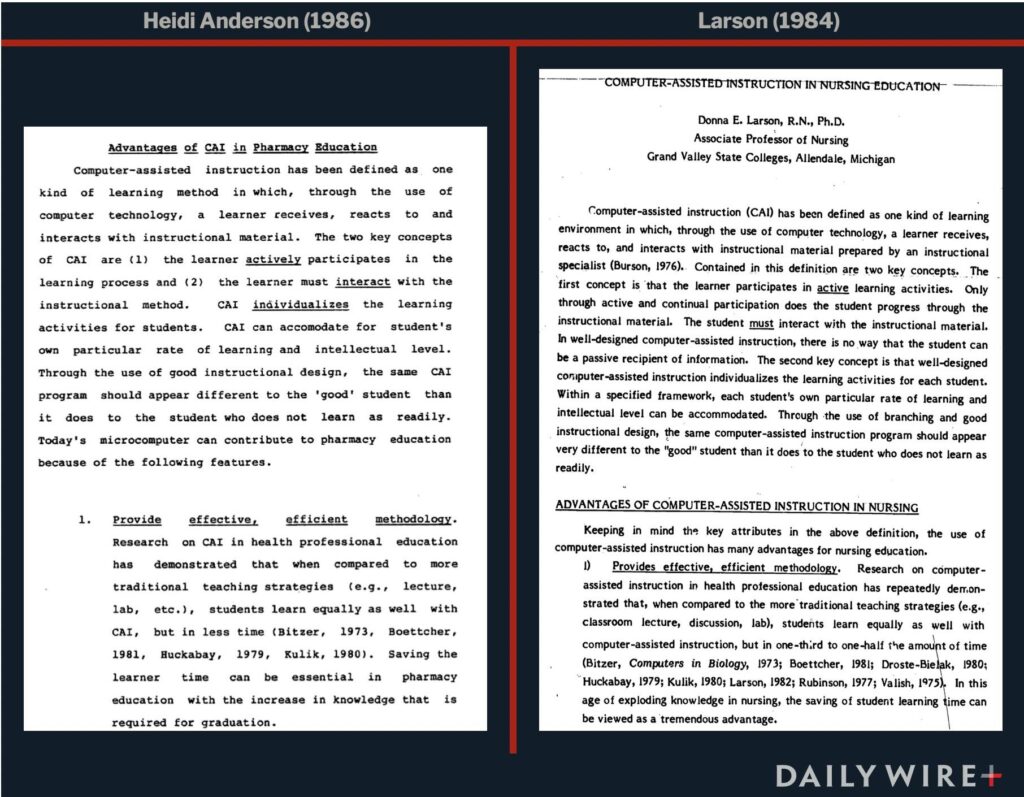
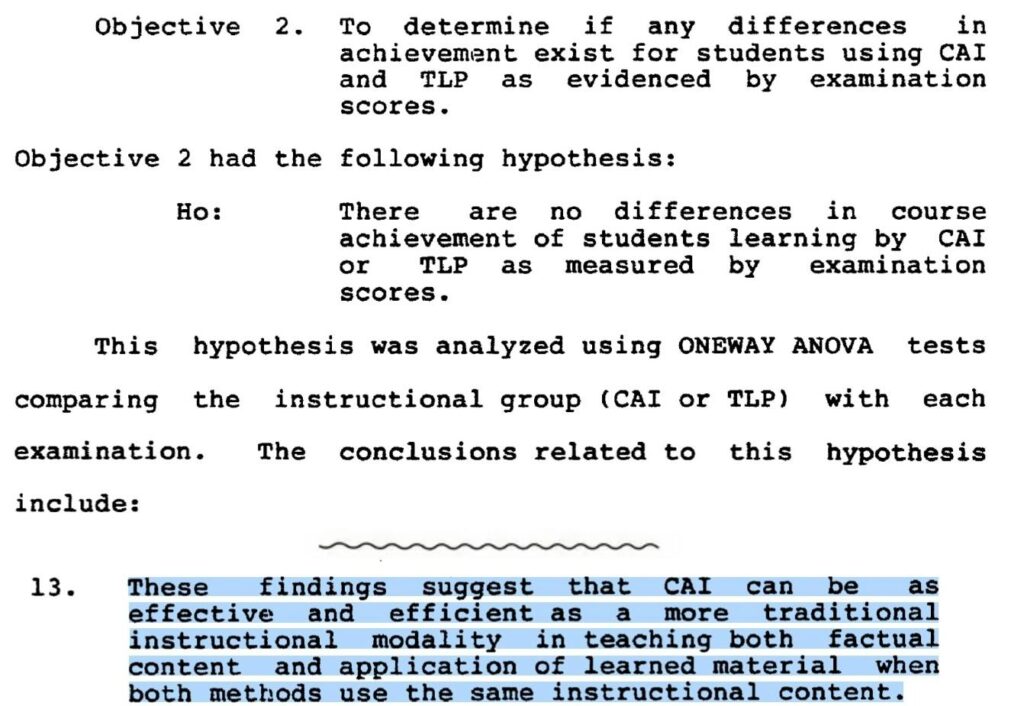
The Daily Wire’s own examination of Anderson’s 1986 dissertation, written about computers in pharmacy education, found extensive copying from a paper by Donna Larson about computers in nursing education. Portions of the text were reproduced with only the field name changed, and one citation — Larson’s reference to her own prior work — was removed, making it less likely reviewers would stumble onto the source. The outlet also noted that Anderson’s stated conclusion from original data, drawn from an experiment with 118 Purdue students, matched another academic’s prior paper word for word.
Anderson said publicly that “integrity, accountability, and trust are the foundations of my leadership and I take these concerns with the utmost seriousness,” according to the Daily Wire. The outlet reported that she simultaneously hired a lawyer to demand the story be removed from the internet, an accusation its attorneys rejected as baseless. Anderson then sued Donna Satterlee, a professor quoted in the piece, who had already been pushed out of her job. Gopalan agreed to represent Satterlee for free, but three days after notifying Anderson’s lawyers, he was added as a defendant — a move he said was designed solely to deprive Satterlee of a lawyer, since it disqualified him from representing her.
Anderson’s attorney, James Walker Jr., framed the matter in racial and political terms, saying he would “protect black women at all cost” and describing Satterlee, a registered Democrat, as a “MAGA supporter.” His firm did not respond to the Daily Wire’s email. In July, Maryland Judge W. Newtown Jackson III denied Satterlee’s motion to dismiss.
Gopalan counter-sued for retaliation, seeking $2 million, arguing that the conduct he was accused of — reporting a public university president’s plagiarism to the state body overseeing her — was a recognized professional duty. He filed a separate suit claiming Anderson terminated $4.6 million in federal grants he had won, leading to the firing of Ph.D. candidates working on cancer research. According to the Daily Record, Gopalan also filed a sealed whistleblower suit alleging that Anderson oversaw a “criminal enterprise” that defrauded the federal government of nearly $200 million by inflating enrollment figures, which reportedly rose from 1,800 to 2,700 between 2021 and 2025.
In August, Satterlee filed a racial discrimination lawsuit against Anderson and the school in state court, after a federal case was dismissed over her separation agreement. Maryland’s attorney general is defending Anderson at taxpayer expense, while Satterlee is representing herself. When Satterlee accompanied a friend to serve court papers on Anderson ally Grace Wasike Namwamba last month, Namwamba secured criminal trespassing charges against her for being on her front porch. Namwamba testified she called the police on the advice of the school’s lawyer. Satterlee had been driven out of her job on the pretense that she was bullying Namwamba by correcting mistakes in department-wide communications; the Daily Wire reported that a review of Namwamba’s own dissertation found passages copied from another paper with a linguistic error inserted as one of the only changes.
A Pattern Beyond One University
The Daily Wire noted that the tactics echo those used in the Arday case, where a law firm threatened a news publication and British police investigated an academic who questioned his research. The outlet described the broader findings as evidence of vicious retaliation, official investigations that cleared obvious misconduct, cult-like secrecy at taxpayer-funded universities, and professors willing to defend a total lack of standards.
The cases raise questions about whether academia has abandoned self-policing and whether a degree from these institutions still signals quality. In defamation law, a public figure like a university president must prove a statement was knowingly false — meaning Anderson would have to show not only that she did not plagiarize, but that no reasonable academic could believe she did. The Daily Wire argued that such a standard would require a world in which doctoral programs are held to lower standards than grade school, and would create precedent barring people from using their own judgment on the academic work of powerful figures.
Source: www.dailywire.com — https://www.dailywire.com/news/after-plagiarism-was-exposed-u-s-colleges-protected-culprits-punished-whistleblowers
Source: www.dailywire.com