
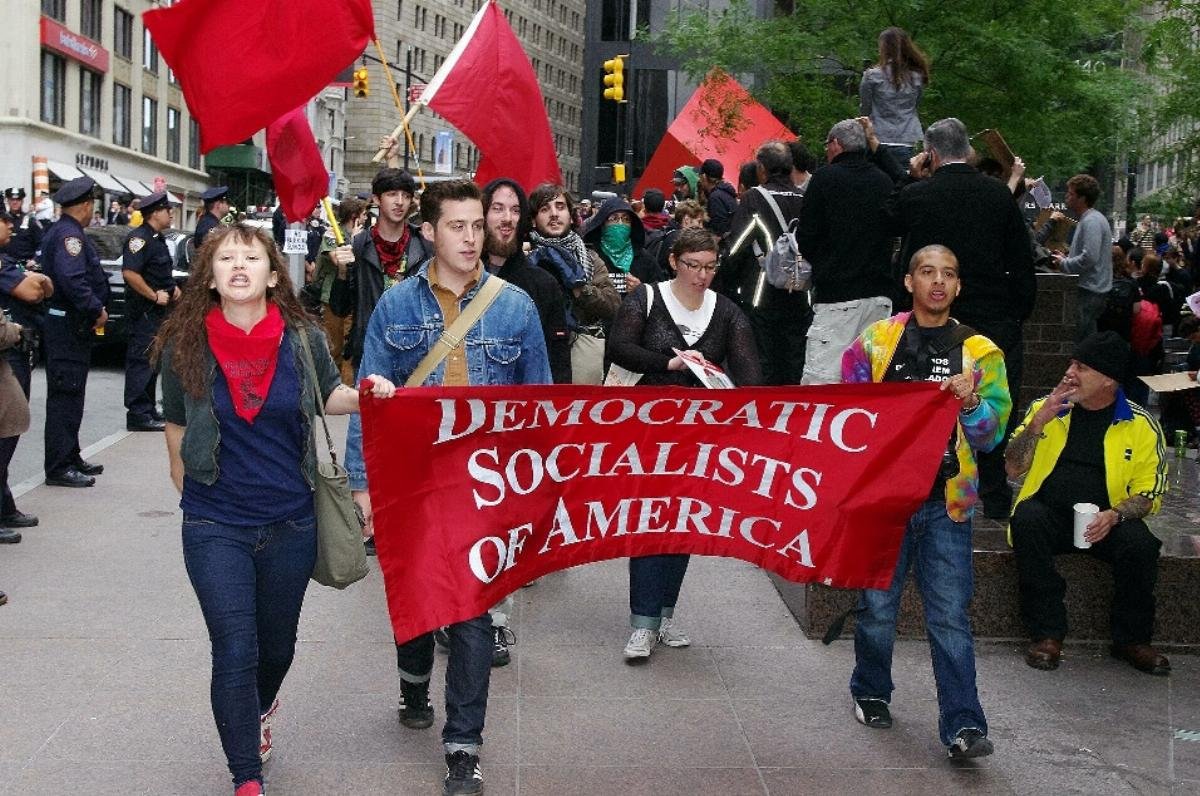
In a commentary published this month by American Thinker, writer Cole P. Ellison argues that two trends — the electoral rise of the Democratic Socialists of America and the growth of Islam as a political force in the United States — are not separate stories, but connected ones. The piece, titled “DSA and Islam: An unholy alliance,” contends that mainstream media outlets normalize socialist primary wins while treating any discussion of Islam and immigration as off-limits, and that those two postures are related.
The argument is not a news report but an opinion essay, and it rests on a stew of demographic data, historical narrative, and a warning drawn from Spain’s recent past. Whether readers find it persuasive will likely depend less on any single fact Ellison cites than on whether they accept his framing: that immigration policy should be evaluated first by what it means for the existing American population and its institutions.
The Demographic and Political Claims
Ellison begins with numbers. He cites Pew Research Center data showing Muslims make up roughly 1.6 percent of the U.S. population, with older projections putting that figure near 2.1 percent by 2050 — growth driven mostly by immigration and a younger age profile. He acknowledges that this is “still a small share,” but insists it represents “a real change.”
He pairs that with the DSA’s platform, which he describes as calling for abolishing ICE, legalizing migration, granting amnesty to people already in the country, and expanding protections regardless of immigration status. The DSA frames these positions as solidarity with an international working class, he notes. Ellison’s counter is that when a movement seeking to weaken border enforcement also advances policies that increase immigration from Muslim-majority countries, Americans should be permitted to ask what that means for the country.

That rhetorical move — recasting a question as one that has been forbidden — is central to the essay. Ellison does not allege a formal, coordinated alliance between DSA leadership and Islamic organizations. Instead, he argues that the two forces share a common effect: pressure on what he calls American sovereignty, and a willingness to treat “the basic character of the place as optional.”
The Spain Comparison
The longest section of the piece turns to Spain. Ellison traces the country’s Christian history — from financing Columbus to the centuries-long Reconquista, which ended in 1492 — and notes it remained majority Christian until the Spanish Socialist Workers’ Party took power in the early 1980s. At that point, he writes, about 90 percent of Spaniards identified as Catholic and church attendance was considerably higher.
Today, he says, Catholic identification has fallen to the low-to-mid 50s, with only a small share actually practicing. Over the same period, the Muslim population grew from well under 1 percent in the early 1980s to roughly 5 percent now — about 2.4 to 2.5 million people — a shift he attributes mainly to immigration from North and West Africa and to children born in Spain to those families.
Ellison is careful, at least on the surface, not to claim that Catholicism alone made Spain what it was. What he argues instead is that the combination of socialist governance, open immigration policies, and a rising Muslim population “changed the country in measurable ways.” His conclusion is blunt: “Spain should still look like Spain, not like Morocco or Algeria.” He frames the preservation of a native culture as a legitimate interest and urges Americans to study the Spanish record and decide they do not want the same outcome.
Where the Essay Goes Beyond Its Evidence
It is worth noting what the piece does and does not establish. The demographic numbers are attributed to Pew and to historical observation, and are presented as context rather than as proof of a causal chain. Ellison’s own language concedes this: his Spain argument is explicitly a correlation — socialism plus immigration plus Muslim population growth equals cultural change — rather than a demonstrated mechanism. Readers who accept the framing will see a cautionary tale; those who don’t will see a series of trends placed side by side and asked to carry more weight than they can.
The broader claim about a DSA-Islam alliance is likewise asserted rather than documented. There is no cited meeting, funding stream, or joint platform. The “alliance” in the headline is a claim about convergent interests and shared political effects, not an organizational fact. That distinction matters, because the essay’s power depends on the reader accepting the convergence as the thing that counts.
The Prescription
Ellison closes with a call to action rather than analysis. His position is that if Americans want to keep the country their ancestors left them, immigration policy must put the existing American people and their institutions first. Political movements that treat border enforcement as illegitimate, in his view, should be opposed for precisely that reason. And citizens who care about what the country has been should say so openly rather than treating the subject as forbidden.
“Spain already ran the experiment,” he writes. “We still have time to choose differently.”
The essay ends there — with a warning, a prescription, and an appeal that the ability to speak freely is crucial to the republic. It is a conclusion that will read to some as a reasonable defense of national boundaries and to others as a familiar argument dressed in demographic clothing. Either way, it is the kind of commentary that American Thinker’s readership expects, and it represents one strain of thinking in a debate that shows no sign of cooling.
Source: www.americanthinker.com — https://www.americanthinker.com/blog/2026/10/dsa-and-islam-an-unholy-alliance/