
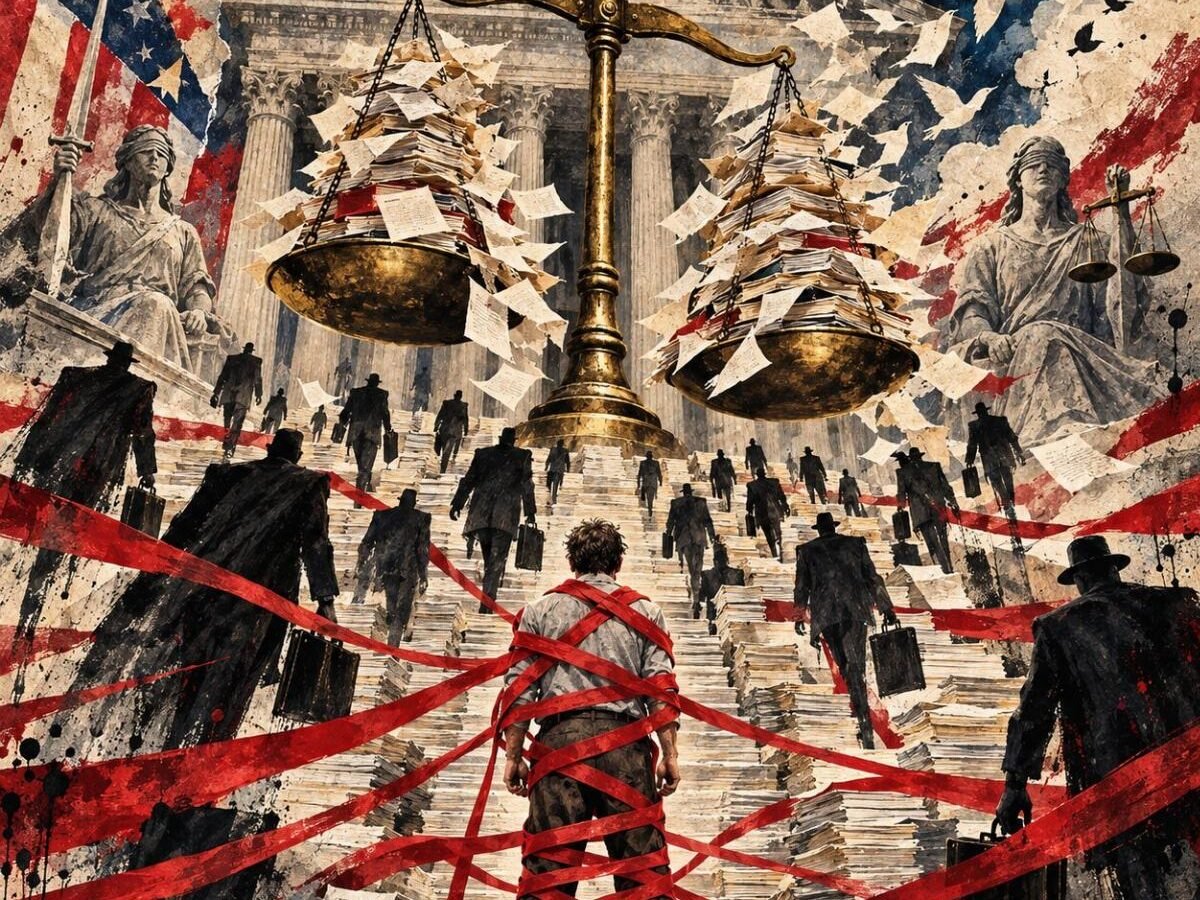
There is a particular kind of nostalgia for an America that never quite existed for the person doing the remembering. American Thinker’s Olivia Murray leans into it deliberately. In a September 17 essay, she reaches for a term coined by John Koenig, “anemoia” — a bittersweet longing for a bygone era you never actually lived through — to describe her yearning for a country where people took “radical ownership” over their own lives and choices.
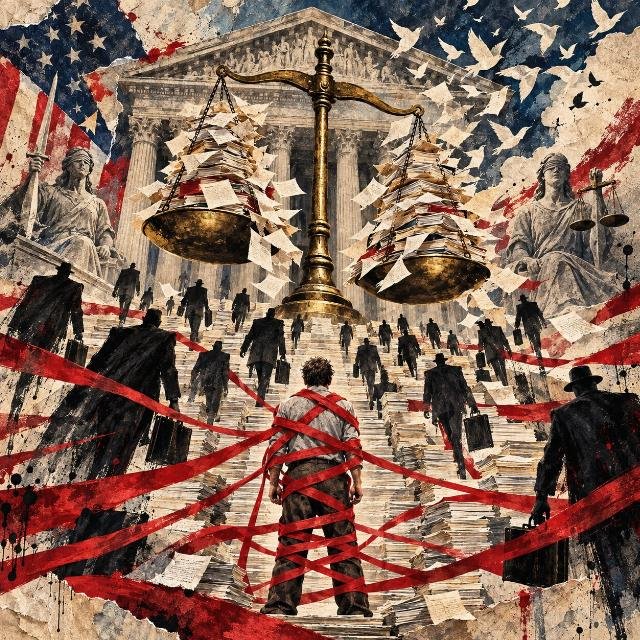
Her argument is blunt: litigiousness has ruined the United States. Not just by eroding freedom, she writes, but by producing a population that cannot accept responsibility for its own decisions, one that has turned its back on “radical sovereignty, independence, and individualism.”
The piece works from the personal to the national. Murray traces the thought back a few years to a kindergarten field trip at a rural Alabama pumpkin patch, where the farmer let children jump from a second-story barn loft onto a pile of hay below. The stairs were rickety, there was no railing at the top, no farm employee supervised the pile to make sure it was clear, and nobody asked a parent to sign a waiver. A modern safety inspector, she suspects, would have a field day.
Her reaction at the time was not alarm but resignation. Some child, eventually, would break an arm. The farmer would get sued. He might lose everything he had spent a life building — because he had opened his property and let kids play the way he presumably played as a boy, with their parents standing right there giving their blessing. Murray’s own position on the matter is refreshingly consistent: if she objected, it was her job to tell her son no. If he got hurt, the medical bill was hers, and she could decide to do things differently next time — or not, accepting that fun and freedom tend to come with bumps, bruises, and the occasional broken bone.
Two New Lawsuits, One Old Complaint
What pushed the essay out into the open was the news cycle. Murray notes that Charlie Kirk’s family is reportedly preparing to sue the university where he was killed over alleged security failures, and that a woman is suing her employer hospital after a patient attacked and beat her.
She is careful — repeatedly — to say she is not blaming Kirk for his own murder or the nurse for the assault she endured. The people at fault, in her framing, are the person who pulled the trigger and the man who punched and kicked the nurse. That is where she draws the line between acknowledging institutional failure and assigning financial blame.
On the Kirk case, her argument is that a public university is funded by taxpayers, and Kirk consented to speak on that campus under the security arrangements that were offered. In her telling, inadequate security should have meant calling the event off; if drones should have been in the air, she asks, why wasn’t Kirk’s own protective detail flying them? She contends she cannot see how a public institution — and by extension the taxpaying public — should bear the cost when a speaker willingly participated in what the school provided. The killer, she argues, is the one who should be sued; if he turns out to be a young man from Utah with no money to satisfy a judgment, she writes, that’s just the way it goes.
The nurse’s case gets the same treatment. Murray’s question is a simple one: if the nurse felt the hospital’s security was inadequate, why not work somewhere else? Nobody forced her to accept the job, she writes; she sought employment and took the offer.
It is an argument that will read as callous to plenty of readers, and Murray seems to know it. “Unpalatable to the modern person” is her own description. But her point is structural rather than personal — she is less interested in these two plaintiffs than in the reflex she believes they represent. If every bad thing that happens sends us looking for someone else to blame and a lawyer to sue, she argues, the country cannot get back to what she considers greatness. What it can recover is resilience, and only by taking “radical responsibility” and accepting that misfortune lands on everyone to varying degrees.
The Frontiersman, the Donner Party, and Stonewall Jackson
To make the case that this stoicism was once ordinary, Murray reaches for three historical examples, each one a story of people who suffered or died without anyone filing suit.
Frontiersmen who weighed the danger of settling hostile territory, she notes, sometimes ended up killed and scalped — wives and children included — and their families did not sue the U.S. government, and by extension the taxpayers, for opening the door to homesteading.
The Donner Party made a catastrophic wrong turn and died of starvation and disease; nobody sued a wagon company over broken wheels or a farmer who sold them poor livestock. They simply died, she writes, and that was that.
And when Stonewall Jackson was shot by his own men — a wound that cost him his arm and then his life — his widow did not bring a wrongful death suit against the Confederate government. His death was tragic and avoidable, Murray concedes, but he chose to fight and chose to ride past the Confederate frontline at night.
The throughline is choice. In each case, someone accepted risk knowingly, and the consequences, however brutal, stayed with them. Murray’s closing image is of a Damocles sword of litigation hanging over everyday life — the thing, in her view, that stands between Americans and being “wildly free.”
Whether or not a reader shares her anemoia, the essay lands on a question that is genuinely contested in American life right now: when a school fails to protect a speaker, or a hospital fails to protect its staff, is a lawsuit a legitimate remedy, or a way of refusing to live with risk? Murray has no doubt about her answer. The modern world, she suspects, will not like it much.
Source: www.americanthinker.com — https://www.americanthinker.com/blog/2026/09/litigiousness-has-ruined-america/