
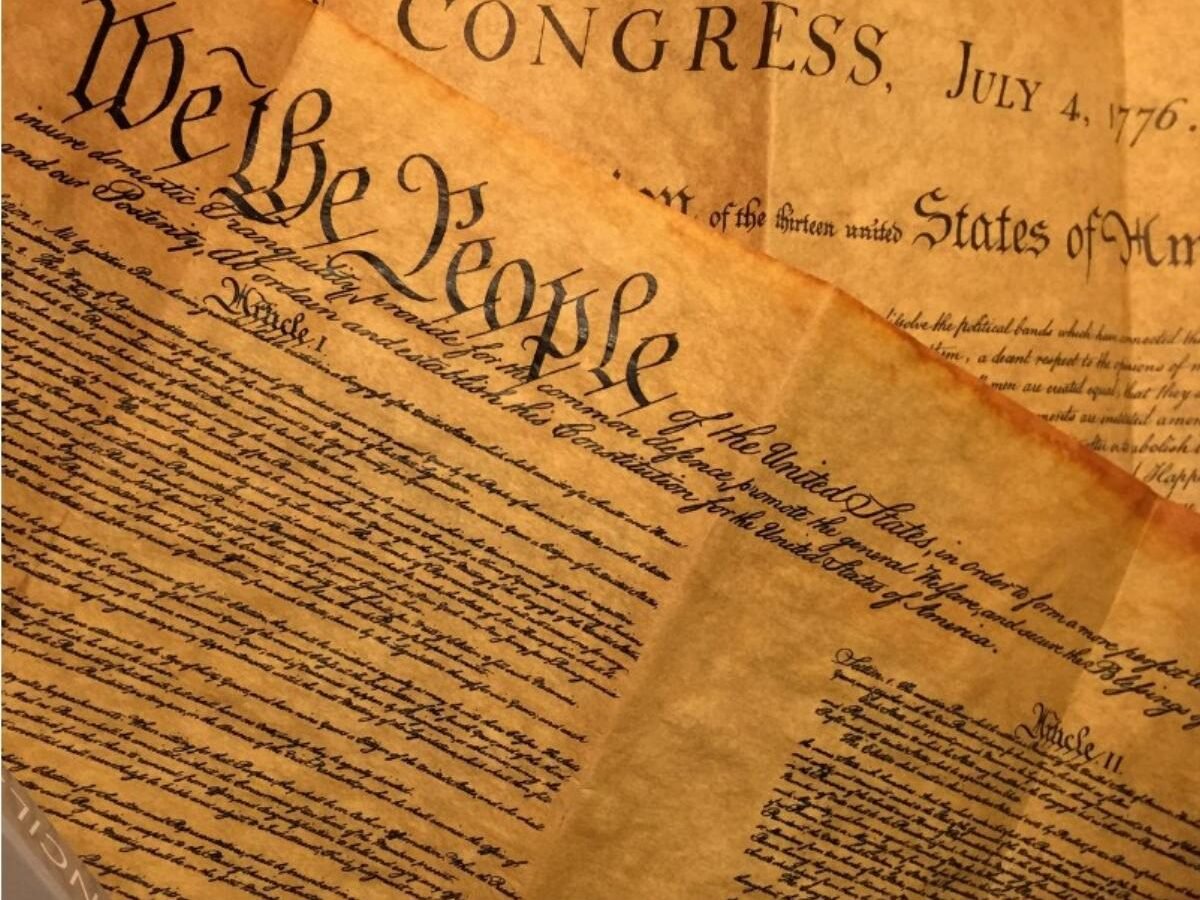
A commentary published this week in American Thinker by Matthew G. Andersson argues that the Supreme Court’s decision not to affirm the president’s recent executive order on election integrity — one centered on voter ID and proof of citizenship — amounts to a self-inflicted constitutional crisis, and goes further than most election-law criticism by openly proposing that the November midterms be suspended until eligibility rules can be enforced.
Andersson’s piece is not a news report but an argument, and it is built on the claim that the Court misread the case before it. In his telling, the justices treated the dispute as a matter of postal rules and mail-processing timelines rather than as a question of constitutional authority. He writes that the Court’s reasoning was “full of granular reference” to federally derived postal regulations that, in his view, have little to do with the national security stakes of the executive order.
The postal-delay argument at the center of the dispute
At the heart of Andersson’s complaint is how the Court weighed the risk of delay. He describes the justices as having been “captured” by the concept of postal delay — the idea that the president’s order would slow mail-ballot processing through rules ostensibly designed to protect it. In his framing, that concern about timing overrode the need for security, and he accuses the Court of falling for what he calls the legal subterfuge of the DNC, losing its “constitutional compass” in the process.
He goes after the Court’s institutional habits directly. According to Andersson, the justices are so accustomed to picking winners and losers in ordinary litigation that they forgot the Constitution can impose a different kind of national duty. A constitutional fight, he warns, can become zero-sum: everyone loses if the country is fractured by political tribalism. Unity, he contends, is the constitutional cause, and no one comes out ahead when an election system is treated as a dispute rather than a shared responsibility.
A Challenger analogy, and a question about the cost of delay
To make his case, Andersson reaches for the 1986 Challenger disaster. He recalls that the shuttle launched from Kennedy Space Center despite what he describes as clear data indicating a booster O-ring would not seal in the low January temperatures. As engineers raised repeated concerns about hot gases escaping around the O-ring, a manager responsible for the launch asked in exasperation, in Andersson’s retelling, “do we have to wait until April?” The dispute, he writes, pitted one group against another instead of uniting a body dedicated to total system integrity — and the perception of delay outweighed the reality of safety.
That, he argues, is the same reasoning error the Court committed: treating a delay or disruption to the November election as a harm that outweighs the cost of doing things correctly. He calls voter ID and proof of citizenship the mail-ballot equivalent of the O-ring, and says the Court has just ensured a “constitutional explosion.” He then poses his own question: if the president’s order took time to implement and improved voting integrity, even if it meant postponing the election until spring, what would the actual cost be? His answer is pointed — that the cost is hard to define except as a delay to the DNC’s ability to commit election fraud, gain what he calls fraudulent control of Congress, and launch a fraudulent impeachment.
Three proposed responses — including pausing the midterms
Andersson defines a constitutional crisis in several ways: a revolt or coup, an overwhelming defiance of the legal order, or a conflict between branches of government. He says the last one clearly exists today, but that the situation goes beyond it. By turning away from what he calls clear presidential authority under the Supremacy Clause — in the face of state violations of election law and a resulting conflict-of-law problem — he labels the Court a “failed branch,” one that is defying the Constitution rather than merely the president, and doing so on a federal matter he considers its direct remit.
From there he lays out three possible solutions. First, the chief executive could simply ignore the Court, which he notes has no enforcement mechanism, police force, or method of defiance beyond writing more opinions on paper. Second, the president could issue another executive order, as Andersson says happened in the birthright controversy, elevating the issue from a technical matter of constitutional interpretation to one of strict national security. Third, and most controversially, he proposes pausing the election until eligibility qualification and proof can be “cured” — that is, until voting can be made legal.
He frames this as a matter of engineering discipline rather than partisan advantage. Mail ballots, which he says now represent roughly a third of all votes, are in his analogy one of the main engines of a voting launch and cannot be treated as merely a state matter or a question of postal rules. The national emergency argument, he insists, has been made and is legitimate and justified. His conclusion: the November midterms must be suspended, or the countdown stopped, until all voting is conducted in strict compliance with voter eligibility requirements.
Andersson also pins responsibility for any delay on the Democratic Party, arguing the DNC engineered a false legal standing to challenge the executive order — a point he attributes to Justice Samuel Alito’s dissent. The true cause of any election delay or emergency action, he writes, is the DNC’s challenge, not the president or his order.
Ajax, memory, and a closing indictment of the Court
Toward the end, Andersson turns literary. He invokes Sophocles’ Ajax, describing a speech often called the “deception speech” because listeners expect Ajax to change. In reality, Ajax refuses to adapt, becomes alienated from his society, and falls on his sword — denying that society its defender in the process. Andersson draws a direct parallel: the Supreme Court, as defender of the Constitution, is refusing to adapt and courting the same fate. He calls the Court ideological in the extreme, accuses it of contempt for both the president and the people’s will, and says it has created a false opposition between a supposed harm to voters who might feel rushed by new rules and the actual democratic procedure of ensuring fairness to all legal voters.
He quotes the play — lines he cites as 646-649, in which hidden things are brought forth by endless years, firm resolve and pledged word falter, and no one may say “it cannot happen here.” He closes by warning that this crisis has happened before, in 2020, and that short memories lead people to “normalize the risk” rather than face it. Unless the problem is solved for the good of the entire nation, he writes, it will resurface again and again.
The column is a commentary piece, and its central factual premise — that the Court declined to affirm the executive order — is taken as given by its author. What makes it notable is less the legal argument than the remedy: a mainstream conservative outlet’s opinion section openly floating the suspension of a federal election, and laying out a menu of executive responses that include ignoring the Court outright. Whether that reflects a broader shift in the right’s posture toward judicial authority, or is simply the loudest version of a familiar complaint, is the open question the piece leaves behind. Andersson is the author of a forthcoming book, “Legally Blind,” on ideology in law and policy, and has testified before the U.S. Senate.
Source: www.americanthinker.com — https://www.americanthinker.com/blog/2026/09/the-u-s-supreme-court-just-launched-a-constitutional-crisis/