
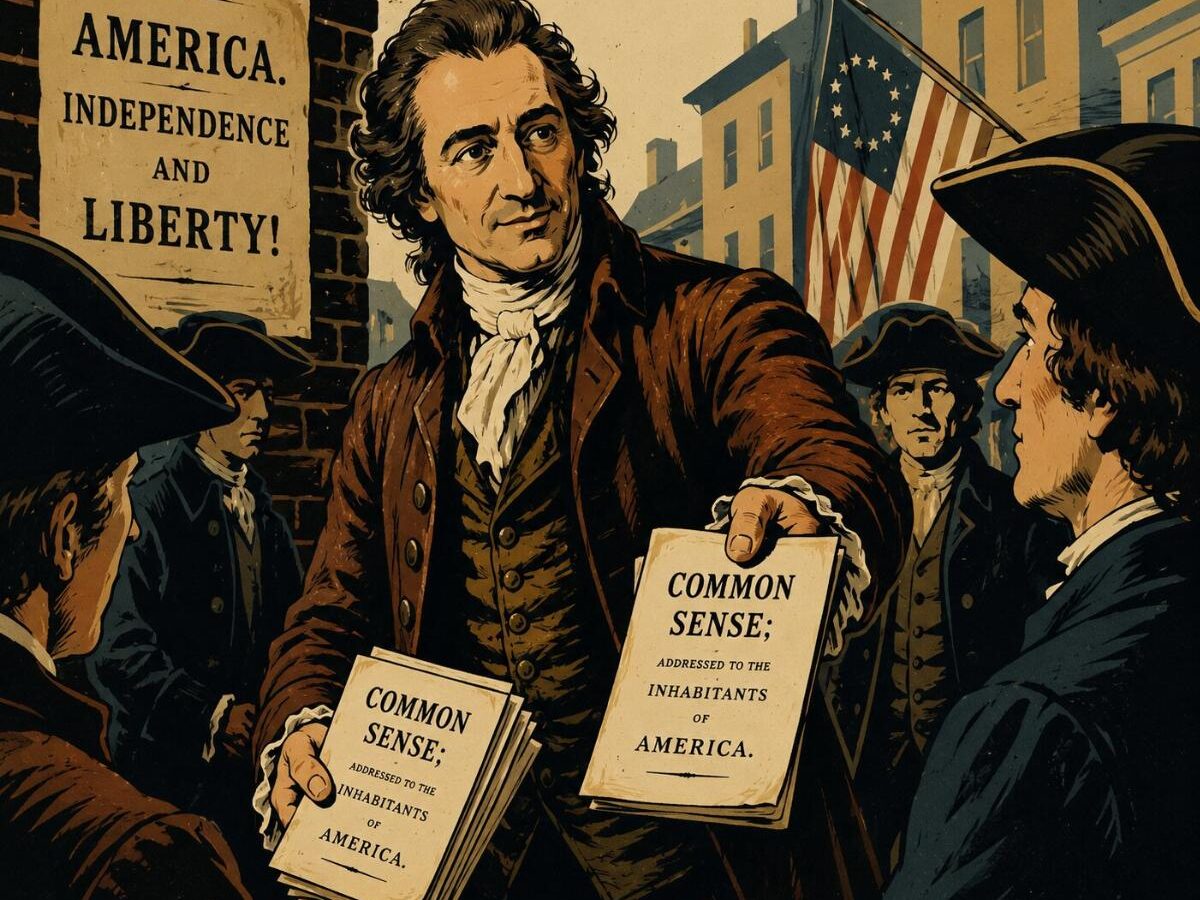
Thomas Paine’s Common Sense sold briskly in early 1776, and a new essay in American Thinker argues its central complaints about concentrated power haven’t aged a day. In “Common Sense 2026 – A call to return to our founding principles,” published October 1, 2026, writer Rick Charles pairs a brief history lesson on Paine’s pamphlet with a modern partisan appeal: that American voters should channel Paine’s spirit into support for President Donald Trump and Republican candidates on November 3, 2026.
The essay’s central conceit is a parallel between two eras of grievance. Paine, a recent immigrant of only two years and largely unknown, published Common Sense in January 1776, making a case for complete independence from Britain in plain language aimed at ordinary colonists. The piece notes that more than 120,000 colonists bought or read it in the first three months — a striking figure for a colonial population of roughly 2.5 million. Charles writes that Paine’s arguments about the dangers of British rule “motivated a generation of patriots ready to sacrifice their lives for the cause of independence and freedom.”
Those arguments, the essay contends, are “universal in nature” and apply just as well today against any government exercising oppressive power over its people. That framing sets up the author’s central claim: that 2026 is a time for a “reckoning” between the American people and their government, along with what Charles calls “various aligned institutions in their current forms.”
A ballot instead of a musket
Here the essay makes its sharpest pivot away from its historical subject. Paine, Charles concedes, advocated revolution by violent means. The modern remedy is different — American citizens today, he writes, hold “the most powerful instrument for change in the world — their vote on the upcoming election day.”
The essay goes on to argue that the federal government has grown from its modest origins into something so large and ubiquitous that it threatens the rights and well-being of Americans. Charles points to 1783, when powers granted by the U.S. Constitution were meant to guarantee rights through a government of limited authority. Over time, he writes, that government has been transformed to address an unlimited number of social and economic issues — a “usurpation” exceeding the Founders’ intent and increasingly responsible for what he calls a growing, unaccountable and oppressive agenda.
He also leans on a well-worn theme in American political thought: the fear of institutional consolidation. The Founders and their contemporaries, the essay notes, worried that people and political institutions tend toward corruption, consolidation of power, and authoritarianism over the long term — and believed that an established government required constant vigilance from the people. Charles’ conclusion is blunt: “We now have a system which functions to exclude the interests and participation of most of its citizens.”
Paine’s vision, revisited
The essay devotes significant space to recapping Paine’s actual arguments, and they are worth restating as the author presents them. Paine believed government was unavoidable because people are fallible — needed to restrain vices and protect life and property. He advocated a republican-style government with a written constitution, in which elected representatives made the laws.
Britain in Paine’s day, Charles writes, was a government of a few thousand wealthy families who saw themselves as “a race apart, naturally superior to everyone else.” Paine directed much of his criticism at the monarchy, characterizing it as corrupt and ineffective and as a violation of natural law. His core claim — that people were citizens, not subjects, born with equal natural rights — is the intellectual seed the essay wants readers to carry into the voting booth.
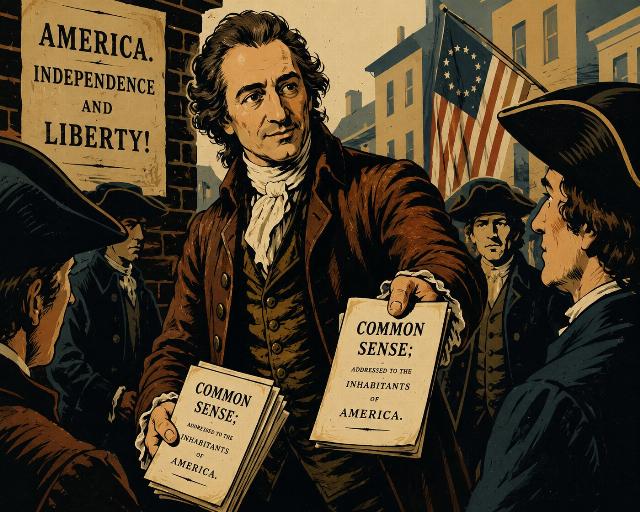
The pamphlet also sketched a positive vision, according to the essay: a new American system in which citizens exercised their individualism, had the right to vote for proper representation, and enjoyed a free market that allowed them to work freely toward personal goals.
A populist opening
From there, the essay moves from history to contemporary politics. Charles argues that Trump’s second election in 2024 is a strong sign the country has entered a new populist era that may produce “much needed change.” He attributes many of the nation’s current political, cultural and economic shortcomings to what he calls the failed progressive policies of the Obama and Biden administrations, and argues that more Americans are coming to understand the reasons behind a diminished quality of life and a declining standard of living.
The essay frames the 250th anniversary year of the Declaration of Independence as the moment for a return to founding principles. Charles maintains those principles are best represented today by Trump’s America First agenda. Paine’s ideas, he writes, were foundational elements Jefferson drew on in composing the Declaration and the Founders drew on in writing the Constitution.
The closing call is explicitly electoral. November 3, 2026, the essay says, is a day to support Trump and the America First agenda by voting for Republican candidates. Charles describes the contemporary Democratic Party as holding a “radical and extreme anti-American agenda” and argues it must never be allowed back into power as currently constituted. He ends where Paine began — with speech — writing that “the ability to speak our minds is crucial to the republic we cherish.”
It’s worth noting what this essay is and isn’t. It is a piece of advocacy published on an opinion site, not a reported news account, and its historical throughput is compressed to serve a present-day argument. The chain of reasoning — from Paine’s case against a distant monarchy to a case for one party’s candidates in 2026 — is the author’s own, and readers who accept the historical premise won’t necessarily follow him to the partisan conclusion. Still, as a specimen of a genre, it’s a tidy example of how 1776 keeps getting drafted into 2026, with Paine’s plainspoken outrage serving as reusable fuel for whichever side of a modern fight claims his mantle.
Source: www.americanthinker.com — https://www.americanthinker.com/blog/2026/10/common-sense-2026-a-call-to-return-to-our-founding-principles/