
For a certain generation of Americans, the weeks after September 11, 2001, are still legible as a mood: quieter streets, cars flying flags, and a sense that the whole country had briefly stopped arguing about anything else. Twenty-five years on, a new essay in American Thinker asks what happened to that feeling — and whether the country kept the promise it made to itself.
The piece, written by Luis Gonzalez and published September 10, 2026, is less a policy argument than a personal inventory. Gonzalez recalls the days after the attacks, when he says he struggled to find an American flag for sale anywhere. An old friend handed him one — “Jimmy’s Flag” — and he hoisted it in defiance, vowing that “WE WOULD NEVER FORGET.”
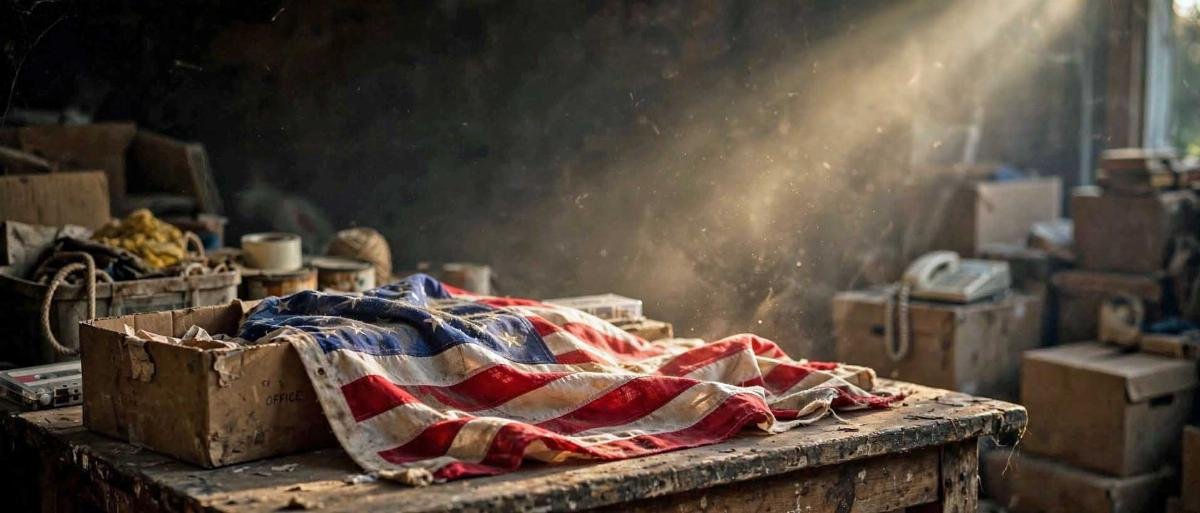
The flag flew for years. Then life intervened: two relocations, a flag display case packed into a moving box labeled “OFFICE,” and a decade of garage clutter. Gonzalez found the box again last week. The stars were frayed, the edges more tattered than he remembered, and dust lay thick along the canton. He wiped it away slowly — and found the blue, red, and white underneath unchanged.
That image — cloth that didn’t forget, even as people did — carries the essay’s real argument. Gonzalez is not writing about a flag. He is writing about what he sees as a country that put its post-9/11 unity in a box and moved on to arguments that didn’t matter, while “the people who never stopped organizing walked right through the gate we forgot to guard.”

The roster of names
To press that case, the essay assembles a list of elected officials and candidates it describes as sworn enemies of the nation — a framing that reflects the author’s own political viewpoint rather than a neutral account. Gonzalez points to statistics he says illustrate the shift: Democratic Socialists of America members holding dozens of federal and state legislative seats and more than 250 elected offices overall, alongside roughly 50 Muslim Americans serving in Congress and state legislatures. The comparison, as he frames it, is striking because a coalition he describes as “markedly anti-American” has achieved representation comparable to that of an entire religious community.
Then he puts names to the argument, promising each with their own words.
Rep. Ilhan Omar, he notes, asked Columbia students last year whether Jewish students were “pro-genocide or anti-genocide,” and once described American support for Israel as “all about the Benjamins, baby.” The House removed her from the Foreign Affairs Committee, and her constituents returned her to office anyway.
Rep. Rashida Tlaib, Gonzalez writes, told a podcast that thinking about the Holocaust gave her a “calming feeling,” retweeted a blood libel about a Palestinian child and presented it as fact before walking it back when the child turned out to have drowned, and has called for abolishing ICE, the police, and the federal prison system — three institutions he calls load-bearing walls of a functioning country.

New York City Mayor Zohran Mamdani, sworn in on New Year’s Day, issued a first executive order revoking the city’s adoption of the State Department’s working definition of antisemitism, and a second lifting restrictions on boycotting Israel. Israel’s foreign ministry, Gonzalez notes, called it “antisemitic gasoline on an open fire.” Mamdani has since gone on national television, as mayor of what Gonzalez calls the largest Jewish city on Earth outside Tel Aviv, to call for abolishing ICE outright.
Abdul El-Sayed, running for Michigan’s Senate seat, has described Israel’s conduct in Gaza as “bloodthirsty,” demanded an end to American military aid, and called ICE “irredeemable.” He campaigned with Twitch streamer Hasan Piker, who once said “America deserved 9/11,” called Hamas “a thousand times better” than the nation it attacked, and said on a livestream that the rapes of October 7 “doesn’t change the dynamic” for him. Asked to disavow Piker, El-Sayed declined.
Five names, Gonzalez writes: two in Congress, one at City Hall, one chasing a Senate seat, and one megaphone bigger than half of cable news. The implication he draws is not that these figures are fringe, but that they are winning.
What the ADL counted
Gonzalez pairs that political roster with data from the Anti-Defamation League, which he says counted 6,274 antisemitic incidents last year, along with the shooting deaths of two Israeli embassy staffers in Washington and the most physical assaults on Jews ever recorded in a single year. He quotes the ADL’s director saying numbers that would have shocked Americans five years ago are now “our floor.”

For Gonzalez, that is the measure of the distance traveled since Congress stood together on the Capitol steps and sang “God Bless America” without irony. The essay is careful to place responsibility at home rather than abroad. “I keep wanting to say somebody did this to us,” he writes. “But nobody did this to us.”
The flag, still flying
What keeps the piece from ending in despair is the flag itself. Gonzalez notes that the same country now electing the officials he criticizes also produced the 343 firefighters who ran up the stairs of the World Trade Center while everyone else ran down. Jimmy never handed him the flag personally — it was Jimmy’s widow, Lidia, who placed it in his hands, because, as Gonzalez puts it, that is what you do with the thing left standing after everything else falls down.
So he plans to hang it out front where the whole street can see it, just as he did in 2001. A flag raised in defiance, he argues, means twice what one raised in comfort ever will. “We said never forget, and then we forgot,” Gonzalez writes. The gate is open and the enemy is coming through it, in his telling — but the flag is flying again, and when he falls, someone else will raise it.
Readers will bring their own politics to a piece that is unapologetically partisan. What is harder to dispute is the underlying question the essay poses, one that has followed the country through a quarter-century of anniversaries: whether the unity of September 2001 was a durable commitment or a mood that faded once the flags came down.
Source: www.americanthinker.com — https://www.americanthinker.com/articles/2026/09/dust-on-the-colors/